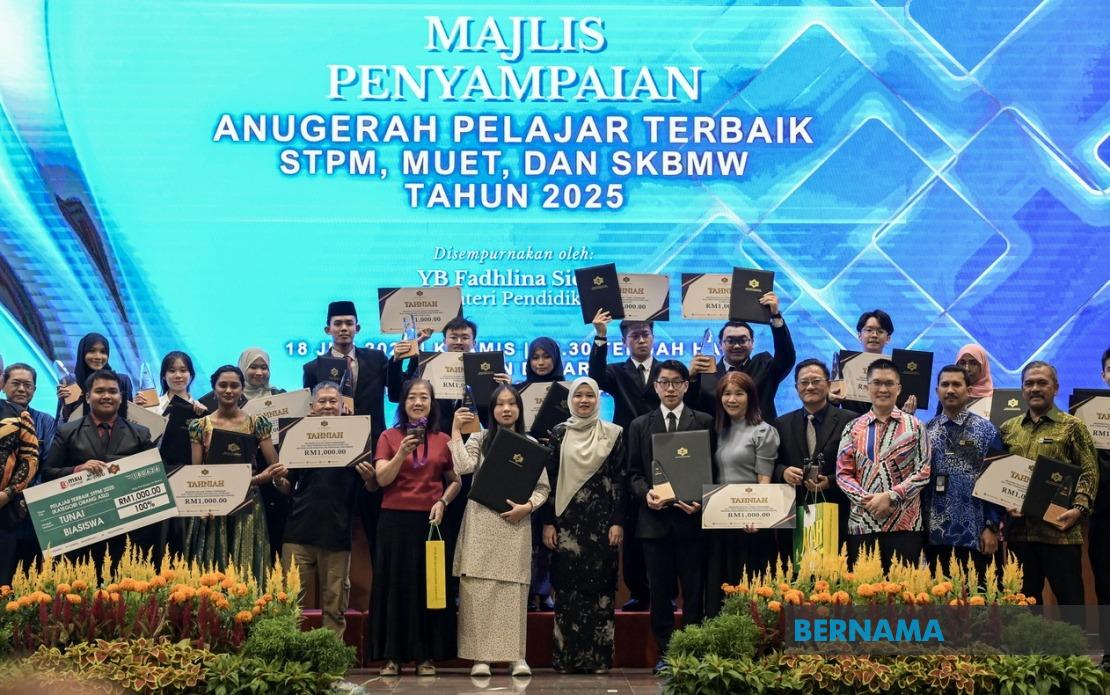
Eighteen exceptional students from the 2025 cohort of Sijil Tinggi Persekolahan Malaysia (STPM) examinations will benefit from a newly launched scholarship programme offered by Malaysia's public universities. The initiative, which targets students with outstanding academic records, provides full tuition-fee sponsorship for Bachelor's degree programmes and represents a significant step by higher education institutions to support talented pre-university graduates.
Education Minister Fadhlina Sidek announced the scholarship programme during a ceremony at the Malaysian Examinations Council building in Kuala Lumpur on June 18, emphasising that the move reflects the government's commitment to revitalising the Form Six system. Speaking at the award presentation for top performers in the 2025 STPM, MUET, and SKBMW examinations, she praised all public universities for their collaborative effort in establishing this competitive scholarship opportunity. The minister stressed that strengthening Malaysia's pre-university education pathway remains a priority, as the nation seeks to encourage more secondary school students to pursue the traditional academic route before university entry.
The tuition-fee scholarships represent a departure from previous approaches, directly addressing a key concern among Malaysian families—the financial burden of higher education. By removing the cost barrier for top achievers, the public universities aim to retain domestic talent and ensure that academic excellence translates into opportunity regardless of socioeconomic background. This move also signals recognition that Form Six students, who typically spend two demanding years in advanced academic study, deserve institutional support when they transition to university-level programmes.
The broader policy context reveals an education ministry intent on reversing enrolment trends in the Form Six system. In recent years, increasing numbers of Malaysian students have opted for matriculation programmes or international pre-university qualifications, perceiving them as more flexible or internationally recognised. By anchoring this scholarship to STPM achievement, the government seeks to make the Form Six route genuinely attractive and to demonstrate that excellence at that level will be rewarded with tangible educational advancement.
Several complementary initiatives underscore this strategic commitment to the Form Six ecosystem. The ministry has expanded Form Six College capacity nationwide, deployed smartboards to enhance classroom instruction, introduced early educational assistance programmes, and distributed MADANI Book Vouchers to support student learning resources. Collectively, these measures address different dimensions of pre-university education—physical infrastructure, teaching technology, financial accessibility, and learning materials—suggesting a comprehensive rather than piecemeal approach to sector reform.
Data released at the award ceremony demonstrates measurable progress in academic outcomes. The national Cumulative Grade Point Average (CGPA) for STPM 2025 reached 2.88, marking an improvement from the previous year's 2.85. While the percentage increase appears modest, it reflects upward trajectory across the entire cohort and suggests that quality-enhancing interventions are beginning to yield results. Malaysian education observers will view this metric as evidence that system-wide improvements are translating into stronger student performance at the pre-university stage.
The scholarship recipients represent the apex of academic achievement in the 2025 examination sitting. Their selection through a competitive, merit-based process ensures that university resources are directed toward students who have demonstrated sustained intellectual excellence and discipline over their two years of Form Six study. The recognition carries symbolic weight beyond financial benefit—it validates the academic rigour of the STPM pathway and signals to prospective Form Six students that national achievement at that level is valued and rewarded.
From a regional perspective, Malaysia's emphasis on strengthening domestic pre-university pathways reflects broader Southeast Asian trends toward building indigenous talent pipelines. As countries compete for skilled human capital, investment in high-quality pre-university education becomes strategically important. Public universities that participate in this scholarship initiative position themselves as destinations for talented young Malaysians, potentially reducing outflow to international institutions and building stronger domestic research and professional bases.
The announcement also touches on Malaysia's evolving approach to education financing during an era of fiscal constraint. Rather than expanding means-tested subsidies broadly, the government targets competitive scholarships toward the highest achievers, balancing equity concerns with fiscal sustainability. This approach appeals to middle-class aspirations and demonstrates that educational merit remains recognised and rewarded, even as universities face budget pressures.
The presence at the announcement of Deputy Education Minister Wong Kah Woh, Malaysian Examinations Council chairman Prof Datuk Dr Md Amin Md Taff, and Education Malaysia director-general Datuk Dr Mohd Azam Ahmad underscored institutional alignment behind the initiative. Coordinated messaging from examination authorities, ministry officials, and education administration suggests this is a deliberate, high-level priority rather than an isolated programme. Such coordination is typically necessary to implement policies that require cooperation across multiple educational bodies.
For Malaysian families with Form Six students, the scholarship availability reframes educational planning. Students who might previously have viewed Form Six as expensive relative to alternatives now have a clear pathway to financial support if they achieve top grades. This incentive structure—rewarding academic excellence with educational cost elimination—may well influence cohort composition and student motivation in Form Six Colleges nationwide during the coming academic year.