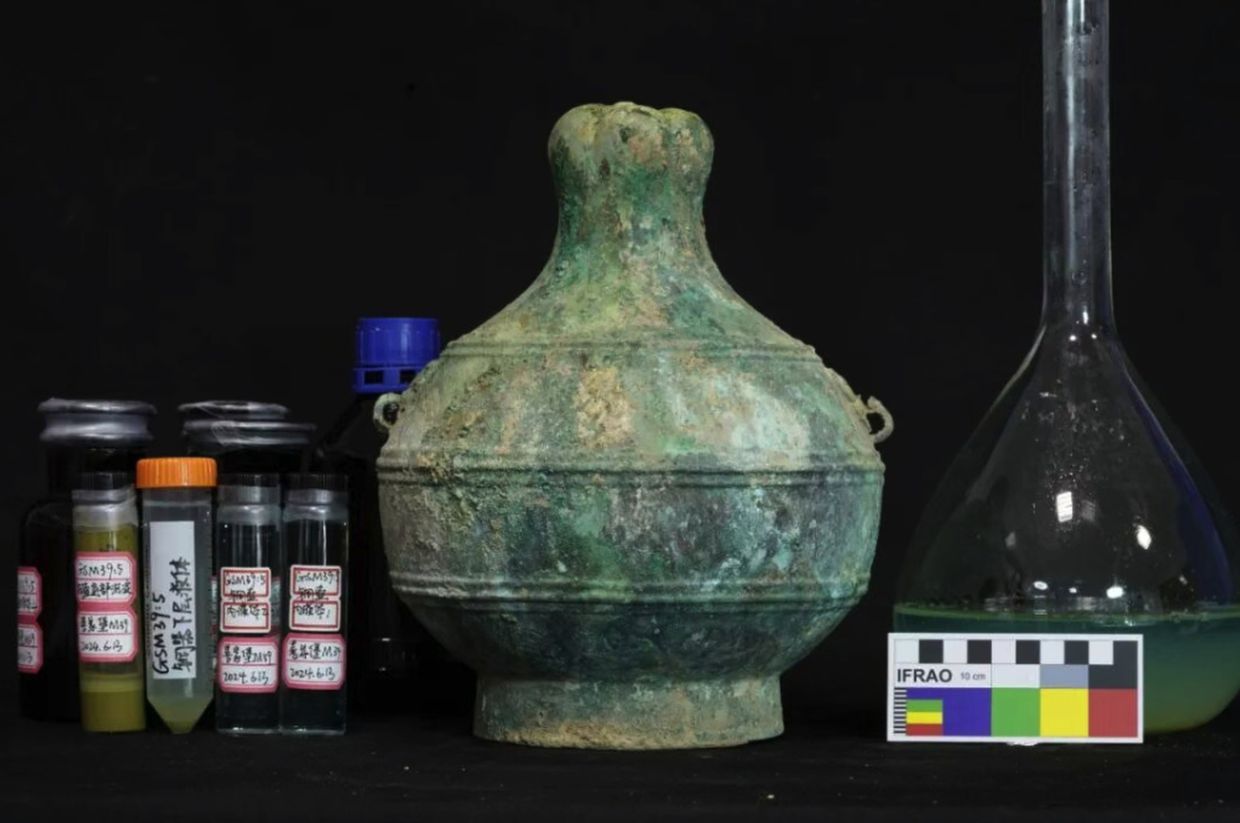
A remarkable archaeological discovery near China's Great Wall has cast new light on the sophisticated brewing practices of the ancient Qin dynasty, offering researchers unprecedented insights into how border garrison soldiers and their families produced wine over two millennia ago. The find — a perfectly sealed bronze wine vessel unearthed at the Shanjiabao cemetery in Ningxia, located just 2 kilometres from remnants of the Warring States Qin Great Wall — represents one of the most significant and well-preserved examples of ancient alcoholic beverage archaeology yet documented in China. The vessel still glistened when discovered, and laboratory analysis confirmed it contained 3,740 millilitres of ancient wine that had remained largely intact through the centuries, providing researchers with an exceptional opportunity to examine the raw materials, fermentation processes, and craftsmanship of Qin-era winemakers.
The discovery emerges from an extensive archaeological excavation of 183 tombs at the Shanjiabao cemetery dating to the Warring States period, with 179 of those tombs belonging to the Qin culture. Scholars believe the site functioned as a public cemetery for military personnel and civilians stationed at the fortified positions that dotted the 170-kilometre stretch of the Qin Great Wall. These Great Wall installations served as critical defensive infrastructure, studded with numerous forts, castles, and barrier outposts of varying sizes where border soldiers and their families maintained constant vigilance. The concentration of Qin-affiliated tombs at this location underscores the significance of the garrison communities that sustained the frontier defences, providing archaeologists with a unique window into the daily lives and burial practices of these border populations.
The bronze vessel recovered from Tomb No. 39 exemplifies the sophisticated engineering and preservation techniques employed during the Qin period. According to Wang Xiaoyang, head of the Shanjiabao cemetery archaeological project at the Ningxia Institute of Cultural Relics and Archaeology, the pot utilised a double-layer sealing mechanism featuring a textile lining on the interior and an outer coating of organic clay. This innovative approach created an airtight seal that protected the contents from oxidation and contamination, allowing the ancient wine to survive in a state of remarkable preservation across more than two millennia. Wang characterised the vessel as the most comprehensively preserved and information-rich wine relic from the Qin state period that has been publicly documented in China to date, highlighting the exceptional nature of the find.
To fully understand the ancient brewing formula and methodology, archaeologists collaborated with researchers at Northwest University to conduct detailed chemical and botanical analysis of the liquid residue. The investigation identified 24 distinct chemical compounds within the wine, including organic acids and their derivatives, amino acids and their derivatives, and various carbohydrates. This sophisticated molecular fingerprint provided clear evidence of the brewing process and ingredient composition, enabling scientists to distinguish between different categories of fermented beverages. The specific distribution pattern of organic acids detected in the liquid matched the chemical signature of artificially aged yellow wine, a crucial finding that confirmed the substance was a grain-based alcoholic beverage rather than a fruit-derived wine such as grape wine.
Starch residue analysis proved particularly illuminating in determining the primary grain source used for fermentation. Testing revealed that over 92 per cent of the starch content originated from broomcorn millet, a hardy grain well-suited to the arid climate of northern China. This finding adds important regional context to broader Chinese archaeological understanding of brewing practices, as ancient China developed distinct winemaking traditions based on geographical and climatic factors. While southern regions typically relied on rice as the foundation for alcoholic beverages, northern areas like Ningxia naturally gravitated toward hardy millet varieties that thrived in drier conditions and offered reliable yields for border communities dependent on local agriculture. The predominance of broomcorn millet in this Qin wine demonstrates how environmental constraints shaped production methods and ingredient selection across ancient China's vast territories.
China stands among the world's earliest civilisations to develop and refine alcoholic beverage production, with archaeological evidence suggesting widespread consumption dating back millennia. In recent decades, an expanding body of discoveries of ancient alcoholic residues across Chinese archaeological sites has sparked sustained scholarly interest in tracing the origins of fermentation technology and documenting the evolution of brewing techniques through successive dynasties and periods. Each discovery contributes incremental knowledge to the broader narrative of how Chinese civilisation mastered complex biochemical processes and adapted them to regional conditions and available resources.
The Shanjiabao cemetery discovery fills a significant gap in regional archaeological knowledge, as it represents the first well-documented evidence of winemaking practices in the Ningxia region during the Warring States period of the Qin state. Prior to this find, scholars possessed limited direct evidence regarding specific brewing methods, grain selections, and fermentation protocols employed by Qin border communities. The new data allows researchers to construct more detailed and accurate models of frontier life, including how military garrisons sustained themselves not merely through military function but through agricultural production, trade, and craft expertise. The wine vessel suggests that despite their isolated and austere border postings, Qin soldiers and administrators maintained access to refined luxury goods and participated in the broader cultural practices of contemporary Chinese civilisation.
The tomb itself tells a poignant human story that resonates across the centuries. The presence of the wine vessel, carefully sealed and filled at burial, indicates a loved one seeking to provide comfort and sustenance for an afterlife journey. Archaeological evidence suggests the deceased may have been a soldier or official stationed at the Great Wall garrison, someone who appreciated fine drink and whose family honoured that preference through the burial ritual. This intimate detail humanises the otherwise abstract historical record, revealing the emotional bonds and cultural values that united Qin families even when separated by the demanding necessities of frontier defence.
For modern Malaysian and Southeast Asian observers, the Shanjiabao discovery offers valuable perspectives on how ancient civilisations managed frontier communities, resource logistics, and cultural continuity in challenging border environments. The engineering sophistication evident in the double-layer sealing technique reflects principles of preservation and protection that transcend cultural and temporal boundaries, suggesting universal human ingenuity in solving practical problems. Furthermore, the discovery underscores how archaeological science — combining laboratory analysis with careful excavation and contextual study — can unlock detailed knowledge from fragmentary physical evidence, a methodology with relevance across the entire Asian region.

