Kuala Lumpur's affordable housing scheme continues to grapple with substantial demand, with approximately 3,000 households still awaiting allocation of People's Housing Programme (PPR) units administered by the city authority. The backlog underscores persistent challenges in meeting housing needs for lower-income Malaysians in the capital, a situation that Minister in the Prime Minister's Department (Federal Territories) Hannah Yeoh acknowledged during a site visit to one of the city's largest public housing complexes.
The waiting list mechanism operates on a first-come, first-served basis, with priority extended to B40 households that satisfy DBKL's established eligibility requirements. This approach, while transparent in principle, means applicants may face extended delays before their turn arrives for allocation. The minister's comments reveal that demand for subsidised housing in Kuala Lumpur significantly outpaces the supply of available units, a chronic issue affecting major Malaysian urban centres where real estate costs remain prohibitively high for working-class families.
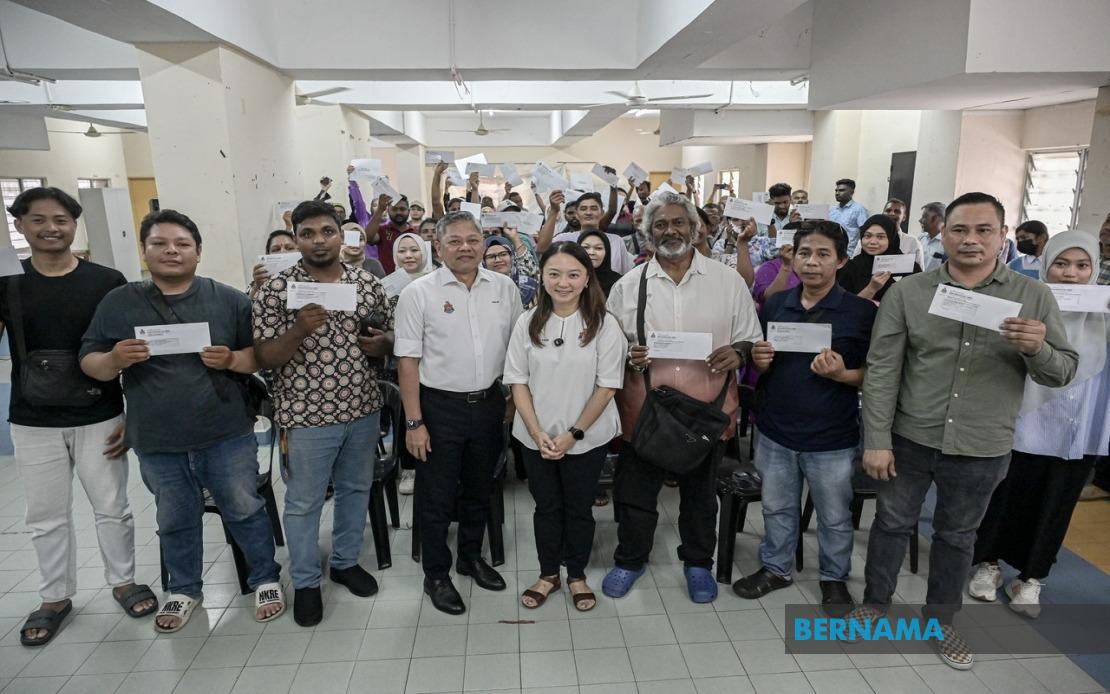
During her visit to PPR Seri Pantai in Pantai Dalam, Hannah distributed housing offer letters to 29 successful applicants whose names had reached the front of the queue. The event also saw the presentation of business premises allocation letters to 40 local traders seeking hawker centre spaces across eight parliamentary constituencies throughout Kuala Lumpur. Such distributions, while representing modest progress, illustrate the incremental pace at which the housing shortage is being addressed.
PPR allocations in Kuala Lumpur incorporate a deliberate strategy to position enforcement personnel within residential communities. Police and fire department staff receive priority consideration for certain units, a policy designed to strengthen security presence and emergency response capabilities in populated neighbourhoods. Additionally, housing authorities have reserved specific units for families displaced by fire or those who have experienced bereavement, reflecting a targeting approach that addresses acute vulnerability beyond straightforward income qualification.
A significant infrastructure milestone was reached at PPR Seri Pantai, where comprehensive maintenance and upgrading initiatives costing RM2,587,100 have concluded. These works form part of a broader RM300 million modernisation programme spanning all public housing and PPR developments across Kuala Lumpur. The completed improvements at the 936-unit complex, which commenced operations in 1998, encompass lift system upgrades, road rehabilitation, enhanced street lighting, water distribution infrastructure renewal, recreational facilities for children, and fire safety system installations. Hannah emphasised that the investment represents public resources and called upon residents to maintain these upgraded facilities responsibly.
The scale of the upgrade programme reflects recognition that many public housing estates suffer from deteriorating conditions that undermine residents' quality of life and property values. Of the 64 public housing projects across Kuala Lumpur, 25 have now received upgrades, with authorities targeting completion of remaining sites by year-end. This sequential approach, while necessary given budget constraints, means some communities will continue experiencing substandard facilities for several additional months.
For Malaysian urban planners and policymakers, the situation at DBKL illustrates broader systemic challenges in affordable housing provision. The widening gap between waiting list numbers and unit availability reflects both rapid urbanisation and insufficient government investment in public housing construction. Regional counterparts in Singapore and Hong Kong have historically maintained larger public housing stocks relative to population, suggesting Malaysia's proportion of subsidised units may be constrained relative to actual demand among lower-income citizens.
The inclusion of enforcement personnel within PPR communities represents an interesting governance experiment. While proponents argue that embedded police and fire presence enhances safety and emergency response, others question whether such placement creates effective community integration or reinforces hierarchical relationships. The approach warrants examination for potential expansion to other public housing schemes throughout Malaysia, contingent upon demonstrable outcomes regarding crime reduction and community cohesion.
For households enduring lengthy waits, the completion of physical upgrades at allocated estates provides limited consolation without corresponding acceleration of new unit allocation. The 3,000 applicants presently in queue face uncertainty regarding their placement timeline, particularly as natural population growth and rural-to-urban migration continue generating fresh demand. Housing affordability remains a critical political economy issue in Malaysia, and Kuala Lumpur's experience reflects national-scale pressures that demand comprehensive strategic responses beyond incremental improvements to existing infrastructure.

