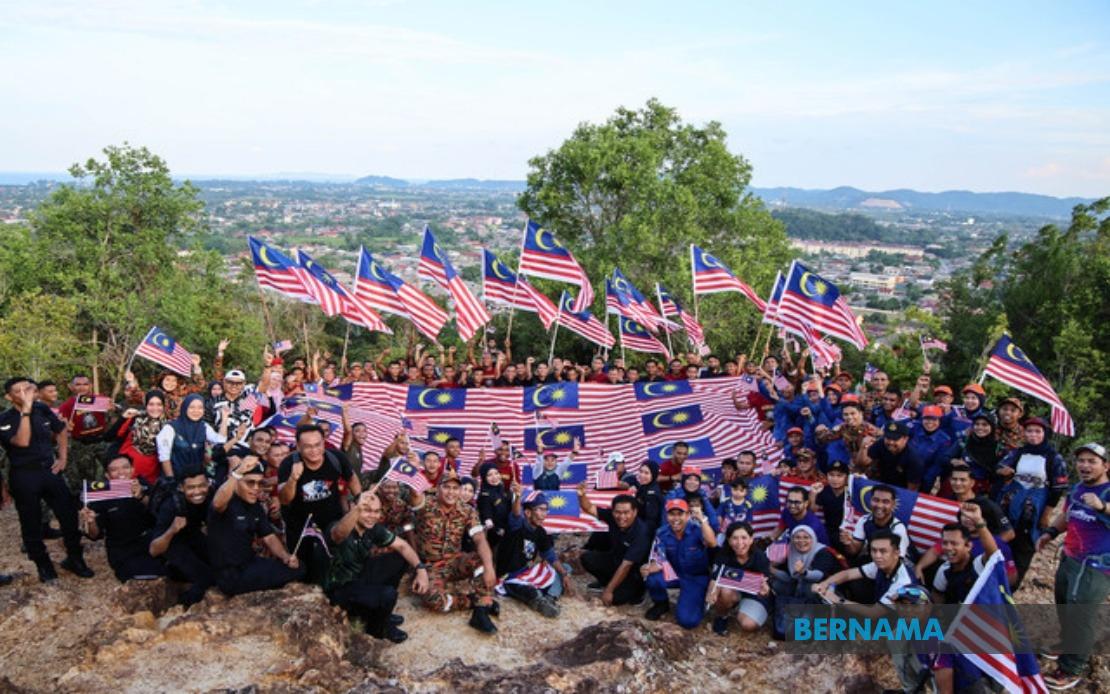
An inaugural patriotic summit expedition brought together 300 participants from across Terengganu's government and security apparatus, reflecting a coordinated effort to blend public service engagement with National Month celebrations. The event, held in Kuala Terengganu, drew uniformed personnel, civil servants, journalists and media professionals in a show of unity that underscores how Malaysia's various institutional bodies are increasingly finding common ground around nationalist themes and community building initiatives.
METRA, the media industry body that spearheaded the undertaking, mobilised an impressive cross-section of the state's administrative machinery. The Terengganu Fire and Rescue Department, Malaysian Armed Forces, Road Transport Department, Malaysian Anti-Corruption Commission, the state's Ministry of Domestic Trade and Cost of Living, Royal Malaysian Customs Department and Civil Defence Force all fielded representatives. This breadth of participation illustrates the growing appetite among government agencies to participate in coordinated public events that showcase institutional cooperation and shared values.
According to METRA president Mohd Zaid Mohd Noor, the gathering served multiple overlapping purposes beyond the symbolic act of climbing a summit together. The initiative emerged from the media fraternity's conviction that journalists and communication specialists bear responsibility for amplifying patriotic messaging across the full spectrum of available platforms. Rather than confining such messaging to traditional news cycles, the approach taken here moved the conversation into the physical and experiential realm, where direct human interaction becomes the primary medium of exchange.
The centrepiece of the expedition involved the collective unfurling of a giant flag during the summit ascent, a powerful visual statement of national pride that participants could literally carry upwards together. This choreography transforms the abstract concept of patriotism into tangible collective action, creating shared memories and visual imagery that extends far beyond the hiking activity itself. Such moments resonate particularly strongly in a country where visual symbols and public demonstrations of national pride occupy significant cultural and political space.
Beyond patriotic expression, organisers deliberately positioned the event as an opportunity to strengthen institutional relationships that often operate in silos despite their complementary missions. The Road Transport Department's work on traffic safety, the Anti-Corruption Commission's investigations, the Customs Department's border operations and the Fire and Rescue Department's emergency response capabilities all benefit from improved coordination and mutual understanding. Summit hikes provide informal settings where personnel from different agencies can interact as fellow Malaysians rather than competing bureaucracies, potentially improving future operational coordination.
Promoting healthy lifestyles emerged as a tertiary objective interwoven throughout the initiative. By framing patriotic service and inter-agency cooperation within an outdoor exercise activity, organisers tapped into Malaysia's growing wellness consciousness while avoiding the appearance of purely ceremonial or politically motivated gathering. Participants could simultaneously achieve personal fitness goals, strengthen professional networks and demonstrate patriotic commitment, creating multiple layers of value from a single event.
The timing during August, Malaysia's National Month, provided natural momentum for such commemorative activities. August encompasses significant nationalist observances including Merdeka celebrations, and government agencies routinely leverage this calendar window to amplify patriotic initiatives. Media practitioners' involvement proved particularly strategic, as journalists occupy privileged positions in amplifying any official message through news coverage, social media, and professional communications channels.
For Southeast Asian observers, the event reflects broader regional trends toward using public participation events as governance tools. Malaysia has increasingly embraced coordinated agency participation in visible public demonstrations of state capacity and national cohesion. Similar patterns appear across ASEAN, where governments stage summit climbs, mass gatherings and outdoor activities partly to demonstrate administrative functionality and partly to foster nationalist sentiment among diverse populations.
The Terengganu initiative also signals media practitioners' evolving role beyond passive information-gathering. By orchestrating the event themselves rather than simply covering it, journalists positioned their industry as active stakeholders in promoting national values and institutional coordination. This represents a subtle but significant shift in how media bodies perceive their function within Malaysian society, moving beyond traditional watchdog roles toward more direct participation in nation-building activities.
The scale of participation—300 people from at least seven major institutions—suggests the concept resonated with both security and civil service communities. In a climate where government agencies frequently grapple with budget constraints and competing priorities, generating enthusiasm for voluntary after-hours participation in outdoor events demonstrates genuine institutional commitment to patriotic exercises and inter-agency bonding. Future years will reveal whether this inaugural summit becomes an annual tradition that institutionalises such cross-agency cooperation.

