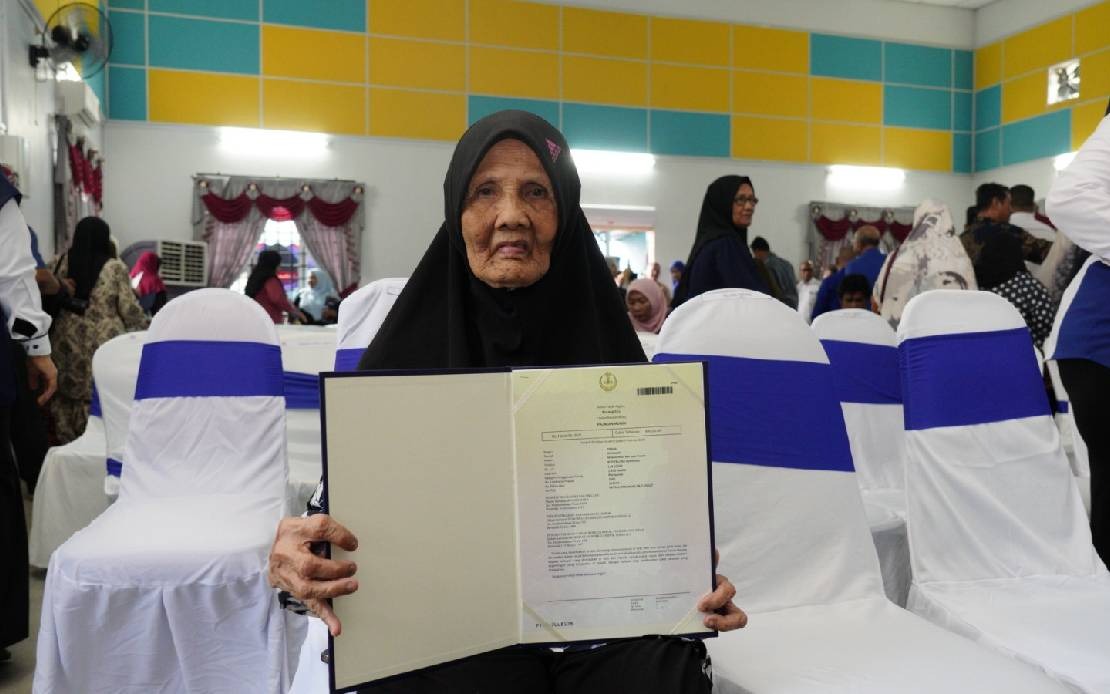
The Federal Land Consolidation and Rehabilitation Authority (FELCRA Berhad) has distributed land ownership certificates to 47 participants in its Seri Gala Area Village Rearrangement Programme, underscoring a development approach that converts marginal agricultural land into productive assets while building household equity in rural communities. The grants were formally handed over during a ceremony in Ipoh on July 14, where state and federal officials acknowledged the initiative as a substantive model for addressing rural economic disparities.
Perak Menteri Besar Datuk Seri Saarani Mohamad characterised the FELCRA Consolidation and Rehabilitation (P&P) Programme as among Malaysia's most effective rural development frameworks, distinct from conventional land schemes that focus narrowly on physical infrastructure. Rather than treating land transfer as mere bureaucratic procedure, he framed asset ownership as a dignity-affirming mechanism that anchors family financial security and intergenerational wealth creation in agricultural communities. This distinction matters in the Malaysian context, where rural populations have historically received infrastructure investment without proportionate increases in household asset ownership.
The programme's operational scope reflects its institutional significance. FELCRA Berhad currently manages approximately 32,000 hectares across nearly 20,000 participants nationwide, positioning Perak as the country's second-largest operational region after Pahang. This scale indicates sustained government commitment to a consolidation model that, unlike some land schemes, involves ongoing participant support and systematic land development rather than one-time allocation. The concentration of FELCRA operations in Pahang and Perak suggests a particular strategic focus on these peninsular states as laboratories for rural economic transformation.
The structural logic underlying FELCRA's approach addresses a persistent constraint in Malaysian agriculture: fragmentation and underutilisation of smallholder plots. By consolidating scattered parcels into coherent development blocks and then transferring ownership to organised participants, the scheme simultaneously improves land productivity and creates documentable household assets. Participants gain formal title deeds—a prerequisite for accessing agricultural credit, implementing improvements, and transferring land to heirs with legal certainty. This contrasts with informal tenure arrangements that leave rural families vulnerable to displacement and unable to leverage land as collateral for enterprise development.
Malaysia's rural development discourse has evolved considerably over recent years, reflecting recognition that infrastructure alone cannot sustain village economies. Deputy Prime Minister and Minister of Rural and Regional Development Datuk Seri Dr Ahmad Zahid Hamidi articulated this shift during World Rural Development Day 2026 celebrations in Jengka, Pahang, advocating for comprehensive rural programmes encompassing human capital, entrepreneurship, welfare improvements, and community agency. FELCRA's model aligns with this broader conceptual shift, integrating land consolidation with technical support, market linkages, and organisational strengthening among participant groups. This integrated approach represents a departure from earlier generations of development schemes that treated land distribution as an endpoint rather than a foundation for sustained economic activity.
The implications for Southeast Asia warrant consideration. Across the region, land consolidation remains contentious, with governments attempting to balance smallholder protection against agricultural modernisation pressures. Malaysia's FELCRA experience—now spanning decades with substantial participant populations—offers neighbouring countries practical lessons in managing consolidation while preserving participant interests. The emphasis on ownership transfer, rather than lease arrangements or cooperative models that retain external control, reflects deliberate policy choices about rural empowerment that resonate across Southeast Asian development debates.
For Perak specifically, the Seri Gala handover represents incremental progress toward state-level rural economic diversification. Perak's economy traditionally concentrated in tin mining and subsequently palm oil, leaving significant segments of the rural population vulnerable to commodity price fluctuations. Land consolidation schemes that create stable household assets and agricultural enterprise opportunities address this structural vulnerability, though their success ultimately depends on market access, technical extension, and credit availability for participants seeking to transition toward higher-value cultivation or diversified rural livelihoods.
The ceremonial aspects of the grant distribution—formalised in a dedicated FELCRA Berhad Seri Gala Grand Hall—underscore institutional efforts to dignify land transfer processes and signal sustained government engagement with rural communities. Such ceremonies serve multiple functions: they provide participants public recognition of legitimate ownership claims, demonstrate political investment in rural constituencies, and create occasions for reviewing programme progress and identifying refinements. The presence of Datuk Mohd Zolkafly Harun (State Rural Development, Plantation, Agriculture and Food Industry Committee chairman), Datuk Seri Ahmad Jazlan Yaakub (FELCRA Berhad chairman), and other officials reflects vertical coordination across federal and state structures required for consolidation programmes to function effectively.
Looking forward, FELCRA's sustainability depends on several factors beyond land transfer mechanics. Participant organisations must maintain cohesion across generational transitions, commodity market volatility necessitates adaptive enterprise strategies, and climate change pressures increasingly shape agricultural viability in Malaysian regions. The scheme's success in building community confidence in rural land value—as officials noted—provides psychological capital that can sustain participants through temporary setbacks, though material returns ultimately determine long-term programme credibility and replicability across other regions seeking rural development models.

