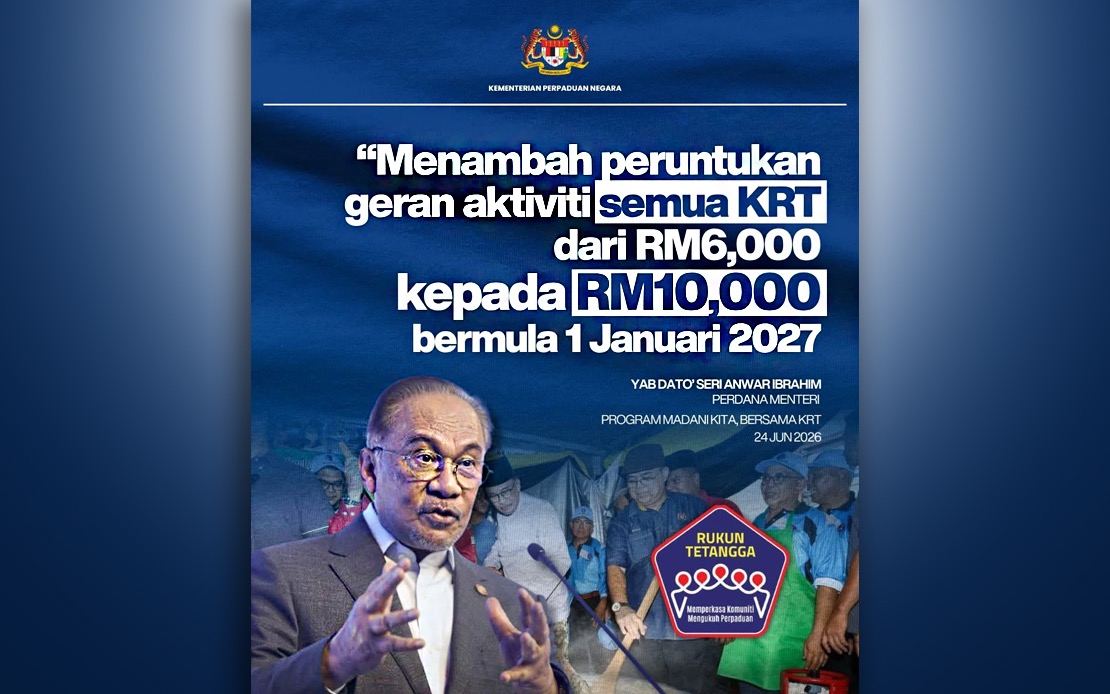
Malaysia's neighbourhood watch movement is set to receive a substantial boost in operational capacity, with the government announcing that all 8,615 registered KRT (Kawasan Rukun Tetangga) groups nationwide will now receive RM10,000 annually—a 67 percent increase from the previous RM6,000 allocation. The enhancement, which takes effect from January 1, 2027, was unveiled by Prime Minister Datuk Seri Anwar Ibrahim during the MADANI KITA programme held in Dataran Segamat, Johor, signalling renewed commitment to strengthening community-level governance structures that have operated for over five decades.
National Unity Minister Datuk Aaron Ago Dagang contextualised the funding boost as recognition of KRT's fundamental role in fostering social cohesion and neighbourhood solidarity across Malaysia's diverse communities. Beyond mere financial support, the minister framed the increase as emblematic of the MADANI Government's broader philosophy of empowering grassroots institutions, which he characterised as the foundational building blocks of a united and progressive society. This positioning reflects a strategic pivot toward bottom-up governance, acknowledging that neighbourhood-level cooperation often proves more effective than top-down policy implementation in addressing localised social challenges.
The scale of KRT's operational reach underscores why this funding decision matters for Malaysia's social fabric. With approximately 250,000 active members operating across the 8,615 registered groups, the neighbourhood watch network touches the lives of over 12 million Malaysians—representing roughly 40 percent of the nation's population. During the past year alone, these grassroots organisations have organised more than 100,000 community activities, ranging from security initiatives and welfare drives to educational programmes and cultural events. This productivity demonstrates that KRT members, despite operating on modest budgets, have successfully mobilised their communities toward collective action.
The additional funding will enable KRT groups to expand their programming portfolio and deepen their community impact. Aaron indicated that enhanced resources would facilitate more ambitious unity activities that bridge ethnic and religious divides, comprehensive community development projects addressing local infrastructure needs, targeted welfare initiatives supporting vulnerable households, educational programmes for youth and adults, neighbourhood security enhancements supplementing official law enforcement, volunteer mobilisation for disaster response and civic projects, and local economic empowerment schemes that create income-generating opportunities. This diversified application reflects recognition that neighbourhood wellbeing encompasses security, development, education, and economic dimensions simultaneously.
For Malaysian communities, particularly in suburban and semi-rural areas where government services may be spatially dispersed, KRT groups function as critical intermediaries between residents and official institutions. The increased grant allocation acknowledges this intermediary role and provides these volunteer-led organisations with greater financial flexibility to respond to emergent community needs without constantly fundraising or seeking external donations. This autonomy particularly benefits less affluent neighbourhoods where residents may lack capacity to contribute substantially to local initiatives, ensuring that KRT programming remains inclusive rather than stratified by neighbourhood wealth.
From a Southeast Asian perspective, Malaysia's investment in neighbourhood-level governance reflects broader regional trends toward community-based social cohesion strategies. As urbanisation and demographic change strain traditional family and ethnic networks, governments across the region increasingly recognise that formally institutionalised neighbourhood structures can substitute for eroding informal social bonds. KRT's longevity and scale position Malaysia as a regional exemplar in this approach, potentially offering lessons for other Southeast Asian nations grappling with similar social fragmentation challenges.
The timing of this funding announcement carries political significance within Malaysia's current governance context. The MADANI framework, which guides the government's policy priorities, explicitly emphasises people-centric development and inclusive growth. By directing additional resources toward KRT, the government signals that its commitment to these principles extends beyond rhetoric to concrete financial allocation. This move also addresses potential criticism that grassroots institutions lack adequate support, demonstrating responsiveness to community feedback and volunteer concerns about resource constraints.
Implementation logistics will prove crucial to realising the intended benefits. The Ministry of National Unity must establish clear mechanisms ensuring that all 8,615 groups receive timely disbursements beginning January 2027, provide capacity-building support to help groups maximise the enhanced budgets through professional financial management and programme planning, and establish accountability frameworks ensuring funds support genuine community benefit rather than administrative overhead. Transparent communication about fund allocation and usage will build public confidence and maintain the legitimacy that KRT relies upon to mobilise volunteer participation.
Looking forward, this funding increase opens possibilities for KRT groups to pioneer innovative community solutions addressing emerging challenges. Enhanced budgets could support digital literacy programmes preparing elderly residents for online government services, mental health awareness initiatives addressing rising psychological stress, climate adaptation projects preparing neighbourhoods for extreme weather events, or inter-ethnic dialogue forums countering polarisation narratives. By providing financial breathing room, the government creates space for grassroots experimentation and adaptation to localised needs that centralised agencies struggle to address effectively.
The announcement also carries implications for volunteerism's sustainability in Malaysia. KRT operations depend fundamentally on unpaid community members dedicating time to organising activities and liaising with neighbours. Inadequate operational funding inevitably burdens volunteers with resource constraints that discourage long-term participation and burnout risk. The funding increase acknowledges this reality and signals that government values volunteer contribution through material support, potentially encouraging younger Malaysians to participate in neighbourhood governance during an era when civic engagement among millennials and Generation Z faces documented decline.
Ultimately, the RM10,000 annual grant represents more than budgetary adjustment; it reflects a deliberate choice to strengthen social infrastructure at the granular level where Malaysians actually build daily relationships across ethnic and religious boundaries. In a nation navigating increasing urbanisation, demographic diversity, and competing globalised influences, neighbourhood-level social cohesion becomes strategically significant for national stability and harmony. By investing substantially in KRT, the government signals that it understands social unity cannot be imposed through legislation alone but must be cultivated through repeated interaction, shared purpose, and collective problem-solving at the neighbourhood level where genuine community happens.

