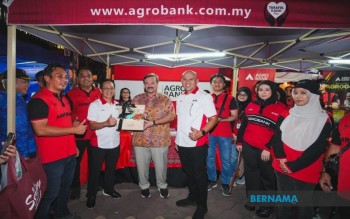
Agrobank's strategy of meeting small business owners where they work has proven remarkably effective, generating financing applications exceeding RM8 million as the bank broadens its reach into underserved entrepreneurial communities. The agricultural financing specialist has transitioned from traditional banking halls to bustling night markets and farmers' markets, recognising that hawkers and micro-entrepreneurs often lack convenient access to formal credit channels. This pragmatic approach reflects a growing acknowledgment within Malaysia's financial sector that conventional banking infrastructure does not adequately serve the nation's vast informal economy.
The bank's expansion into Sabah marks a significant milestone in bringing financial services to East Malaysia's small trading communities. Sessions conducted at Api-Api Night Market on Jalan Gaya and Papar Tamu Farmers' Market drew considerable participation, with 153 hawkers and entrepreneurs attending the night market engagement and 95 traders at the farmers' market venue. These numbers underscore genuine demand for accessible financing among traders who have historically struggled to secure capital from mainstream lenders. The selection of these locations reflects the bank's understanding that night markets and farmers' markets function as vital economic engines within their respective communities, generating employment and sustaining local commerce networks that extend far beyond their immediate physical spaces.
The financing needs addressed during these sessions centred primarily on working capital requirements and business expansion plans. Small traders frequently operate on tight cash flows, managing inventory turnover and managing seasonal fluctuations without substantial financial buffers. By bringing its services directly to these markets, Agrobank has eliminated a major friction point in the borrowing process—the time and psychological barriers associated with visiting a formal banking institution. Moreover, the on-site environment allows loan officers to better understand the operational realities of individual businesses, potentially enabling more contextualised lending decisions than remote applications might permit.
Agrobank's expansion strategy represents a philosophical shift in how state-linked financial institutions approach market penetration in Malaysia's smaller business segments. Rather than expecting traders to conform to standardised banking procedures, the bank has adapted its service delivery model to meet clients in their own commercial ecosystems. This demonstrates recognition that hawkers and micro-entrepreneurs often lack formal business documentation, consistent income statements, or collateral that traditional lenders demand. Direct engagement sessions allow relationship-building and informal assessment of creditworthiness based on observable business operations and direct conversation with proprietors.
The initiative gained high-level political endorsement when Finance Minister II Datuk Seri Amir Hamzah Azizan observed the Api-Api Night Market session, signalling government prioritisation of financial inclusion for the informal sector. This political visibility reflects broader policy objectives within the current administration to democratise access to credit and ensure that economic development benefits reach beyond corporate entities and established businesses. The attention from senior finance ministry officials suggests these engagement sessions align with strategic government directives and may receive ongoing institutional support.
Agrobank Group President and Chief Executive Officer Datuk Tengku Ahmad Badli Shah Raja Hussin framed the Sabah expansion as essential to understanding regional business contexts. Borneo's trading communities operate within distinct geographical, logistical, and market conditions compared to Peninsular Malaysia's more developed infrastructure. Hawkers in Sabah and Sarawak face different supply chain challenges, seasonal patterns, and competitive dynamics than their Klang Valley counterparts. By establishing direct engagement in these markets, Agrobank positions itself to develop regionally-appropriate financing products and advisory services that acknowledge these contextual differences rather than imposing one-size-fits-all solutions.
The bank's commitment extends beyond merely approving loans. Agrobank emphasises providing financial advisory services and non-financial support to help traders professionalise their business management practices. This holistic approach recognises that many hawkers and micro-entrepreneurs lack formal business training and structured financial management capabilities. By combining access to capital with educational support and ongoing advisory engagement, the bank seeks to improve the sustainability and growth trajectory of its client businesses, potentially reducing default rates while building longer-term relationships with this market segment.
These engagement initiatives directly support Prime Minister Datuk Seri Anwar Ibrahim's directive requiring financial agencies to accelerate disbursement of RM5 billion earmarked for small traders. This substantial capital commitment reflects government determination to inject liquidity into Malaysia's informal and micro-business sectors, sectors that employ millions and contribute significantly to local economic resilience. The RM5 billion target acknowledges that conventional financing mechanisms have left substantial funding gaps for businesses below corporate lending thresholds but above microfinance loan sizes, a crucial middle tier requiring attention.
The expansion from Klang Valley's earlier sessions to Sabah signals Agrobank's intention to establish this outreach model as a systematic, nationwide approach rather than a one-off pilot initiative. If successfully replicated across other states and market types, this strategy could substantially increase formal credit accessibility for Malaysia's estimated 1.8 million small and micro-enterprises. Many of these businesses currently operate without access to affordable institutional financing, relying instead on informal lenders, family capital, or retained earnings to fund expansion.
For Malaysian traders and hawkers, these sessions represent tangible movement toward dismantling financial barriers that have historically constrained business growth. Access to affordable working capital enables traders to expand inventory, upgrade equipment, or manage seasonal cash shortfalls without resorting to exploitative informal lending arrangements. For the broader economy, improved financing access in the informal sector potentially catalyses modest but widespread productivity improvements and business formalisation, gradually expanding the tax base while strengthening economic stability at the grassroots level.
The strong response to initial sessions—generating RM8 million in applications from just two Sabah locations—suggests substantial unmet demand for accessible financing across Malaysia's trading communities. If this engagement model continues expanding systematically across states and market types, the RM5 billion government financing target could be substantially deployed, potentially reaching tens of thousands of small business operators. Success here would demonstrate that significant financial inclusion gains become possible when institutions deliberately reshape service delivery to accommodate client circumstances rather than requiring clients to adapt to institutional constraints.
Looking forward, Agrobank's approach establishes a template that other financial institutions might emulate, potentially accelerating financial system evolution toward genuine inclusion. The visible success of direct market engagement validates what many economists have long argued—that substantial segments of Malaysia's economy remain financially underserved not because viable businesses lack creditworthiness, but because conventional banking infrastructure fundamentally mismatches the needs, constraints, and operational rhythms of informal sector traders. By demonstrating that meaningful engagement requires physical presence and contextualised service delivery, Agrobank contributes to shifting industry practices toward more inclusive financing models.

