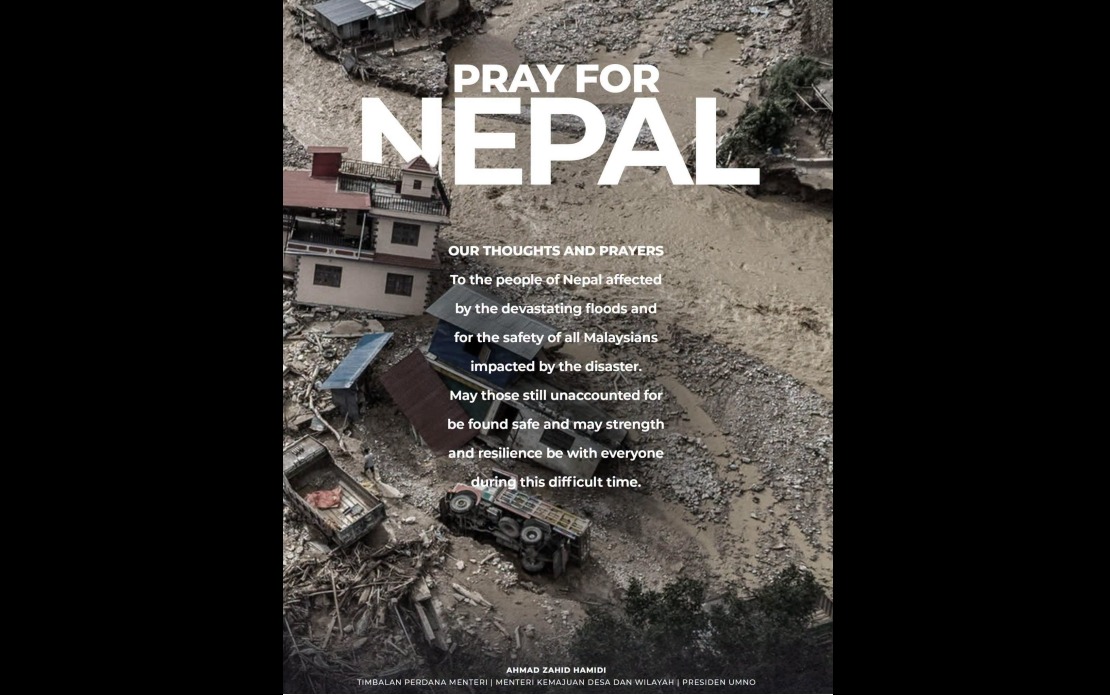
Deputy Prime Minister Datuk Seri Dr Ahmad Zahid Hamidi has voiced serious concern regarding the welfare and whereabouts of Malaysians trapped in the catastrophic flooding that has ravaged Nepal, expressing hope that those currently unaccounted for will emerge safely and be reunited with loved ones awaiting news from the disaster zone.
In a statement released through social media, Ahmad Zahid conveyed his heartfelt condolences to families who have suffered bereavement as a result of the disaster, simultaneously pledging Malaysia's solidarity with the Nepali nation during this period of acute crisis. The Deputy Prime Minister's remarks underscore the immediate humanitarian dimension of the calamity that has extended beyond Nepal's borders to impact Malaysian nationals caught in the path of the destruction.
The scale of the tragedy is captured in sobering statistics released by Nepal's tourism authority, which recorded 359 confirmed deaths by Thursday evening local time, with the figure continuing to climb as rescue teams work through debris and affected areas. The flash flooding has indiscriminately devastated communities, displacing entire families from their homes and destroying livelihoods across multiple regions. For Malaysian travellers and residents in Nepal, the disaster presents an urgent situation requiring coordinated diplomatic and humanitarian response.
In his statement, Ahmad Zahid conveyed a personal sense of anguish at the unfolding catastrophe, acknowledging both the immediate loss of life and the broader humanitarian consequences affecting survivors. His reference to families "anxiously awaiting news of those who remain missing" speaks to the particular anxiety experienced by Malaysian next-of-kin scattered across the country, desperate for confirmation of their relatives' fates as communication networks struggle under the strain of disaster recovery operations.
The Deputy Prime Minister's appeal for divine intervention in accelerating search and rescue operations reflects the challenging conditions facing emergency responders, who are navigating treacherous terrain, damaged infrastructure, and unpredictable weather patterns as they attempt to locate survivors and recover bodies. Malaysian government agencies would ordinarily coordinate with their Nepali counterparts to facilitate these operations and identify Malaysian nationals among those missing or requiring evacuation assistance.
Ahmad Zahid's invocation of resilience and strength for affected families serves as both a spiritual comfort and implicit acknowledgement that recovery from such disasters extends far beyond the immediate crisis phase. The psychological and material rebuilding required by communities devastated by flash flooding can extend across months and years, particularly in regions where tourism and seasonal migration patterns mean Malaysian nationals may be scattered across multiple locations when disaster strikes.
The timing of flash flooding during what typically constitutes peak tourist season in Nepal compounds the challenge, as many Malaysians may be present as travellers, trekking enthusiasts, or temporarily resident expatriates. The sudden emergence of flooding in August highlights the vulnerability of the Himalayan region to extreme weather events linked to monsoon patterns, a phenomenon that affects broader South Asian climatic systems and occasionally impacts Southeast Asia through secondary effects.
From a regional perspective, this disaster underscores the importance of maintaining robust diplomatic channels and emergency response protocols between Malaysia and Nepal. The Ministry of Foreign Affairs would typically activate consular networks to verify the status of Malaysian nationals, coordinate with local authorities on documentation and evacuation requirements, and facilitate family communication. Such mechanisms have been tested repeatedly across Southeast Asia during natural disasters and human-caused emergencies.
The humanitarian crisis in Nepal also carries implications for Malaysian volunteer and development organisations that maintain ongoing projects in the region. These groups often find themselves suddenly conscripted into emergency relief efforts, providing not only material assistance but also psychological support and documentation services for affected populations. Ahmad Zahid's public statement may serve as a mobilising signal for such organisations to marshal resources and coordinate with government agencies.
Beyond the immediate sympathy and diplomatic courtesy embedded in Ahmad Zahid's remarks lies a broader acknowledgement of the interdependence characterising contemporary South Asia. Malaysians' presence in Nepal—whether as tourists, workers, students, or long-term residents—reflects decades of economic integration, educational exchange, and cultural connectivity that transcend formal political boundaries. When disaster strikes, these connections become conduits for extended personal networks attempting to ascertain welfare and provide support across international borders.
The Deputy Prime Minister's statement also implicitly positions Malaysia within a broader international community responding to the Nepali tragedy, where numerous nations are offering financial assistance, technical expertise in search and rescue operations, and diplomatic support. Malaysian neutrality and regional credibility in South Asian affairs contribute to its role as a constructive partner in such multilateral humanitarian responses, particularly given Malaysia's own experience managing cross-border emergency coordination following regional disasters.
Moving forward, the affected Malaysian families and individuals will require sustained government attention extending beyond initial crisis management. Consular services will need to process identity documentation for those displaced, coordinate evacuation if necessary, and facilitate financial support or insurance claims. Mental health and psychosocial support services may become relevant for those who survived traumatic experiences, particularly if Malaysians witnessed or were caught directly in flooding situations.

