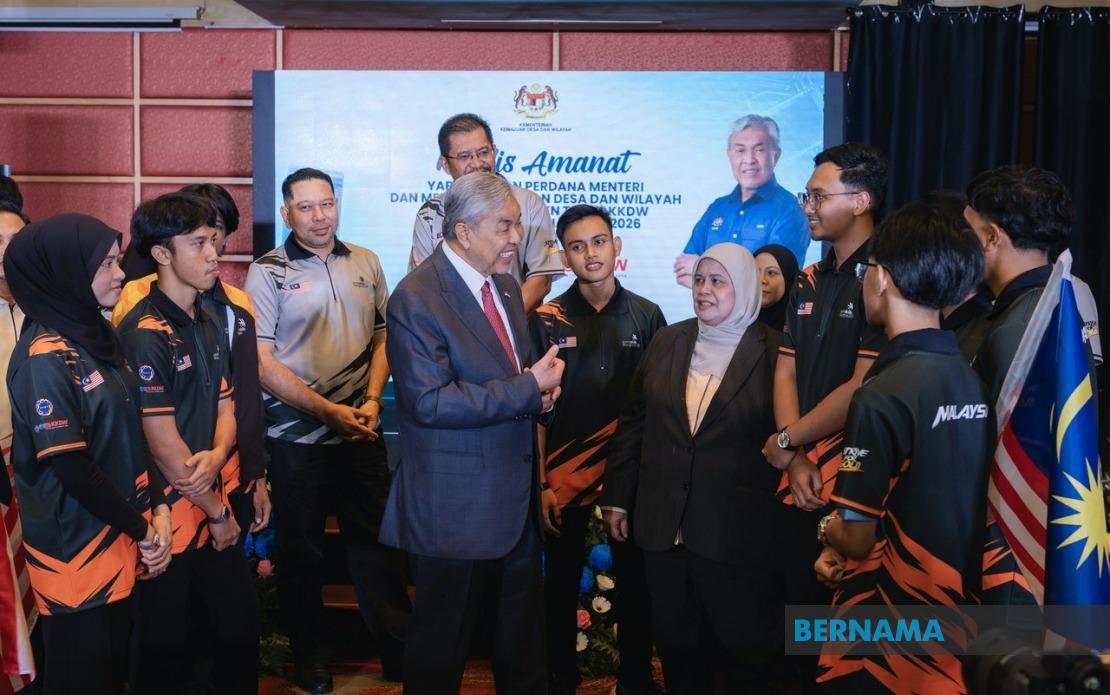
Deputy Prime Minister Datuk Seri Dr Ahmad Zahid Hamidi has announced an ambitious incentive scheme designed to recognise excellence among Malaysia's technical and vocational talent, pledging to personally fund umrah pilgrimages for gold medal winners from the country's TVET sector competing at the WorldSkills Competition (WSC) 2026 in Shanghai, China, scheduled to take place from September 22 to 27. The commitment represents a significant gesture of support for Malaysia's emerging skilled workforce and underscores the government's investment in vocational excellence on the international stage.
Ahmad Zahid, who holds the dual portfolio of Deputy Prime Minister and Minister of Rural and Regional Development, indicated that the sponsorship would be extended not only to the winning participants themselves but also to their parents, creating a family-centred recognition of achievement. He characterised the initiative as a personal expression of gratitude for the dedication and hard work these students have demonstrated in preparing to represent Malaysia at one of the world's most prestigious vocational skills competitions. The funding would be drawn entirely from his own resources rather than government budgets, establishing this as a voluntary gesture of encouragement.
Speaking at an official address to the TVET@KKDW contingent assembled for the Shanghai competition, Ahmad Zahid left no ambiguity about the scope of his commitment, declaring that should all nine Malaysian representatives capture gold medals—an unprecedented achievement that would require each participant to emerge victorious in their respective discipline—he would personally ensure all eighteen individuals—the nine competitors and their parents—could undertake the Islamic pilgrimage. This formulation of the pledge effectively set the terms for maximum potential impact while simultaneously acknowledging the extraordinary difficulty of such a clean sweep at international competition level.
The nine-member Malaysian delegation represents the TVET institutions operating under the Ministry of Rural and Regional Development's purview and covers a diverse range of modern technical skills reflecting contemporary industry demands. The team includes Nadratulliyana Ab Malek competing in Fashion Technology, Haziq Syahmi Nazri in Automobile Painting, Amirul Sharif Sharifudin in Electronics, Mohammad Ezaly Iman Ramli in Cyber Security, and Wan Hamiz Ozai Wan Hamidzi in Rail Vehicle Technology. Complementing this first cohort are Khairul Idham Bahari in Cabinetmaking, Muhamad Nashrul Zulkifli in Digital Construction, Muhammad Haziq Lailla Zamri in Electrical Installations, and Muhammad Huzairy Mohamad Thes in Mechanical Engineering CAD.
WorldSkills competitions serve as global benchmarks for vocational excellence, attracting competitors from across the world to demonstrate technical proficiency, problem-solving abilities, and professional standards. For participating nations, successful showings at these events provide both validation of educational quality and valuable international visibility. Malaysia's continued participation reflects the country's commitment to positioning its TVET sector as competitive at the highest international level, an objective that has gained momentum as regional economies increasingly emphasise skilled trades and technical expertise.
The timing of Ahmad Zahid's announcement carries particular significance given ongoing discussions in Malaysia about strengthening the vocational education pathway and elevating the professional status of technical careers. For too long, technical and vocational training in Southeast Asia has sometimes occupied a secondary tier in educational hierarchy, with university pathways receiving disproportionate prestige and resources. Initiatives like Ahmad Zahid's pledge, while symbolic, contribute to a cultural shift recognising that technical excellence demands equivalent recognition to academic achievement.
For the nine selected participants, the announcement creates additional motivation beyond the inherent honour of international competition. The prospect of an umrah pilgrimage—a spiritual journey holding deep religious significance for Muslims—represents a meaningful form of recognition that extends beyond conventional material rewards. For families, particularly those from rural and regional areas that the Ministry of Rural and Regional Development specifically serves, such an opportunity carries profound personal and spiritual importance. This recognition of family involvement also reflects understanding of the support systems essential to individual achievement, particularly for young competitors balancing intensive training with studies.
The Deputy Minister's gesture also signals broader government positioning regarding TVET as a strategic priority area deserving high-level ministerial support. By personally committing resources rather than merely making statements of encouragement, Ahmad Zahid demonstrates tangible backing that can motivate both current participants and future generations considering vocational pathways. Such leadership engagement helps counter persistent social perceptions that technical education represents a second-class option compared to traditional academic routes.
Shanghai's hosting of WorldSkills 2026 adds geographic and geopolitical dimensions to Malaysia's participation. Competing within China's sphere provides opportunities for regional networking and benchmarking against other Southeast Asian and Asian competitors. The venue choice also reflects China's prominent position in global technical manufacturing and innovation, making success there particularly meaningful for participants entering industries where Chinese companies play substantial roles.
Looking ahead to September 2026, the Malaysian contingent faces rigorous preparation demands across their respective disciplines. WorldSkills competitions are known for their exacting standards and intensive competitive environments where margins between medallists are often razor-thin. The participants will be competing against established international contenders from developed nations with extensive TVET infrastructure and resources. Success requires not only technical mastery but strategic thinking, time management under pressure, and mental resilience in high-stakes environments.
Ahmad Zahid's announcement also comes at a moment when Malaysia is articulating clearer strategic direction around skills development and workforce preparation. As manufacturing sectors increasingly demand advanced technical competencies and digital integration transforms traditional trades, the availability of internationally competitive vocational talent becomes economically critical. Medal performances at WorldSkills events provide external validation of educational programme quality and help attract investment and industry partnership.
The Ministry of Rural and Regional Development's expansion into TVET provision reflects recognition that skill development opportunities must reach beyond urban centres and reach populations in secondary and tertiary cities and rural areas. The nine competitors selected from TVET@KKDW institutions represent not only individual achievement but also institutional capability spread across the country's regional development framework. Their international competition participation thus carries significance extending beyond personal accomplishment to regional development objectives.
As the Shanghai competition approaches, Ahmad Zahid's pledge will likely feature prominently in pre-competition media narratives and team motivation materials. Whether motivational or symbolic, the commitment represents a notable instance of high-level government backing for vocational excellence and may set precedent for how Malaysia recognises and supports technical achievement internationally.

