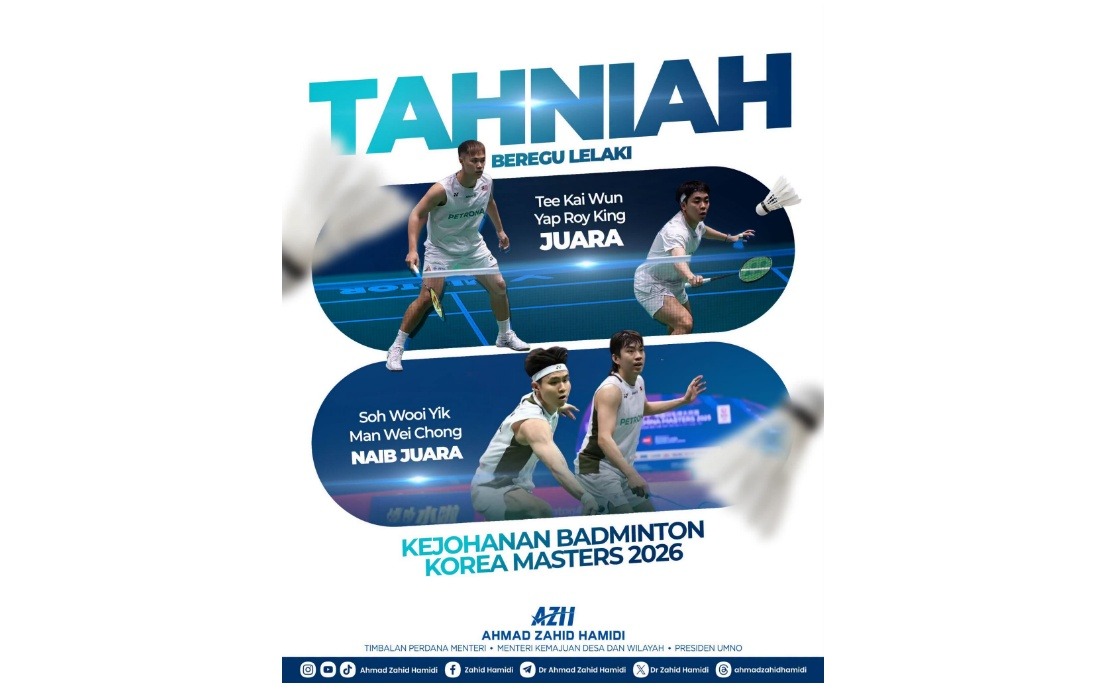
Deputy Prime Minister Datuk Seri Dr Ahmad Zahid Hamidi has lauded the exceptional achievements of Malaysia's badminton contingent at the 2026 Korea Masters Badminton Championships, where two Malaysian men's doubles pairings secured the top positions in an all-Malaysian showdown. The event, held at the Yi Sun-sin Gymnasium in Asan, showcased the depth and quality of Malaysia's badminton talent on the international circuit, reinforcing the nation's standing as a powerhouse in the sport.
Tee Kai Wun partnered with Yap Roy King claimed the championship crown in their debut appearance at the prestigious Korea Masters tournament. The pair delivered a commanding performance to overcome their compatriots Soh Wooi Yik and Man Wei Chong in the final, securing victory with a scoreline of 21-13, 21-18 in a tightly contested match that lasted 31 minutes. Their triumph demonstrated the tactical maturity and competitive resolve required to succeed at the highest levels of international badminton competition.
In his congratulatory message released via social media, Ahmad Zahid recognised the significance of the result and its broader implications for Malaysian badminton development. He emphasised that such successes serve as important catalysts for future achievements, motivating athletes to continue pursuing excellence and representing their nation with distinction on global sporting platforms. The Deputy Prime Minister's acknowledgment underscores the government's investment in and commitment to supporting Malaysian athletes across various sporting disciplines.
The Korea Masters victory holds particular significance within Malaysia's badminton history, representing only the second occasion the nation has claimed the men's doubles title at this tournament. The previous triumph came in 2024 when Soh Wooi Yik partnered with Aaron Chia to claim the crown, demonstrating a consistent pattern of Malaysian excellence in men's doubles badminton during recent years. This recurring success at major international tournaments validates the systematic approach Malaysia has taken toward talent identification, coaching infrastructure, and competitive scheduling.
The fact that both finalists were Malaysian pairs underscores the remarkable depth available within the domestic badminton ecosystem. Rather than facing external competition in the final, the championship was decided entirely between two homegrown partnerships, reflecting the strength of Malaysia's player pool and the effectiveness of the national badminton association's development programmes. This internal competition at the championship level frequently sharpens athletes' skills and accelerates their progression toward world-class standards.
For Soh Wooi Yik and Man Wei Chong, finishing as runners-up at the Korea Masters represents a respectable outcome that positions them competitively within the global men's doubles rankings. Despite the final loss, their advancement to the championship match demonstrates their capability to compete at the tournament's highest level. The pairing will likely view this experience as valuable preparation for upcoming international fixtures and as motivation to refine their game further.
Badminton remains one of Malaysia's most consistent sources of international sporting success, with the nation regularly producing world-ranked players and competitive pairs across multiple categories. The Korea Masters has become an important fixture on the professional badminton calendar, attracting the sport's elite competitors and offering substantial ranking points. Malaysian shuttlers' continued prominence at such tournaments reinforces the country's position within the global badminton hierarchy and attracts investment and sponsorship support for the sport domestically.
The timing of this championship success carries additional relevance given the ongoing competitive calendar leading toward major international tournaments, including the Olympic Games and world championships. Victories at prestigious Masters events build momentum and confidence among athletes while attracting media attention and public support. For developing badminton ecosystems across Southeast Asia, Malaysia's consistent performance at events like the Korea Masters serves as a benchmark and inspiration for other nations seeking to establish competitive badminton programmes.
The government's recognition of badminton achievements through high-level political acknowledgment, as evidenced by Ahmad Zahid's congratulatory remarks, reflects an understanding of sport's broader cultural and diplomatic significance. Such recognition encourages continued investment in grassroots badminton development while validating the career choices of professional athletes who represent Malaysia internationally. The pathway from emerging pairs to Korea Masters champions requires sustained commitment from both individual athletes and supporting institutional frameworks, making official acknowledgment of their efforts particularly meaningful.

