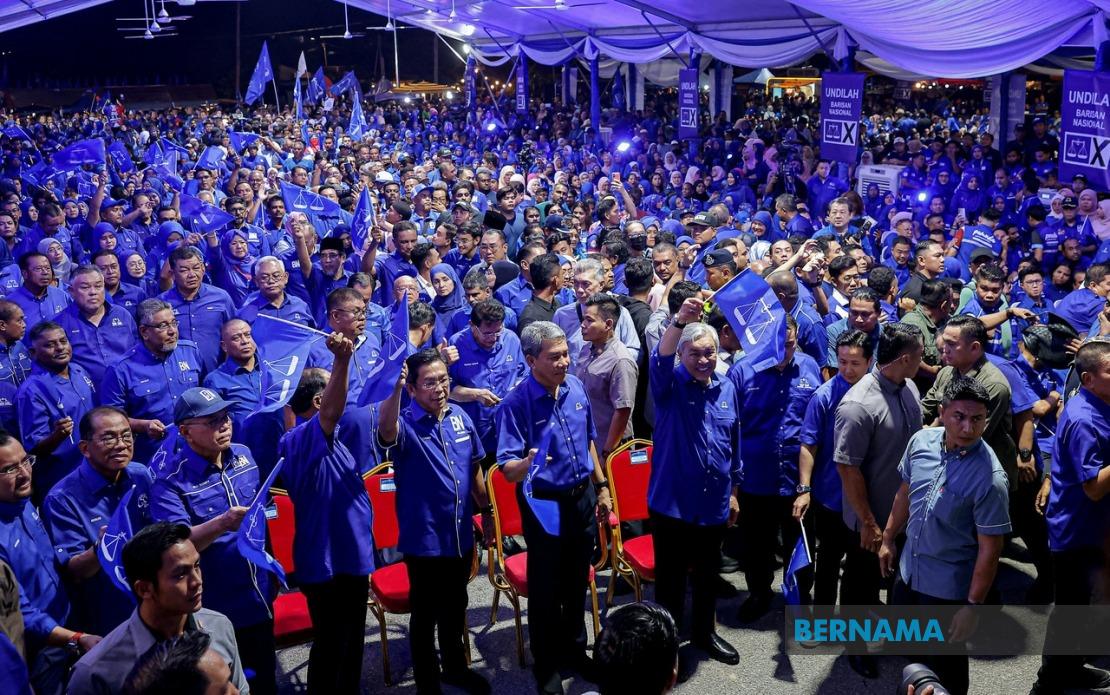
Barisan Nasional's commanding performance in the recent Johor state election should energize the coalition's campaign machinery ahead of the 16th Negeri Sembilan state election, according to BN chairman Datuk Seri Dr Ahmad Zahid Hamidi. Speaking at the launch of the coalition's election apparatus and candidate announcement ceremony at Tuanku Abdul Rahman Stadium in Paroi on July 15, Ahmad Zahid positioned the Johor triumph as a strategic template for replicating success in the upcoming contest, particularly as BN seeks to expand its foothold across Malaysia's peninsular states.
The UMNO president highlighted the scale of BN's Johor achievement to galvanize party workers for the Negeri Sembilan campaign. By capturing 48 of the 56 state seats and securing nearly 60 per cent of the popular vote, BN achieved its strongest performance in the state's electoral history. Ahmad Zahid attributed this breakthrough to voter confidence in BN's capacity to deliver political certainty, stimulate economic activity, and maintain administrative competence. These assertions underscore how BN is attempting to frame itself as the guarantor of stability in an increasingly fragmented political landscape, a narrative particularly resonant with middle-class and business-oriented constituencies concerned about policy continuity.
Ahmad Zahid emphasized that Johor's success stemmed from internal coalition cohesion, with BN component parties functioning as an integrated unit rather than competing factions. He stressed that the same collaborative methodology must be replicated in Negeri Sembilan, where factional tensions and leadership rivalries have occasionally complicated candidate selection processes. By explicitly calling for members to transcend personal grievances and factional preferences, Ahmad Zahid was acknowledging the reality that Malaysian state elections frequently hinge on whether ruling coalitions can present a unified front or whether internal divisions become exploitable vulnerabilities. This represents a critical operational lesson from Johor, where disciplined party machinery and clear messaging helped BN consolidate support across demographic segments.
The coalition leader instructed party operatives to commence intensive ground operations immediately, prioritizing direct voter engagement through house-to-house canvassing. This tactical emphasis on grassroots contact reflects evolving campaign methodologies in Malaysian politics, where digital platforms and social media have complemented rather than replaced traditional face-to-face mobilization. For Negeri Sembilan, a state encompassing urban centers, suburban areas, and rural constituencies, this multi-layered engagement strategy becomes particularly important for reaching diverse voter demographics across geographical variations.
Ahmad Zahid addressed the perennial challenge of candidate selection in Malaysian party politics, cautioning members against allowing personal aspirations for candidacy to overshadow the collective objective of securing electoral victory. This guidance reveals ongoing tensions within BN's member parties regarding the allocation of nominations, particularly as promising politicians compete for limited state assembly opportunities. By depersonalizing the candidacy question and reframing it as secondary to overall campaign success, Ahmad Zahid attempted to preempt post-announcement discord that might undermine party morale. He clarified that irrespective of which individuals receive nominations or which candidate emerges as the Menteri Besar frontrunner, party machinery must maintain operational focus and disciplined execution.
The Deputy Prime Minister expressed confidence that BN would substantially improve upon its 2023 Negeri Sembilan performance, when the coalition secured 14 state assembly seats. This projection implies BN is targeting substantially higher numbers in the upcoming election, positioning the contest as a genuine opportunity for seat gains rather than mere defensive consolidation. The improvement trajectory from 2023 to 2025 reflects both improved organizational preparation and potentially changed voter sentiment regarding BN's governance record over the intervening period.
The Election Commission timeline structures the campaign within a compressed schedule, with nomination day set for the following Saturday, early voting scheduled for July 28, and general polling designated for August 1. This condensed electoral calendar requires campaigns to operate with particular efficiency and coordination, leaving minimal margin for organizational mishaps or messaging confusion. For BN, maximizing impact within this limited timeframe necessitates pre-positioned campaign infrastructure and pre-prepared communications strategies rather than improvised approaches.
Negeri Sembilan's electoral significance extends beyond its state assembly seats. As a state traditionally aligned with BN but recently experiencing tighter electoral competition, the contest serves as a barometer for broader peninsular voter sentiment regarding the coalition. A decisive BN victory would reinforce momentum emerging from Johor and project strength heading toward potential future federal-level electoral assessments. Conversely, a narrower margin or unexpected setback would complicate BN's narrative of resurgent popularity and raise questions about the transferability of Johor's success to other state contexts with distinct political dynamics and voter compositions.
For Southeast Asian observers monitoring Malaysian political developments, the Negeri Sembilan election provides insights into contemporary coalition governance in a regional democracy navigating ideological polarization and institutional adaptation. BN's ability to maintain member-party discipline while distributing electoral spoils equitably influences how multiparty alliances function across Southeast Asia. Similarly, the coalition's strategic communications emphasis on governance competency and economic delivery reflects a deliberate pivot away from identity-based political messaging toward performance-oriented governance narratives that might resonate across increasingly heterogeneous electorates.

