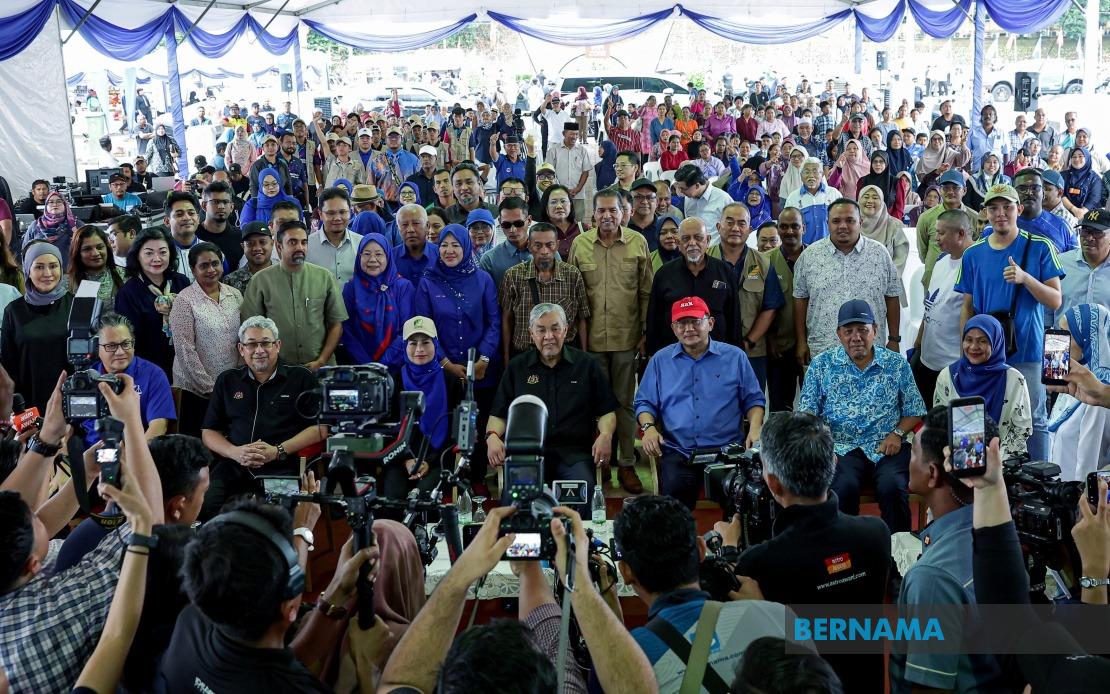
With Negeri Sembilan's 16th state election entering its final stretch, Deputy Prime Minister Datuk Seri Dr Ahmad Zahid Hamidi has issued a stark reminder to political parties that campaigning must remain anchored in policy substance rather than divisive social issues. Speaking after launching an agricultural initiative in Kuala Pilah on July 25, the Barisan Nasional chairman drew a clear line on what should and should not feature in electoral messaging, signalling the federal government's commitment to maintaining standards of political conduct during a sensitive state contest.
Ahmad Zahid's intervention reflects growing concerns about campaign tone in Malaysia's state elections. The Deputy Prime Minister specifically cautioned against weaponising matters of race, religion, culture and socioeconomic background—issues that have historically proven volatile in Malaysian electoral contests. Rather than permitting politicians to exploit these fault lines, Ahmad Zahid insisted that parties instead direct their energies towards substantive discussions of policies designed to improve residents' lives. This framing positions the government as guardian of civic values, though it also suggests that without such reminders, the temptation to cross ethical boundaries might otherwise prove irresistible.
Central to Ahmad Zahid's message was an assertion that political decorum must transcend the federal-state divide. He emphasised that leaders at both national and state levels bear responsibility for upholding professional standards, particularly when presenting competing visions to voters. The call carries added weight given that Ahmad Zahid chairs BN, making his words an official party position rather than mere personal opinion. His statement effectively frames ethical campaigning as non-negotiable across Malaysia's political system, establishing expectations that will be difficult for other parties to ignore without appearing unprincipled by comparison.
The Deputy Prime Minister also addressed the thorny question of past leaders and decisions. While acknowledging that political parties naturally disagree on matters of substance, Ahmad Zahid argued that disagreement need not entail personal disparagement of individual politicians or criticism of their predecessors. This suggests a sophisticated understanding of campaign dynamics: parties can distinguish themselves through policy alternatives without resorting to character assassination. For Malaysian voters accustomed to sometimes acrimonious state election campaigns, such appeals to restraint represent an attempt to elevate discourse, though whether they will be heeded remains uncertain.
Significantly, Ahmad Zahid used the occasion to reaffirm Barisan Nasional's unwavering support for Prime Minister Datuk Seri Anwar Ibrahim and the federal Unity Government. This statement serves multiple purposes simultaneously. It reassures coalition partners that BN remains committed to the Putrajaya administration, countering any perception that state-level contests might provide cover for federal political manoeuvring. At the same time, by emphasising unity at the national level, Ahmad Zahid implicitly argues that this same spirit of cooperation should extend downwards into state politics, creating pressure on opposition parties to demonstrate similar maturity.
The Deputy Prime Minister went further, explicitly denying that BN has any intention of toppling the MADANI Government through what he termed "backdoor" political manoeuvres. This defensive posture suggests that such rumours have circulated, requiring formal contradiction. In Malaysian politics, where informal negotiations and sudden shifts in coalition arrangements occur with enough regularity to fuel speculation, Ahmad Zahid's emphatic denial carries significance. By publicly abjuring any coup-like scenario, he attempts to stabilise expectations among coalition partners and investors nervous about political uncertainty.
Meanwhile, in Johor, UMNO vice-president Datuk Seri Mohamed Khaled Nordin addressed persistent questions about BN's tactical alliance with rival coalition Perikatan Nasional in the Negeri Sembilan contest. Khaled's clarification that the arrangement represents merely a seat-sharing understanding rather than a merger or deep fusion is legally accurate but politically loaded. The distinction matters because if PN voters perceive BN-PN cooperation as temporary and purely transactional, they may prove less enthusiastic than if the pact carried broader strategic implications. Conversely, if BN supporters fear permanent realignment, they might grow anxious about their coalition's future.
The practical consequence of the BN-PN understanding is the elimination of three-way contests in selected constituencies, allowing both coalitions to concentrate firepower against common opponents rather than fragmenting votes through internal competition. Khaled's emphasis that other parties should not misinterpret this arrangement suggests that Perikatan Nasional may be attempting to position itself as a potential future partner for Barisan Nasional outside the Unity Government framework. Such positioning carries obvious implications for Malaysian politics' longer-term trajectory, even if publicly both coalitions maintain loyalty to existing arrangements.
The timing of these statements deserves scrutiny. Early voting for the Negeri Sembilan election occurs on July 28, with main polling day set for August 1. This compressed campaign period means that Ahmad Zahid's call for ethical standards comes relatively late in the process, when party machinery is already at full capacity and campaign messaging largely set. Whether political parties can or will recalibrate their messaging at this stage seems questionable, though Ahmad Zahid's intervention at least establishes a public benchmark against which subsequent campaign conduct can be measured.
For Malaysian and Southeast Asian observers, the Negeri Sembilan contest represents a useful gauge of how Malaysia's political system balances competitive democracy with inclusive governance. The willingness of federal leaders to articulate standards for state-level campaigns suggests institutional maturation, yet the need for such reminders also underscores persistent vulnerabilities. Whether elections can turn genuinely on policy substance rather than identity-based appeals remains a defining question for Malaysia's political development in coming years.

