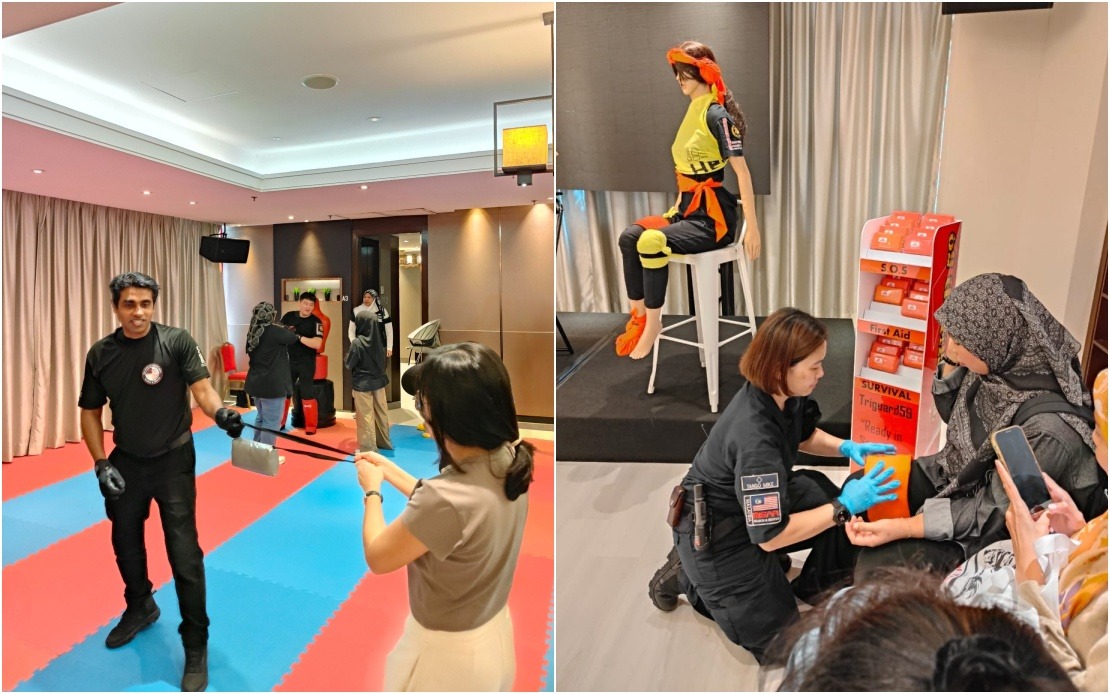
Allianz Malaysia has deepened its commitment to community safety by partnering with Kelab Marshal Keselamatan Jalan Raya Kuala Lumpur (RSMC) to deliver the ninth iteration of a targeted women's safety campaign, reaching 200 female participants at an event held in Seri Kembangan, Selangor. The initiative reflects a sustained corporate effort to address street crime vulnerabilities affecting Malaysian women, combining practical skill-building with awareness-raising activities designed for participants aged 16 and above.
The programme structure incorporated a multi-layered approach to personal security education. Rather than adopting a purely lecture-based format, organisers delivered hands-on demonstrations alongside classroom instruction, covering a spectrum of real-world threats that women face daily. Participants gained exposure to scenarios involving residential break-ins, organised bag snatching operations, transportation-related fraud schemes, unwanted stalking behaviour, vehicle hijacking techniques, post-accident protocols and foundational self-defence manoeuvres. This breadth of content acknowledges that street crime encompasses diverse threat vectors, each requiring distinct awareness and response strategies.
A significant innovation in this year's campaign was the introduction of structured dialogue sessions between participants and RSMC specialists. These interactive forums moved beyond theoretical instruction by creating space for women to articulate personal safety concerns drawn from lived experience. The specialists then provided contextualised guidance tailored to individual circumstances, transforming generic safety advice into actionable solutions applicable to participants' specific environments and daily routines. This dialogical component represents a methodological shift toward participatory safety education rather than top-down information delivery.
Sean Wang, Allianz Malaysia's chief executive officer, highlighted an unexpected but significant outcome: community leaders expressed interest in replicating the programme within their own neighbourhoods. This grassroots enthusiasm signals growing recognition among local stakeholders that women's safety transcends individual responsibility and requires community-wide mobilisation. Wang's commentary underscores that programme success extends beyond attendance figures to encompass how knowledge diffuses through social networks and institutional channels beyond the initial event. The ripple effect—wherein trained participants become vectors for safety awareness within families and community organisations—amplifies the initiative's societal impact disproportionately to direct participant numbers.
Captain K. Balasupramaniam, founder and president of RSMC, framed the campaign within a broader philosophy of empowerment through knowledge. His articulation emphasised that street crime awareness transcends defensive tactics; it encompasses building psychological and informational foundations enabling informed decision-making when confronted with ambiguous or threatening situations. This conceptualisation recognises that vulnerability often stems not merely from physical weakness but from informational asymmetries and unfamiliarity with risk indicators and response protocols. By equipping women with this cognitive toolkit, the programme addresses a fundamental dimension of personal security frequently overlooked in conventional safety campaigns.
The venue selection—Wisma Huazong YTL Hall in Seri Kembangan—suggests deliberate geographic targeting within the Klang Valley metropolitan area, where concentration of urban populations correlates with documented street crime prevalence. This strategic deployment reflects data-informed programme positioning, directing resources toward communities with elevated risk exposure. For Malaysian cities and towns experiencing similar urban crime pressures, the replicability of this model offers a proven template for corporate-civil society collaboration in community safety provision.
Allianz Malaysia's corporate social responsibility framework positions insurance expertise alongside safety education, creating thematic coherence between the organisation's business interests and community welfare priorities. This alignment differs from purely philanthropic corporate engagement; it grounds safety initiatives within the company's core operational expertise. Participants benefit not only from generic safety knowledge but from principles informed by insurance risk assessment and loss prevention methodologies, introducing them to systematic approaches professionals utilise for hazard identification and mitigation.
The longitudinal dimension—this being the ninth annual iteration—indicates institutional commitment transcending one-off community relations gestures. Nine years of sustained programming suggests accumulated knowledge about programme efficacy, audience needs and implementation refinements. The evolution from earlier iterations to this year's enhanced dialogue component illustrates responsiveness to participant feedback and emerging understanding of effective adult safety education practices. For evaluation purposes, such longitudinal consistency provides valuable baseline data for assessing cumulative reach and community penetration effects across the Selangor region.
The participation of 200 women in a single event, while representing meaningful direct impact, gains significance when contextualised within broader demographic trends. With Malaysia's female population exceeding 8 million, even successful large-scale programming reaches fractional percentages of the target demographic. However, the emphasis on participant transformation into community advocates addresses this scaling challenge by leveraging social influence and informal knowledge transmission networks. Each trained participant potentially influences family members, workplace colleagues, and community associations, creating secondary awareness waves multiplying direct programme reach.
For Malaysian policymakers and community organisations, this initiative offers instructive elements regarding effective public safety engagement. The combination of practical skill training, structured dialogue, and emphasis on advocate development demonstrates that public safety outcomes depend not merely on enforcement capacity but on community knowledge and active participation. The success metrics Allianz Malaysia emphasises—interest from community leaders and participant willingness to serve as safety advocates—signal measurable community behavioural change beyond simple knowledge acquisition. This represents substantive evidence that well-structured interventions can catalyse social mobilisation around safety concerns.
The programme's gender specificity acknowledges that street crime victimisation patterns differ along gender lines, with women disproportionately experiencing particular crime categories such as bag snatching and carjacking-related violence. Targeted interventions recognising these differential vulnerabilities prove more effective than gender-neutral approaches that may inadvertently obscure specific threat categories affecting particular populations. This evidence-informed targeting principle has implications for how Malaysian law enforcement and community safety organisations structure public engagement efforts.
Moving forward, the sustained partnership between Allianz Malaysia and RSMC demonstrates mutual recognition that comprehensive community safety requires ongoing collaboration between private sector resources and civil society expertise. Neither institutional category possesses sufficient leverage alone; insurance companies bring funding and risk analysis capacity while road safety organisations contribute operational expertise and community relationships. This complementary partnership model offers a governance template applicable to other social domains requiring sustained resource commitment and technical knowledge.

