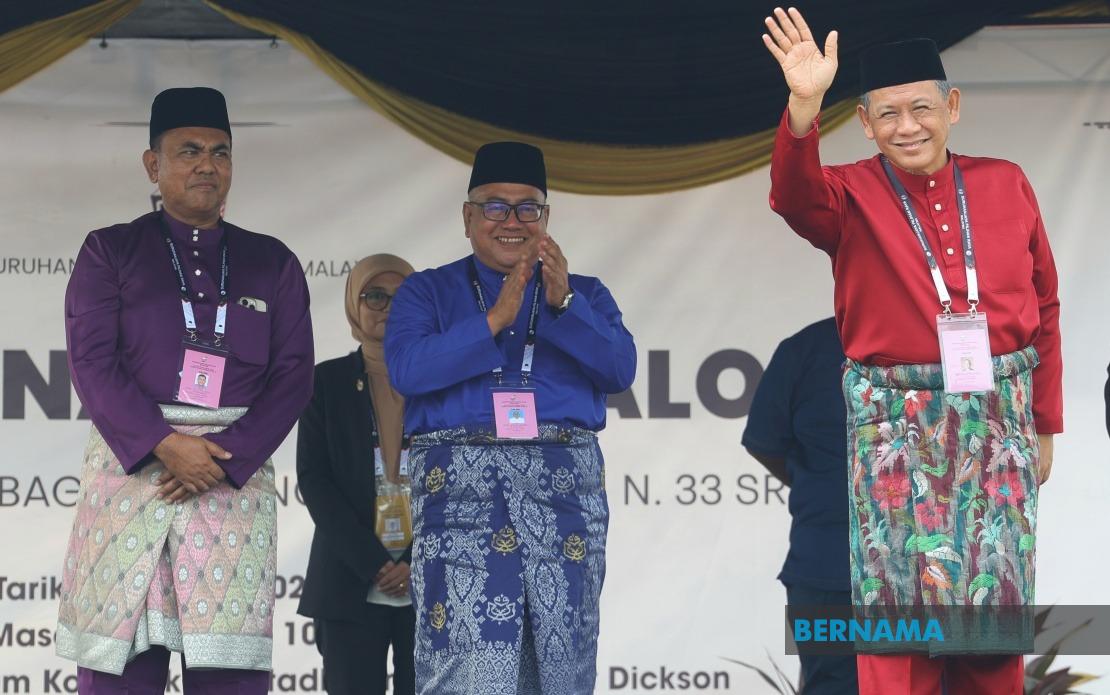
The political landscape in Negeri Sembilan is set to intensify as Menteri Besar Datuk Seri Aminuddin Harun of Pakatan Harapan prepares for a three-way contest in the Linggi constituency during the 16th state election. Nomination papers were closed on July 18 at the Port Dickson District Administration Complex Auditorium, where returning officer Nurhazelin Makli confirmed the final candidate roster. Aminuddin's position as the state's chief executive, coupled with his direct challenge from both Barisan Nasional and Bersatu, signals the intensifying fragmentation in Malaysian politics that has reshaped competition patterns across several state legislatures.
Aminuddin faces stiff opposition from incumbent Datuk Mohd Faizal Ramli, representing Barisan Nasional, as well as Bersatu's Datuk Zamri Md Said. This three-cornered fight reflects the broader reconfiguration of Malaysia's political coalitions, particularly Bersatu's evolving positioning following its entry into Perikatan Nasional. The contest is being closely observed by analysts tracking the viability of Pakatan Harapan's governance in the state and whether its message resonates beyond its core constituencies. Aminuddin's personal profile and performance as MB will be tested against challenges from two distinct political formations with different regional bases and voter appeals.
The battle for Linggi represents only one chapter in a complex electoral narrative unfolding across Negeri Sembilan's legislative constituencies. In Sri Tanjung, incumbent Dr G. Rajassekaran is defending his Pakatan Harapan seat against both Barisan Nasional's A. Achutan and newcomer Leevineshwaraan Murugan, fielded by Bersatu. The involvement of new candidates suggests organisational changes and renewed energy among competing parties seeking to capture the growing urban and semi-urban electorate in these constituencies. Each party appears to be investing resources in constituencies where demographic shifts favour their respective strategic positioning.
The Lukut seat presents a different configuration, with Pakatan Harapan incumbent Choo Ken Hwa confronting Perikatan Nasional's Sathes Kumar Nilameham and independent candidate Teo Seng Lee. The emergence of independent candidates across multiple constituencies reflects voter sentiment regarding the perceived limitations of traditional party structures and a desire for alternative representation. This trend underscores evolving electoral dynamics where personality, local governance records, and direct constituent relationships increasingly influence voting behaviour independent of macro-political coalitional shifts.
Bagan Pinang presents perhaps the most ideologically fractured contest, with PAS incumbent Abd Fatah Zakaria defending against Nasir Raman from Pakatan Harapan and Bersatu's Sheikh Junaidy Jamaludin. This configuration highlights how Malaysia's Islamic political constituencies have become contested terrain, with different organisations claiming legitimacy in representing Muslim and conservative voter interests. The presence of all three blocs in this single seat demonstrates the depth of political polarisation and the absence of clear dominant coalitions at the state level.
In contrast, the Chuah seat presents a binary contest between Pakatan Harapan's Yew Boon Lye and Barisan Nasional's Pau Jeou Ching. Straight fights between the two traditional Malaysian political formations remain relatively rare in contemporary elections, reflecting how other players have successfully fragmented the electoral landscape. Such contests tend to mobilise voters more clearly around established party brands and policy platforms, potentially revealing underlying voter sentiment unencumbered by third-party interventions.
The Election Commission has designated August 1 as polling day for the state election, with early voting scheduled for July 28. This timeline provides political parties and candidates approximately two weeks for campaigning and voter engagement. Early voting provisions recognise the needs of military and police personnel stationed away from their constituencies, institutional arrangements that have become standard in Malaysian electoral administration. The availability of early voting options typically benefits better-organised and well-resourced campaigns capable of managing logistics across multiple voting venues.
Electoral participation is expected to be substantial, with 889,490 registered voters across Negeri Sembilan eligible to cast ballots. This figure comprises 867,151 ordinary voters, alongside 16,884 military personnel and their spouses, and 5,455 police personnel and their families. The voter base has likely expanded since the previous state election, reflecting population movements and new voter registration drives, factors that typically advantage opposition parties seeking to broaden their coalitional base. The demographic composition of eligible voters—the preponderance of civilian voters relative to security force personnel—suggests that civilian concerns around economic management and service delivery will dominate campaign discourse.
The Negeri Sembilan state election arrives at a significant juncture for Malaysian politics. Having experienced federal governance transitions since 2018, the state electorate will assess whether Pakatan Harapan's stewardship at the state level has delivered tangible benefits justifying continued mandate renewal. Simultaneously, Bersatu's presence across multiple constituencies raises questions about voter receptivity to coalition flexibility and whether swing voters perceive new partners as preferable alternatives to established configurations. The outcomes in constituencies like Linggi—where high-profile political figures directly contest—will offer valuable indicators regarding voter sentiment on contemporary political alternatives and coalition viability.
The competitive landscape also reflects Negeri Sembilan's changing demographic and economic profile. The state's proximity to Kuala Lumpur and the Selangor border creates economic interdependencies that transcend state boundaries, potentially moderating traditional state-level political loyalties. Younger, increasingly urbanised voter cohorts may prioritise economic opportunity and governance quality over established party loyalties, creating openings for new candidates and reshuffled coalitions. The presence of independent candidates and newcomers across constituencies suggests both established parties and emerging challengers are attempting to capture these shifting voter preferences, making the August 1 poll a critical indicator of Malaysia's contemporary political trajectory.

