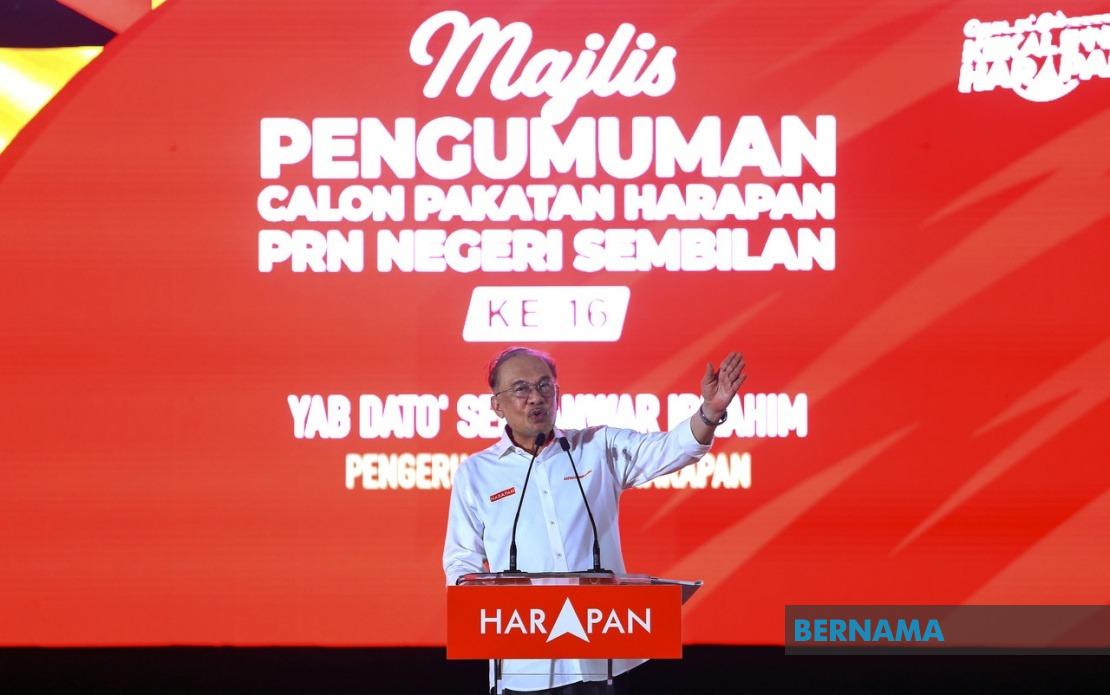
Pakatan Harapan has locked in two of its heavyweight candidates for the forthcoming Negeri Sembilan state election, with Menteri Besar Datuk Seri Aminuddin Harun switching constituencies to contest the Linggi seat while opposition DAP leader Anthony Loke gears up for a fourth consecutive term in Chennah. The announcement came during a formal candidate unveiling ceremony in Kuala Pilah on July 14, where Prime Minister Datuk Seri Anwar Ibrahim, serving as PH chairman, confirmed the nominations before a gathering of coalition officials and thousands of party supporters.
Aminuddin's nomination marks a significant strategic repositioning ahead of the 16th state election. The seasoned politician, who has represented the Sikamat constituency continuously since 2008—securing four consecutive victories—will now seek to consolidate PH's hold over the Linggi division. His credentials as both state PH chairman and the state's chief administrator position him as a marquee candidate capable of rallying voter support across multiple demographic segments in a constituency where the coalition seeks to strengthen its foothold.
The shift in Aminuddin's electoral base reflects broader tactical considerations within PH's campaign planning. While Sikamat has been reliably held by the coalition, the decision to deploy him in Linggi signals confidence that PH can expand its territorial control in Negeri Sembilan despite an increasingly competitive political landscape. The move also suggests internal confidence that the Sikamat seat can be successfully defended by another coalition candidate, indicating depth in PH's bench strength across the state.
Meanwhile, Loke's continuation in Chennah underscores DAP's entrenchment in its stronghold on the western flank of Negeri Sembilan. The 56-year-old has become synonymous with the constituency, having maintained an unbroken parliamentary presence there since his first election in 2013. His defence of the seat carries symbolic weight for the broader coalition, as established incumbents represent stability and voter confidence in PH's governance narrative.
Loke's tenure in Chennah has been characterised by consistent constituent engagement and infrastructure advocacy, making him a familiar figure to voters who have experienced his tenure across multiple election cycles. His re-nomination suggests PH strategists believe his personal vote and organisational machinery remain formidable enough to withstand opposition pressure, even as broader state-level dynamics shift. A successful fourth term would extend his political longevity and potentially position him for enhanced roles within DAP's state and national hierarchies.
The formal announcement was orchestrated with considerable ceremony, reflecting PH's strategic messaging about continuity and experienced leadership. The gathering included Amanah president Datuk Seri Mohamad Sabu, PH communications director Datuk Seri Fahmi Fadzil, and coalition election director Datuk Seri Amirudin Shari, signalling that these nominations carried the imprimatur of the coalition's top echelon. The presence of thousands of supporters was designed to project momentum and grassroots enthusiasm heading into the campaign proper.
For Malaysian politics, these nominations reflect a broader pattern of established coalitions relying on tested incumbents to maintain territorial control. The Negeri Sembilan election will serve as a significant test of PH's electoral resilience in a state where it has held executive power but faces determined opposition challenge. The outcomes in both Linggi and Chennah will provide valuable metrics for assessing coalition strength ahead of any future federal elections.
The Negeri Sembilan state election carries particular importance for PH's political calculations. The state represents a bellwether of coalition performance in peninsular Malaysia's heartland, and outcomes here will reverberate through party corridors in Putrajaya. Aminuddin's repositioning and Loke's defensive stand represent the coalition's preferred narrative—aggressive expansion while protecting established bastions—though execution in the field will ultimately determine whether this strategy translates into electoral gains.
From a Southeast Asian perspective, the Negeri Sembilan contest exemplifies Malaysia's democratic practice of regular electoral renewal and leadership accountability at the state level. The nomination of experienced administrators like Aminuddin alongside seasoned opposition figures like Loke demonstrates the competitive nature of Malaysian democracy, where multiple coalitions vie for voter support through both grassroots organising and high-profile candidature strategies. The transparency of the nomination process, conducted publicly through formal announcements attended by media representatives, reflects democratic norms that have become embedded in Malaysian electoral practice over recent decades.

