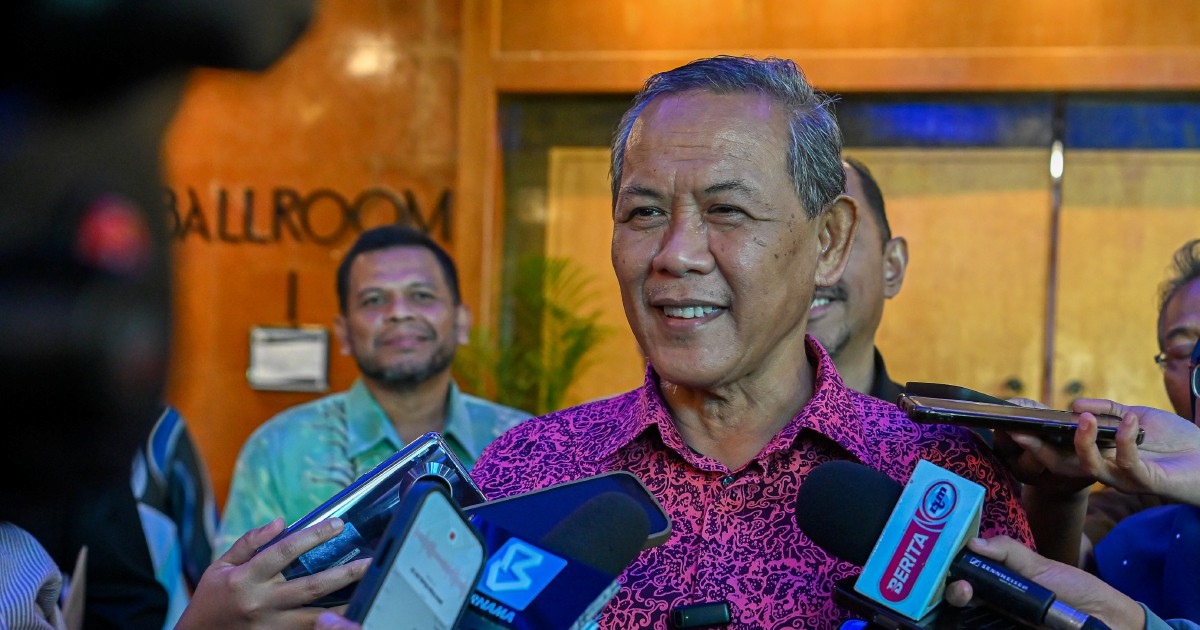
Negri Sembilan Menteri Besar Datuk Seri Aminuddin Harun has made a pointed appeal to the electorate not to allow the Linggi River's persistent flooding to become a political football in the approaching 16th state election, instead urging them to evaluate the administration's concrete initiatives aimed at tackling this long-standing regional challenge. Speaking in Seremban, Aminuddin emphasized that voters should base their electoral decisions on the substance of the government's response to the chronic inundation problem rather than permitting opponents to weaponize the issue for electoral advantage.
The Linggi River has plagued communities along its course with repeated seasonal flooding, affecting agricultural productivity, disrupting commerce, and creating untold hardship for residents who live in vulnerable low-lying areas. The issue resonates deeply across Negri Sembilan, particularly in districts where flooding has become almost cyclical, destroying crops, damaging infrastructure, and displacing families. For years, the recurring disaster has become emblematic of governance failures and environmental mismanagement, making it a potent campaign issue whenever state or federal elections loom on the horizon.
Aminuddin's intervention appears designed to reset the narrative around the government's response by redirecting public attention toward the mitigation infrastructure and engineering solutions already in motion. By framing the flood crisis as fundamentally an operational and technical matter rather than a political one, the Menteri Besar is attempting to insulate the administration from opposition attacks that invariably blame inadequate planning and negligent oversight. This rhetorical pivot is common in Malaysian politics—attempting to neutralize an issue by recharacterizing it as apolitical when the opposite is transparently obvious.
The underlying tension in Aminuddin's statement reflects a broader reality: citizens affected by flooding do not distinguish between technical solutions and political responsibility. When communities endure repeated inundation, they inevitably judge the government that oversees them as culpable for failing to prevent or adequately prepare for predictable seasonal hazards. The call not to politicize the issue thus rings somewhat hollow to those wading through floodwaters, as the very existence of the problem is itself a political question about resource allocation, planning priorities, and administrative competence.
The mitigation works referenced by Aminuddin likely encompass a range of interventions, potentially including riverbank reinforcement, drainage system improvements, flood barrier construction, or watershed management initiatives. Such projects typically involve substantial capital expenditure and extended implementation timelines, and their effectiveness depends on rigorous engineering, proper maintenance, and adequate operational funding. Whether these measures will materially reduce flood risk in the affected areas remains a question that will be tested in the coming monsoon seasons.
The political calculus surrounding the Linggi flooding problem is particularly sharp because Negri Sembilan has a competitive electoral landscape where even modest swings in support across a few constituencies can determine overall control of the state assembly. Opposition parties will naturally emphasize the government's historical inability to solve the problem as evidence of systemic failure, while the ruling coalition will highlight any investments in mitigation infrastructure as proof of commitment and competence. In this context, Aminuddin's plea for a non-partisan approach appears more as an attempt to constrain opposition messaging than a genuine call for political consensus.
For Malaysian voters in affected regions, the Linggi flooding issue encapsulates broader governance concerns: whether state administrations can deliver tangible improvements to citizens' daily lives, whether elected officials prioritize public welfare or political considerations, and whether the machinery of government functions effectively to address persistent challenges. The recurring nature of the floods suggests that previous interventions have been insufficient or inadequately maintained, raising legitimate questions about how current mitigation plans will prove more effective. Residents will reasonably expect to see concrete results rather than rhetorical reassurance.
From a regional Southeast Asian perspective, Linggi's struggle with chronic flooding reflects challenges facing many river systems across the broader region, where climate change is intensifying precipitation patterns and development has often compromised natural water management systems. Malaysia's experience—both successes and failures—in managing flood risk offers instructive lessons for neighboring countries grappling with similar environmental pressures. Effective flood mitigation requires sustained cross-party commitment and long-term investment, not merely rhetoric about avoiding politicization.
The underlying scientific and engineering realities of flood prevention do not change based on electoral cycles or political positioning. The Linggi River will continue to surge in the coming monsoon seasons regardless of how politicians characterize the issue, and communities will judge their leaders primarily on whether the waters stay out of their homes and fields. Aminuddin's call for voters to focus on mitigation efforts is reasonable, but only if those efforts demonstrably reduce the frequency and severity of flooding. Until that occurs, affected residents will understandably view the flood crisis as fundamentally a matter of political accountability and administrative performance.

