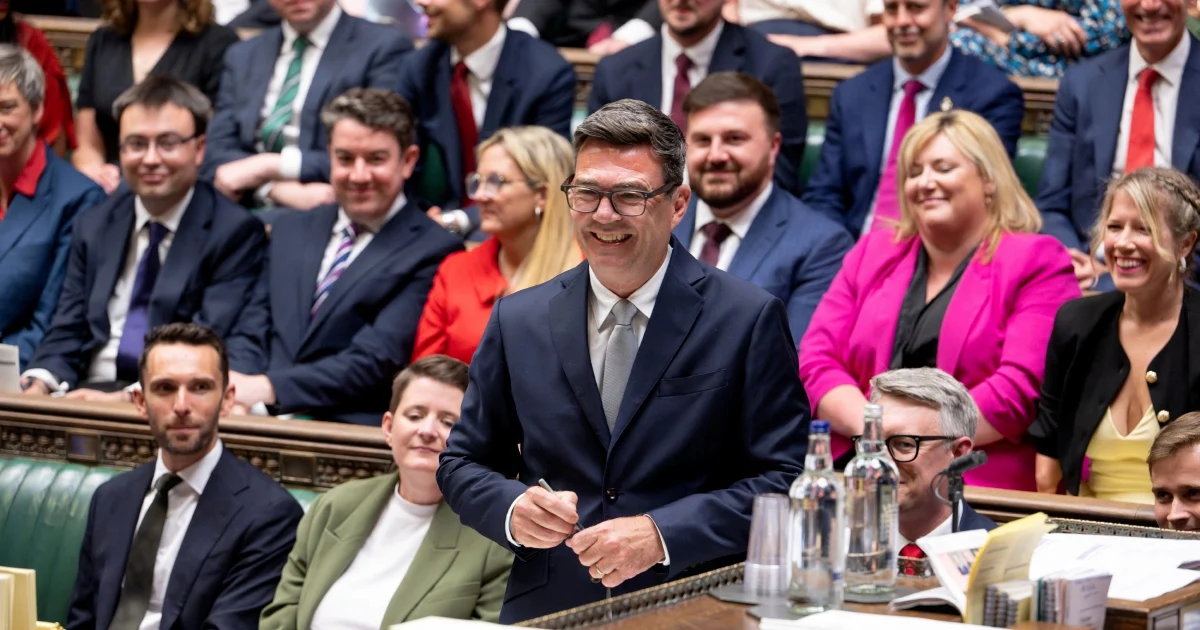
Andy Burnham's position within Britain's Labour Party has undergone a dramatic shift following the sudden announcement of Keir Starmer's resignation as party leader. The Greater Manchester mayor, long regarded as a towering figure in northern English politics, received a rapturous reception in parliament on Monday, signalling the beginning of what many observers view as an inevitable ascent toward Number 10. The moment crystallises a political journey that has transformed Burnham from a disappointed Westminster insider into a regional strongman whose political capital appears to transcend traditional party boundaries.
Burnham's elevation reflects deeper currents running through modern British politics. Once a three-time Cabinet minister under Tony Blair and Gordon Brown, his earlier Westminster career ended in disappointment. He contested the Labour leadership twice without success, first in 2010 and again in 2015, falling short as the party opted for other candidates. These defeats might have seemed to mark the end of his national political ambitions, yet Burnham's subsequent reinvention as an urban leader has arguably strengthened rather than weakened his standing. His tenure as mayor of Greater Manchester since 2017 has positioned him as an advocate for regional devolution and northern economic renaissance, themes that resonate powerfully across post-industrial communities increasingly conscious of London's dominance over national affairs.
The nickname "King of the North" that has attached itself to Burnham captures something genuine about his political appeal. His administration has overseen infrastructure investments, negotiated devolved powers from Westminster, and championed causes—from bus services to healthcare provision—that affect the daily lives of millions in northwest England. Unlike some national politicians who regard regional roles as stepping stones, Burnham has genuinely invested in his mayoralty, building a platform that extends beyond traditional party tribalism. This regional credibility comes at a moment when Labour's national standing requires reconstruction following what many view as a disappointing period under Starmer's leadership.
The timing of Starmer's resignation creates both opportunity and complexity for Burnham's potential candidacy. Labour's membership and parliamentary party face immediate questions about succession, and the process of selecting a new leader will inevitably expose the party's internal tensions. Burnham enters such a contest as a heavyweight with genuine cross-party respect and a demonstrated capacity to govern large, complex constituencies. His northern English roots and dialect carry symbolic weight in a party that has struggled to reconnect with former strongholds in Scotland, Wales, and northern England—regions where Conservative gains in recent elections have demonstrated alarming cracks in Labour's once-secure electoral foundation.
For Malaysian and Southeast Asian observers, Burnham's potential ascendancy illustrates how regional autonomy and devolved governance can produce compelling political leaders. His success in Greater Manchester reflects a model where cities and regions exercise genuine authority over policy affecting their populations, a contrast to more centralised governance structures. The enthusiasm for Burnham's potential leadership indicates broader appetite among British voters for politicians rooted in communities beyond the London bubble, a sentiment with echoes across our region where metropolis-periphery tensions similarly shape electoral outcomes.
Burnham's policy platform, forged through his mayoral work, emphasises investment in public services, regional economic development, and reconnecting government with ordinary communities. These themes align broadly with centre-left instincts but with a distinctly northern inflection emphasising pragmatism over ideological purity. His willingness to work across party lines when negotiating devolution deals demonstrates flexibility that could prove valuable in navigating parliament's current fractured composition. Whether such pragmatism represents refreshing realism or problematic compromise likely depends on which Labour constituency one consults.
The parliamentary reception Burnham received signals confidence among colleagues that he represents a pathway back toward electoral viability. Labour's recent general election defeat, followed by what many regard as Starmer's cautious approach to opposition, has left the party searching for renewed direction and emotional connection with voters. Burnham's public profile, built on addressing tangible problems within his mayoralty rather than purely Westminster-focused positioning, offers a distinct alternative. His ability to speak convincingly about cost-of-living pressures, NHS collapse, and infrastructure decay stems from negotiating these challenges daily rather than discussing them abstractly.
Yet Burnham faces substantial hurdles in converting parliamentary goodwill into sustained support among the broader membership and electorate. His previous leadership defeats, while not disqualifying, suggest limitations in his previous national appeal. Critics may argue that his regional success, while genuine, has not required the level of compromise and coalition-building necessary to manage a national party spanning diverse ideological factions. The Labour membership that will ultimately vote on any leadership election includes activists further left than Burnham's broadly centrist positioning, and the broader electorate, having rejected Labour in recent cycles, requires convincing that a change in leader fundamentally addresses their concerns.
The months ahead will test whether Burnham's northern credentials and regional success can translate into a sustained movement toward the national leadership. His parliamentary welcome provides momentum, but transforming such moments into electoral victory requires sustained narrative development, coalition-building across party factions, and demonstrating that his regional achievements contain lessons applicable to governing the entire nation. Whether Britain's voters, having turned toward Conservative leadership in recent years, view a resurgent Labour under Burnham's potential leadership as genuinely preferable remains the paramount question shaping Westminster calculation.

