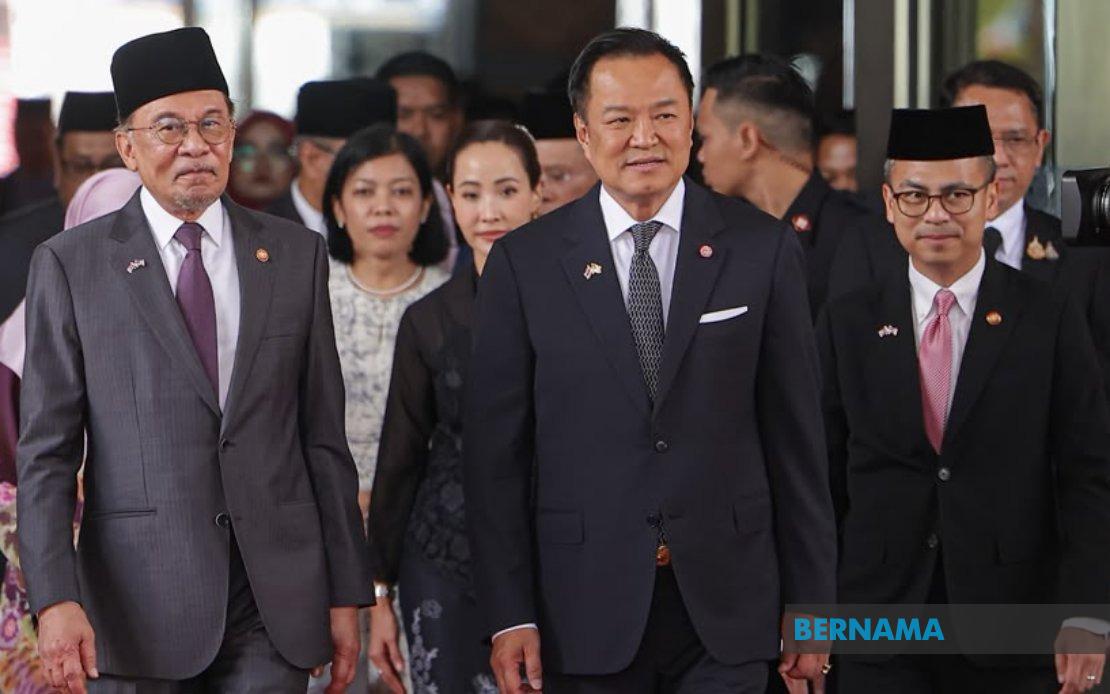
Prime Minister Datuk Seri Anwar Ibrahim and Thailand's Prime Minister Anutin Charnvirakul convened for substantive bilateral discussions on July 9 at the Perdana Putra Complex in Putrajaya, marking a high-level engagement aimed at widening the scope and deepening the substance of Malaysia-Thailand relations across multiple sectors. The meeting, part of Anutin's two-day official visit to Malaysia, reflected both governments' commitment to leveraging their geographic proximity and shared regional interests as major Southeast Asian economies navigating complex trade and security challenges.
Anutin's arrival at Kuala Lumpur International Airport at 11:11 am was marked by a formal reception by Anwar at the Bunga Raya Complex before the delegations proceeded to the capital. The ceremonial nature of the reception underscored the diplomatic significance both nations attach to this engagement, signalling to the region and international community that Malaysia and Thailand view their bilateral relationship as a cornerstone of broader ASEAN cohesion and stability.
During their discussions, the two leaders evaluated existing bilateral arrangements and charted pathways for expanded collaboration spanning several strategic domains. Trade and investment emerged as a priority area, reflecting both nations' aspirations to increase bilateral commerce and attracting regional capital flows. Border connectivity featured prominently on the agenda, a particularly salient issue given the two countries share a long land boundary where infrastructure development and cross-border facilitation directly impact economic integration and people movement. Security cooperation, encompassing transnational challenges from trafficking to cybersecurity, represented another critical dimension, as both nations face similar vulnerabilities in an era of hybrid threats.
The agricultural sector received dedicated attention through a planned Memorandum of Understanding on agricultural cooperation, to be signed during the meeting. This initiative carries special relevance for Malaysia and Thailand, both significant agricultural producers within ASEAN. Enhanced coordination in crop development, pest management, supply chain resilience and food security positioning can strengthen both economies' capacity to respond to climate variability and market disruptions affecting the broader region. Tourism collaboration also featured in discussions, as both nations seek to attract visitors and build integrated tourist circuits that distribute economic benefits across Southeast Asia. Educational exchanges and people-to-people cultural programmes further the long-term objective of cementing bilateral ties through individual-level connections that transcend government structures.
Regional and international matters of shared concern formed a broader strategic context for these bilateral conversations. Within the ASEAN framework, Malaysia and Thailand coordinate positions on critical issues ranging from the Myanmar crisis to maritime security and the South China Sea, where consensus-building remains challenging. The leaders' expected discussion of developments affecting the region through ASEAN mechanisms indicates both governments' determination to maintain the Association's centrality in regional geopolitics, even as great power competition intensifies.
The composition of delegations participating in the meeting reflected the comprehensive nature of the agenda. Malaysia's representation included Datuk Seri Fadillah Yusof, the Deputy Prime Minister overseeing energy and water transformation priorities increasingly important to both nations, alongside Foreign Minister Datuk Seri Mohamad Hasan and other senior ministers spanning transport, agriculture, home affairs, investment and trade. Thailand's delegation was similarly constituted at ministerial level, with Deputy Prime Minister Sihasak Phuangketkeow leading the Thai Foreign Ministry's participation and additional deputies representing transport, finance, and substantive portfolios including agriculture, defence and labour matters.
This ministerial depth on both sides, rather than limiting discussions to prime ministerial-level exchanges, enabled technical specialists to address sector-specific opportunities and constraints that shape bilateral cooperation in practice. Agriculture ministers from both countries, for instance, could discuss crop varieties suited to similar climatic zones, disease management protocols and potential joint research initiatives. Transport ministers could evaluate infrastructure projects spanning road, rail and maritime connectivity that would benefit both economies and strengthen regional logistics networks. The cross-sector participation thus transformed the bilateral meeting from a symbolic diplomatic encounter into a substantive working engagement where practical pathways forward could be identified.
The scheduled signing of the agricultural MOU during the meeting held symbolic and functional significance. Agriculture remains central to both Malaysia's and Thailand's economies, particularly for rural communities where farming populations remain substantial despite urbanisation trends. Enhanced cooperation signals both governments' commitment to supporting these constituencies while modernising agricultural practices. For Malaysia's smallholder farmers, knowledge exchange with Thai counterparts experienced in high-value crop production and export marketing could yield productivity improvements. Similarly, Thai agricultural interests benefit from Malaysian expertise in agri-technology and organised farmer cooperatives.
The official luncheon Anwar was to host for Anutin and his delegation extended the engagement beyond formal ministerial sessions, creating informal settings where leaders could discuss nuanced issues and build personal rapport that facilitates future cooperation. Such informal exchanges often prove as consequential as structured negotiations in establishing the tone and trajectory of bilateral relations, as personal connections between leaders can expedite decision-making on contentious matters or encourage creative problem-solving when formal mechanisms face deadlock.
For Malaysia and Thailand specifically, and for Southeast Asia more broadly, this bilateral engagement assumes significance at a moment when regional cohesion faces pressures from great power competition and unilateral policy shifts by major partners. By reinforcing bilateral foundations through expanded cooperation in trade, security and people exchanges, Malaysia and Thailand demonstrate that ASEAN nations remain committed to advancing regional integration even as individual countries carefully navigate their diverse international relationships. The meeting thus carried implications extending well beyond bilateral cooperation, serving as a model for how ASEAN members might deepen partnerships while maintaining strategic autonomy. For Malaysian stakeholders across business, agriculture and tourism sectors, the outcomes of these discussions could translate into expanded market access, investment opportunities and collaborative ventures with Thai counterparts, generating economic benefits that ripple through broader supply chains and regional value networks.

