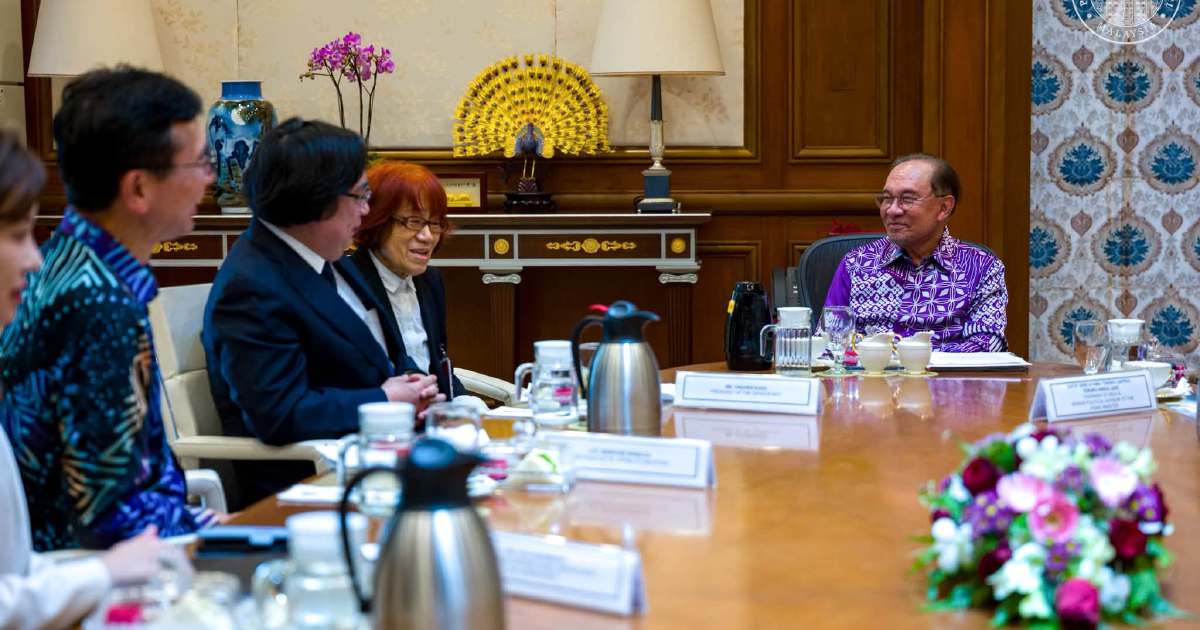
Prime Minister Datuk Seri Anwar Ibrahim received Genron NPO president Yasushi Kudo at his office in Kuala Lumpur, signalling continued commitment to deepening the longstanding bilateral relationship between Malaysia and Japan. The courtesy call brought together two key figures instrumental in shaping policy discourse in their respective nations, with both parties emphasising the importance of elevating strategic dialogue channels that have historically underpinned the partnership.
Genron NPO, a Japanese think tank and non-profit organisation, has long played an influential role in Japan's foreign policy formulation, particularly regarding Southeast Asia. Under Kudo's leadership, the organisation has expanded its engagement with regional stakeholders, positioning itself as a bridge between Japanese decision-makers and their counterparts across the Asia-Pacific. This visit to Malaysia underscores the organisation's ongoing interest in strengthening ties with one of Japan's most significant partners in the region.
The discussions between Anwar and Kudo touched upon the various dimensions of Malaysia-Japan cooperation, reflecting the multifaceted nature of the bilateral relationship. Both nations maintain robust economic linkages, with Japanese investment flowing into Malaysia across manufacturing, automotive, electronics, and services sectors. The meeting likely covered ways to sustain and expand these commercial partnerships while addressing emerging challenges in the regional landscape.
Strategic dialogue mechanisms represent a cornerstone of modern bilateral relations, allowing governments and policy influencers to exchange perspectives on regional security, trade, and geopolitical developments. By emphasising the strengthening of such channels, both Anwar and Kudo acknowledged that face-to-face engagement and open communication remain essential in navigating the complexities of the Indo-Pacific region. This commitment reflects a broader regional trend toward institutionalising dialogue at multiple levels—governmental, business, and intellectual.
The timing of this engagement carries particular significance given the current regional environment. Southeast Asia has become an increasingly contested space, with major powers competing for influence and investment. Malaysia, as a founding member of ASEAN and a nation with strategic geographic positioning along vital maritime trade routes, holds considerable importance in regional geopolitical calculations. Japan, meanwhile, has sought to deepen its engagement with Southeast Asian nations through various mechanisms, including the Quad framework and bilateral partnerships.
The relationship between Malaysia and Japan extends far beyond immediate diplomatic courtesies. Japanese companies operate across Malaysia's manufacturing heartland, contributing substantially to employment and technological transfer. In return, Malaysia provides Japan with access to regional markets and supply chains, making the economic partnership mutually beneficial. Educational exchanges also play a vital role, with Malaysian students studying at Japanese universities and Japanese language programmes flourishing in Malaysian institutions.
From a Malaysian perspective, maintaining and strengthening ties with Japan offers several advantages. Japan remains one of the world's most technologically advanced economies, and partnerships in areas such as industrial robotics, renewable energy, and digital transformation can support Malaysia's aspirations toward higher-value economic activities. Additionally, Japan's commitment to regional stability and its emphasis on rules-based order align with Malaysia's foreign policy interests.
Genron NPO's presence in these discussions adds intellectual weight to the bilateral engagement. Think tanks and civil society organisations often serve as conduits for exploring ideas and policy options that governments might not formally pursue at first instance. By engaging with such organisations, Malaysia's leadership demonstrates openness to diverse perspectives and a willingness to engage with Japan's intellectual establishment, not merely its government apparatus.
The emphasis on strengthening strategic dialogue suggests that both parties recognise the need for sustained, high-level engagement to address shared concerns. Regional issues such as maritime security, climate change, and economic resilience require coordinated responses. The Malaysia-Japan relationship provides a platform for such cooperation, whether through ASEAN mechanisms or bilateral channels.
Looking forward, the outcomes of this engagement may manifest in various forms. These could include expanded cultural and educational exchanges, enhanced business collaboration frameworks, or deeper coordination on regional issues through existing forums. The flexibility inherent in emphasising dialogue allows both nations to identify areas of mutual interest as circumstances evolve.
For Malaysian observers, this meeting exemplifies the government's proactive approach to international relations and its recognition that securing Malaysia's interests requires sustained engagement with key partners. Japan's significance as a technological leader, stable investor, and important voice in regional affairs makes the relationship strategically important. The visit by Kudo and the receptiveness shown by Anwar demonstrate that both sides view this partnership as sufficiently important to warrant continued investment in dialogue and cooperation.
As Malaysia navigates the complex terrain of regional diplomacy, maintaining strong relationships with Japan provides both practical benefits and strategic leverage. The emphasis on dialogue frameworks suggests a measured, long-term approach to bilateral relations—one that acknowledges current strengths while remaining alert to future opportunities for deepening cooperation across political, economic, and intellectual domains.

