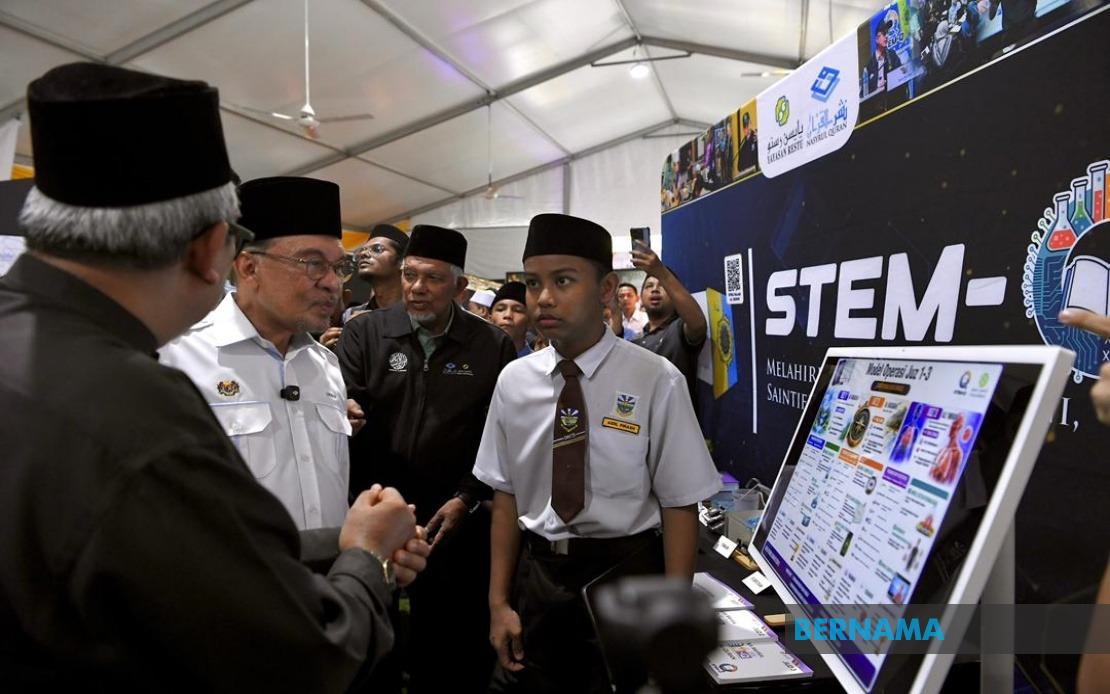
Prime Minister Datuk Seri Anwar Ibrahim has approved RM4.6 million in additional funding this year to enhance basic infrastructure across 27 Islamic educational institutions in Penang, representing a significant expansion of government support for religious education facilities in the state. The allocation roughly doubles the RM2.11 million disbursed in the preceding year, which had benefited 11 Islamic schools, underscoring the administration's commitment to accelerating development in this sector.
Anwar, who simultaneously holds the portfolio of Finance Minister, outlined the scope of the upgrading works during remarks at the National Tadabbur Perdana and Maidah Wanita MADANI Permatang Pauh programmes held at Masjid Muhajirin in Butterworth. The new funding is earmarked for comprehensive infrastructure improvements, encompassing repairs and construction of boundary walls and fences, renovation of madrasah facilities, upgrading of school buildings, construction of new kindergarten structures, and expansion of tahfiz academy capacity. This broad range of improvements reflects recognition that Islamic educational institutions require diverse physical investments to function effectively and accommodate growing enrolment.
The escalating investment signals the government's determination to prioritize religious education infrastructure as part of a wider policy framework. By increasing allocations year-on-year, federal authorities are attempting to demonstrate sustained commitment to supporting Islamic schools beyond one-off announcements. For Penang specifically, which has a substantial Muslim population and numerous established Islamic educational networks, the funding injection addresses longstanding infrastructure gaps that have constrained facility quality and capacity expansion in recent years.
Beyond capital allocation, Anwar emphasized the necessity for Islamic education to remain contemporary and responsive to technological advancement. He specifically highlighted the potential role of artificial intelligence in enhancing Quranic and Islamic studies programmes, suggesting that educational institutions should explore digital tools and computational methods to improve pedagogical outcomes. This positioning reflects a modernization agenda within the broader Islamic education sector, recognizing that maintaining relevance requires engagement with emerging technologies rather than insulation from them.
However, Anwar tempered his technology advocacy with a critical ethical framework. He cautioned that artificial intelligence must be anchored in moral principles and guided by established values rather than deployed purely for instrumental skill development. This qualification is significant, as it reflects concerns within conservative religious circles about the spiritual and ethical implications of technological systems. The Prime Minister's framing suggests that AI adoption should complement rather than replace value-based instruction, ensuring that enhanced learning tools reinforce Islamic principles rather than circumvent them through amoral efficiency.
The announcement also encompassed a broader call for civil society mobilization around religious programming. Anwar encouraged Malaysians to leverage constitutional freedoms to organize and conduct religious activities independently, citing Quran study circles, tadabbur sessions (reflective Quranic interpretation), and Islamic lectures as exemplary initiatives. This emphasis on grassroots religious engagement reflects a decentralized approach to strengthening Islamic knowledge and practice, positioning government funding as complementary to community-led efforts rather than the sole driver of religious education development.
For Malaysian policymakers, Anwar's focus on Penang carries particular significance within the broader context of federal-state relations. Penang has historically maintained distinct approaches to Islamic administration, with its state government exercising considerable autonomy over religious affairs. Federal funding announcements therefore represent opportunities for the central government to increase influence over Islamic educational standards and curricula, while simultaneously demonstrating responsiveness to constituents' religious concerns. The substantial year-on-year increase suggests this is a growth area within federal budget priorities.
The emphasis on enhancing traditional Islamic education infrastructure—madrasahs, tahfiz academies, and mosque-based facilities—also reflects recognition that these institutions remain central to community life across Malaysia. Despite rising enrollment in government schools and secular education pathways, Islamic educational institutions continue to serve millions of Malaysian families seeking religious grounding alongside academic credentials. Upgrading physical infrastructure addresses a legitimate constraint on these institutions' ability to serve their constituencies effectively.
From a regional perspective, Malaysia's experience with publicly-funded Islamic education offers models worth monitoring. Unlike some Southeast Asian nations where religious education remains largely privately funded or informal, Malaysia has developed state-supported systems combining government schools, religious schools, and mosque-based facilities. Anwar's emphasis on technological integration and values-based guidance suggests Malaysian policymakers are attempting to navigate tensions between modernization and religious authenticity—challenges relevant to Indonesia, Brunei, and other Muslim-majority societies in the region.
The funding allocation also carries implications for educational equity and access. By distributing resources across 27 institutions rather than concentrating investment in flagship facilities, the federal government is attempting to ensure that infrastructure improvements benefit diverse communities across Penang's urban and suburban areas. This distributional approach contrasts with development models that concentrate resources in major centers, potentially addressing longstanding grievances about unequal educational infrastructure investment across different regions.
Moving forward, the sustainability of such funding increases will depend on fiscal space available within Malaysia's federal budget and competing developmental priorities. If religious education funding continues expanding in real terms, it may create precedent effects across other states and policy domains. Conversely, if budget pressures force retrenchment, these investments could face vulnerability relative to other government programmes with stronger political constituencies or more demonstrable economic returns.

