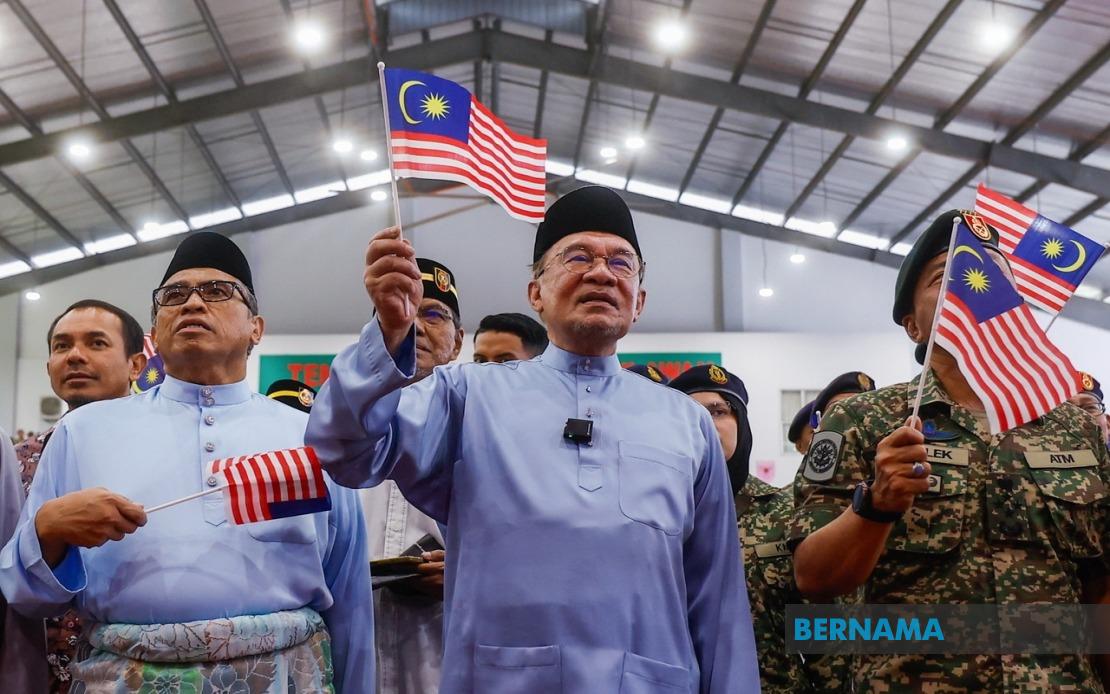
Prime Minister Datuk Seri Anwar Ibrahim has issued a forceful plea to all contesting parties in the 16th Negeri Sembilan state election to reject slander and disinformation as campaign tools, delivering his message at a public event in Port Dickson on July 24. The appeal comes against the backdrop of escalating tensions in the run-up to polling day on August 1, with the premier emphasizing that Malaysian politics must move beyond personal attacks and fabricated allegations that undermine democratic discourse.
Anwar drew on his own political trajectory to illustrate the corrosive effects of false claims, recounting that he had received a message that morning falsely attributing a statement to him about spreading propaganda among military personnel and veterans. The alleged misquote exemplifies what he described as a troubling practice of taking statements out of context, editing them selectively, and then presenting the distorted versions as authentic utterances. His frustration was evident as he characterized such tactics as symptomatic of a troubling direction for the nation's political culture, one increasingly divorced from substantive debate on governance and policy.
The Prime Minister acknowledged his own imperfections and admitted to making mistakes throughout his lengthy career in public life, even offering an apology for any statements or actions that might have caused harm. However, he drew a clear distinction between legitimate criticism and character assassination, emphasizing that while he remains open to fair scrutiny, deliberate misrepresentation crosses an ethical line that should not be tolerated in democratic competition. His remarks reflect a broader tension within Malaysian politics between the freedom necessary for robust electoral contests and the responsibility of candidates to maintain basic standards of truthfulness.
The event highlighted the involvement of senior government figures in supporting the campaign narrative. Present alongside the Prime Minister were Chief Secretary to the Government Tan Sri Shamsul Azri Abu Bakar, Deputy Defence Minister Adly Zahari, Chief of Defence Forces General Tan Sri Malek Razak Sulaiman, and Army chief General Tan Sri Azhan Md Othman. The attendance of military leadership lent weight to Anwar's assertion that false claims were being circulated about his interactions with defence and security personnel, and underscored the government's concern that misinformation campaigns were targeting sensitive institutions.
Beyond the immediate controversy, Anwar utilized the occasion to reflect on the pattern of unfounded accusations he has faced over decades in politics. He expressed hope that his experiences might serve as a cautionary tale for others, encouraging political actors to recognize the long-term damage inflicted by resorting to slander and distortion. This personal narrative positions the appeal not merely as a tactical advantage for the incumbent but as a principled stand on the standards that should govern electoral behaviour. For Malaysian voters observing the campaign, Anwar's willingness to reference his own suffering at the hands of alleged falsehoods may resonate as either genuine concern or strategic positioning, depending on individual political perspectives.
Anwar also used the platform to reinforce the government's expectations of the civil service during the election period. He called on state and federal bureaucrats to maintain their commitment to supporting the administration's reform agenda while continuing to prioritize national peace and stability. This message is particularly significant in Malaysia's context, where the neutrality and professionalism of the public sector during elections has historically been a point of contention between ruling and opposition coalitions. By emphasizing that implementation of government policies must continue uninterrupted, Anwar signalled that the election, while important, should not be allowed to derail ongoing administrative functions.
Pakatan Harapan, the ruling coalition, is contesting all 36 state seats in Negeri Sembilan under a carefully negotiated distribution of nominations. The coalition's three component parties—PKR, DAP, and Amanah—are fielding 16, 11, and nine candidates respectively. This allocation reflects the relative strength and influence of each party within the coalition and suggests that despite public calls for clean politics, the coalition itself has had to engage in internal negotiations and horse-trading to determine candidacies. The composition of the slate indicates PKR's dominance within the coalition framework, consistent with Anwar's leadership role as Prime Minister.
The electoral timeline adds urgency to Anwar's appeal. Early voting has been scheduled for July 28, with the main polling day set for August 1, leaving less than a week from the Prime Minister's statement for campaigns to either heed or ignore his call for restraint. The compressed campaign window means that any shift toward cleaner discourse would need to happen immediately and visibly, or the final days of campaigning could still be dominated by the kind of allegations Anwar criticized. The timing also suggests that the government may be concerned about the momentum of negative campaigning and hopes to reset the tone before the final push to election day.
For Malaysian voters in Negeri Sembilan and observers nationwide, Anwar's intervention raises questions about the effectiveness of appeals for civility when structural incentives in electoral politics often reward sensationalism and controversy. The state election represents a test case for whether Malaysian politics can maintain higher standards of discourse, or whether the competitive pressures of winning elections inevitably push parties toward the tactics the Prime Minister condemned. The result in Negeri Sembilan will provide early indicators of whether such appeals have genuine traction or remain largely rhetorical gestures.
The broader implications for Malaysian democracy extend beyond the immediate state contest. If slander and misinformation are becoming normalized in state-level campaigns, they are likely to intensify in federal electoral cycles. Anwar's call for restraint can be read as an attempt to establish norms that might benefit his coalition going forward, particularly given that ruling coalitions typically face higher scrutiny and more aggressive opposition tactics. Conversely, it can be understood as a genuine expression of concern about the degradation of political discourse in a nation where democratic institutions remain relatively young and require continuous reinforcement of democratic values.
Ultimately, the success of Anwar's message will depend not on his rhetoric alone but on whether political parties across the spectrum choose to embrace more responsible campaign practices. The Prime Minister's challenge to all parties to refrain from slander and false information represents an important moment in Malaysia's electoral evolution, one that tests whether the nation's political leaders are willing to place the health of democratic institutions above short-term electoral advantage.

