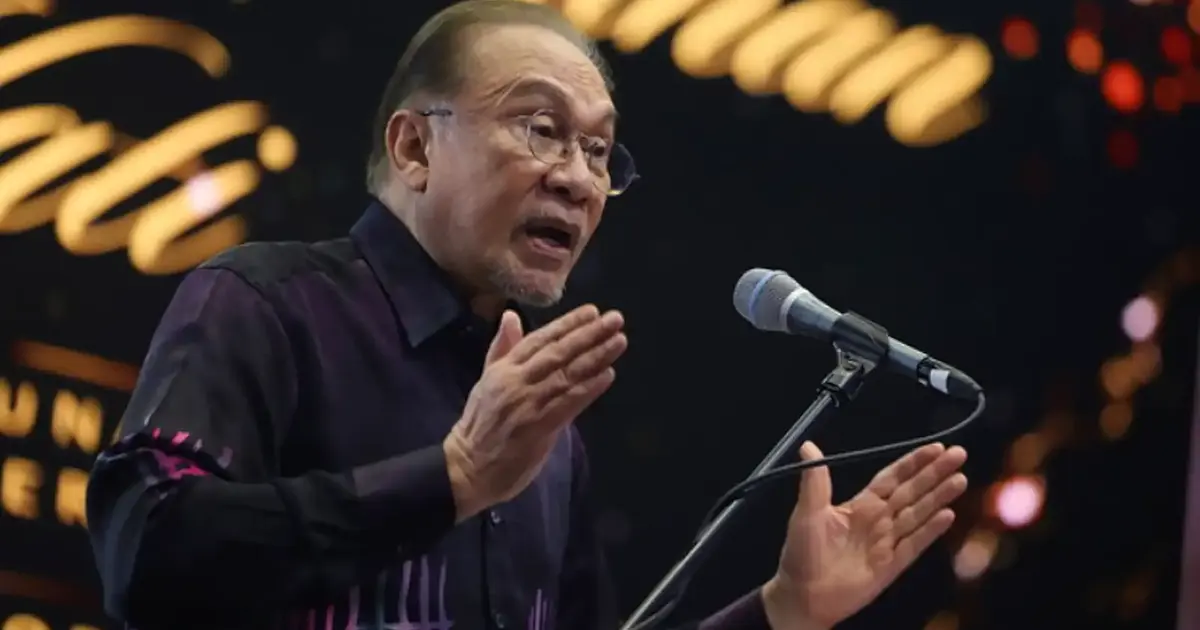
Prime Minister Anwar Ibrahim has issued a call for national unity, urging Malaysians to disregard inflammatory rhetoric emanating from certain political leaders and to recognize ethnic diversity as a cornerstone of the country's enduring resilience. Speaking to the broader Malaysian audience, Anwar emphasized that the multicultural fabric binding the nation together has historically served as a competitive advantage rather than a liability, positioning the rejection of hate speech as essential to preserving social cohesion.
The appeal comes at a time when political discourse in Malaysia has occasionally been marked by divisive statements that seek to weaponize cultural and religious identity for electoral gain. By framing diversity not merely as a neutral characteristic but as an active strength, Anwar's statement attempts to reorient the national conversation toward constructive engagement across communal lines. This approach reflects a deliberate strategy to differentiate his administration's vision from that of rival political camps that may rely on more polarizing messaging.
Malaysia's success as a modern economy rests significantly on its ability to harness the talents and contributions of its Malay, Chinese, Indian, and indigenous communities. Each demographic group has historically brought distinct skills, entrepreneurial energy, and cultural perspectives that have collectively propelled the nation's development. When political leaders deliberately amplify grievances or resort to inflammatory language targeting specific ethnic or religious groups, they risk undermining the tacit social contracts that have allowed Malaysia to function as a multireligious, multiethnic state despite periodic tensions.
The Prime Minister's intervention suggests an awareness that certain rhetorical trends have crossed thresholds that concern the highest levels of government. Whether motivated by genuine concern about social fragmentation or by the political calculus of positioning himself as the statesman above the fray, Anwar's remarks serve to publicly distance his administration from divisive tactics. For Malaysian voters and regional observers, such statements signal an intention to maintain constitutional frameworks that protect minority rights and enshrine secular governance principles.
The specific reference to "certain leaders" without naming individuals reflects a common diplomatic practice that allows the Prime Minister to make a broad point without escalating direct confrontation with named rivals. This approach enables opposing factions to either accept the message without losing face or to dismiss it as vague grandstanding, depending on their political interests. The ambiguity is deliberate, offering flexibility for multiple interpretations while still placing a marker on the side of unity rhetoric.
Regionally, Malaysia's commitment to managing ethnic diversity peacefully holds implications beyond its borders. Southeast Asian nations including Singapore, Thailand, and Indonesia grapple with similar dynamics of plural societies navigating identity politics in democratic contexts. How Malaysia handles these challenges—or fails to do so—influences perceptions of whether multiethnic democracies can truly function without descent into majoritarian overreach or minority marginalization.
Historically, Malaysia's founding social contract, articulated at independence, reflected a bargain whereby the indigenous Malay-Muslim majority accepted equal citizenship for non-indigenous minorities in exchange for provisions favouring Bumiputera status and Islam's constitutional position. This arrangement, while imperfect and constantly renegotiated, has provided a framework within which diverse communities have coexisted. Violations of this understanding through inflammatory rhetoric—whether from Malay-Muslim leaders seeking to mobilize conservative constituencies or from non-Bumiputera politicians appealing to voters feeling sidelined—threaten the stability this framework provides.
Anwar's invocation of diversity as a strength rather than a burden also carries economic weight. Multinational investors, skilled diaspora communities, and international partners view ethnic harmony as a prerequisite for stable operations and long-term commitments. Nations that become perceived as ethnically fractious or religiously intolerant face capital flight, talent drain, and reduced foreign direct investment. By publicly championing unity, the Prime Minister signals to both domestic and international audiences that Malaysia intends to remain a predictable, cohesive market despite inevitable political disagreements.
The statement equally reflects internal party considerations. Anwar's own coalition, which encompasses multiple ethnic-based parties and non-communal formations, depends on maintaining sufficient interethnic cooperation to govern effectively. Should divisive rhetoric become normalized or should voters increasingly fragment along strict ethnic lines, his governing coalition's mathematical advantage could erode. Thus, calming divisive rhetoric serves both principled governance aims and practical political interests.
Moving forward, the true test of such statements lies in implementation. Rhetoric condemning hate speech carries weight only when backed by government action—whether through educational initiatives promoting interfaith understanding, enforcement of laws against incitement, or deliberate inclusion of minority voices in policymaking processes. Malaysian civil society organizations, religious leaders from both Muslim and non-Muslim communities, and opposition parties will likely scrutinize whether Anwar's government translates these words into consistent, measurable actions that reinforce cohesion across communal boundaries.

