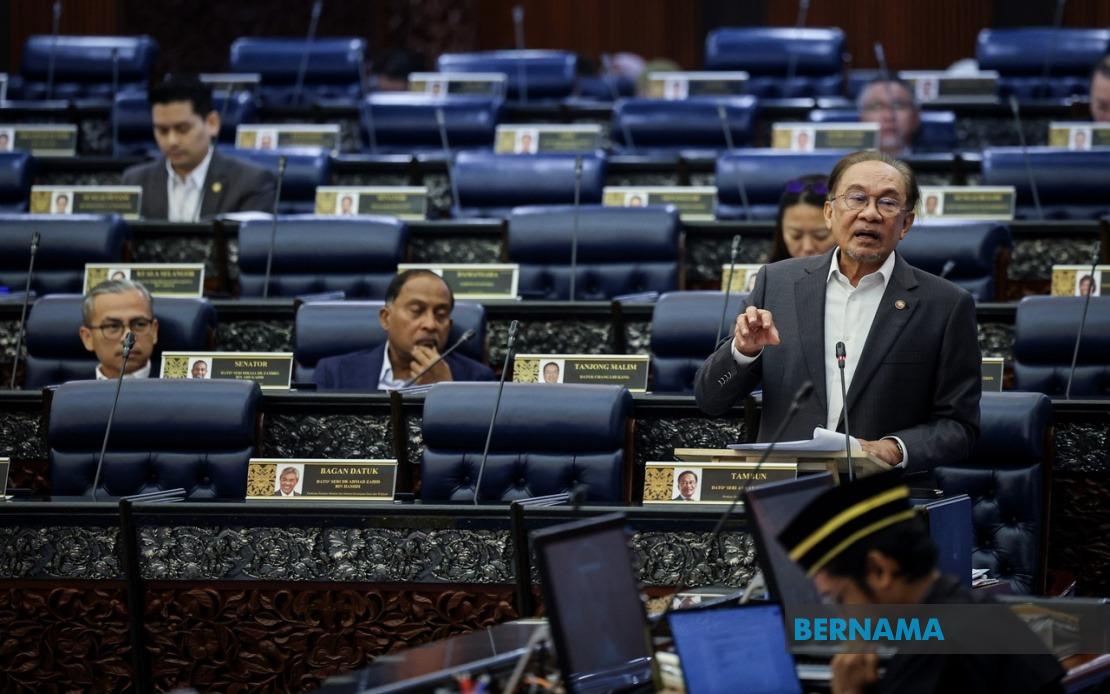
Prime Minister Datuk Seri Anwar Ibrahim moved swiftly on Wednesday to defuse controversy surrounding his public comments on the Johor state election's polling schedule, insisting during parliamentary proceedings that he had neither sought to undermine the Election Commission's authority nor ventured into electoral interference. Speaking in the Dewan Rakyat during Minister's Question Time, Anwar reframed his earlier remarks about Sunday voting as a matter of practical observation rather than political pressure, emphasizing the EC's complete autonomy in setting election dates regardless of his personal preferences.
The Prime Minister's clarification came after opposition figure Ahmad Fadhli Shaari from Pasir Mas raised parliamentary questions about media reports documenting Anwar's campaign trail comments favouring Sunday polling over the Saturday date the EC had ultimately chosen for the Johor contest. Anwar's intervention to address the matter directly reflects sensitivity around perceptions of executive overreach in electoral administration—a concern that resonates across Southeast Asia's democracies where the independence of electoral bodies remains a touchstone of democratic credibility.
Central to Anwar's explanation was the specific circumstance of Malaysian cross-border workers in Singapore. He outlined that because many of the estimated hundreds of thousands of Malaysians employed across the causeway work half-day Saturdays, a Sunday voting arrangement would theoretically simplify their return journey home to cast ballots. This practical reasoning, Anwar suggested, had motivated his public musing rather than any desire to dictate electoral logistics. His framing attempted to distinguish between offering an observation grounded in logistical reality and presuming to override institutional decision-making, a distinction he believed warranted clearer public understanding.
Yet the incident underscores broader tensions within Malaysia's electoral framework. The EC functions as a constitutionally independent body with explicit authority over polling logistics, yet prime ministerial commentary on electoral matters—particularly when voiced during campaign periods—inevitably carries weight beyond ordinary public discourse. Anwar's parliamentary statement suggests awareness of this dynamic, prompting him to insert clarifying language that his remarks "should not be construed as interference."
The opposition's parliamentary questioning also probed whether Malaysia might formally coordinate with Singapore's government on voting facilitation for its citizens. Anwar flatly rejected this trajectory, asserting Malaysia's traditional adherence to non-interference in foreign electoral processes and conversely expecting reciprocal respect for Malaysian sovereignty over its own elections. Even as he acknowledged exemplary bilateral relations with Singapore, including cordial personal ties with Prime Minister Lawrence Wong, Anwar drew a categorical line: electoral administration remained firmly within Malaysia's exclusive domain.
Instead, Anwar explained that informal coordination had already occurred at the corporate level. Singapore-based companies employing Malaysian workers had been advised that Malaysia would facilitate employees taking time to return home for voting purposes, representing a pragmatic accommodation achieved through business-to-business channels rather than state-to-state negotiation. This distinction carries significance for bilateral relations, particularly given Singapore's historical sensitivities regarding any perception of external influence over its governance structures.
The Johor election itself represents a meaningful political moment in Malaysia's devolved federal structure. State-level contests shape regional political trajectories while testing party machinery and messaging strategies, making them consequential for overall coalition dynamics. The timing and logistics of such elections thus hold genuine political weight, explaining why Anwar's comments attracted scrutiny from parliamentarians sensitive to proper institutional boundaries.
Moreover, the cross-border worker dimension reflects broader Southeast Asian realities. Labour mobility across the region—whether Malaysians in Singapore, Indonesians in Malaysia, or workers traversing other borders—creates practical friction between electoral participation rights and logistical constraints. Countries managing diverse diaspora populations often face similar tensions between accommodating voter accessibility and maintaining administrative coherence. Anwar's public grappling with this challenge, though framed as personal observation rather than policy, signals recognition of evolving electoral participation patterns across the region.
The parliamentary exchange also reveals internal opposition vigilance regarding executive overreach. While Anwar commands a coalition majority, opposition parliamentarians remain attentive to instances where executive commentary might subtly influence ostensibly independent institutions. In multi-ethnic Malaysia's complicated political landscape, maintaining demonstrable respect for institutional independence carries legitimacy weight that extends beyond formal legal requirements. Anwar's preemptive parliamentary clarification appears calibrated to address precisely these concerns before they metastasize into broader credibility questions.
Looking forward, the incident illustrates delicate calibration required of elected leaders navigating independent regulatory bodies. Anwar's clarification attempts to preserve both his credibility as Prime Minister willing to engage substantive policy discussions and the EC's independence as an institutional actor. Whether this distinction holds public persuasiveness likely depends on how Malaysian media and civic observers assess the remarks' original context and intent. The broader principle—that electoral administration requires insulation from executive pressure—remains universally accepted across democracies, even as specific applications generate legitimate debate about where neutral observation ends and inappropriate influence begins.

