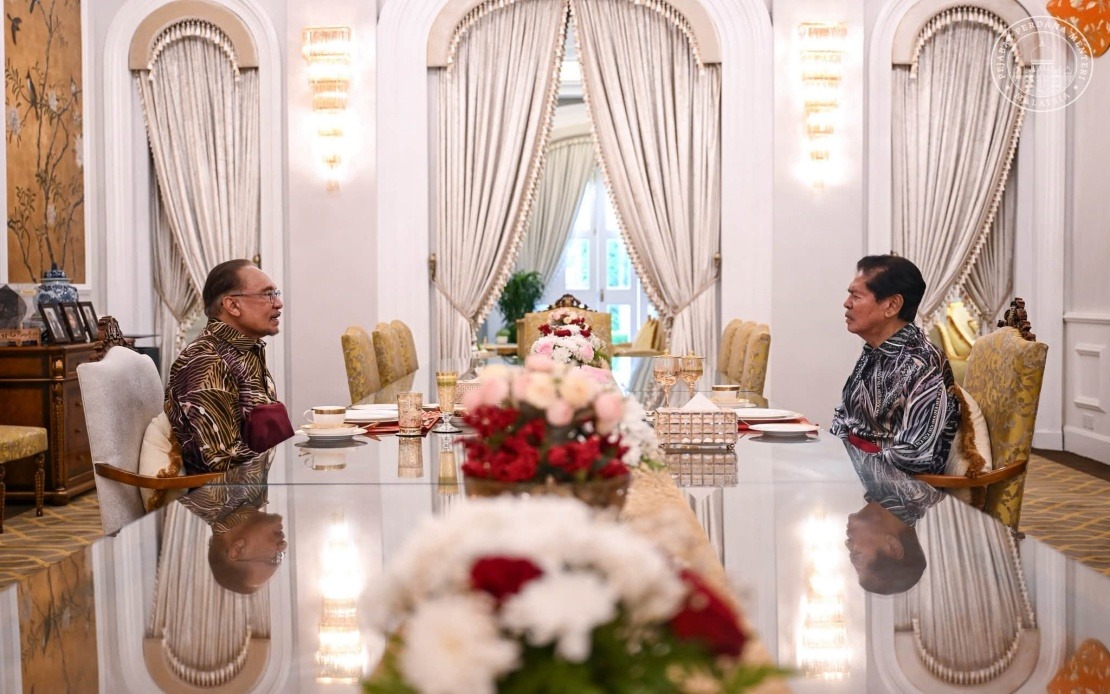
Prime Minister Datuk Seri Anwar Ibrahim brought his two-day working visit to Penang to a formal close on August 29 with an afternoon tea reception hosted by State Governor Tun Ramli Ngah Talib at the gubernatorial residence, Seri Mutiara. The occasion marked the culmination of an intensive schedule that showcased federal engagement with the northern state across multiple policy and community initiatives.
Through a Facebook statement, Anwar characterised the meeting as instrumental in deepening the institutional relationship between Kuala Lumpur and Penang's state government. He emphasised that the gathering reaffirmed mutual dedication to advancing Penang's economic and social agenda while maintaining the welfare of residents as a shared priority. Such messaging underscores the administration's broader push to position federal-state coordination as foundational to Malaysia's development trajectory.
Governor Ramli responded warmly to the occasion, describing it as a valuable opportunity to discuss contemporary issues affecting both Penang and the nation at large. His remarks highlighted the ceremonial and substantive dimensions of the meeting—a format typical of high-level bilateral engagements that combine protocol with policy discussion. The Governor's willingness to host the Prime Minister at his official residence reflected customary courtesies extended during state visits by national leaders.
A particularly human element emerged when Ramli's grandson, Aldrey Alfi, participated in the reception. According to the Governor, the young boy engaged the Prime Minister with questions and received cordial responses, creating an informal moment that Ramli noted in his social media post. Such family-inclusive dimensions of formal functions offer Malaysian leaders opportunities to project approachability and warmth alongside their governance roles.
Anwar's two-day sojourn to Penang was densely scheduled, reflecting the typical pattern of prime ministerial visits designed to maximise media visibility and policy announcements. His itinerary encompassed the Permatang Pauh Entrepreneur Revival Programme, a community economic initiative targeting small and medium-sized enterprises in the parliamentary constituency. The programme aligns with the federal government's MADANI framework, which prioritises inclusive growth and entrepreneurial development across Malaysia's regions.
The visit also included participation in the 15th Malaysia Scout Jamboree, a major youth mobilisation event that draws scouts from across the country. Prime ministerial attendance at such gatherings serves multiple purposes: reinforcing national youth development priorities, demonstrating commitment to civil society organisations, and generating favourable media coverage. Scouting movements maintain historical significance in Malaysian civic culture and remain platforms for inculcating national values among young citizens.
Additionally, Anwar's schedule featured the MADANI Sahabat 2026 National Day Countdown Programme, an initiative framed around the government's flagship development agenda. The MADANI framework—encompassing dignity, resilience, prosperity, and generosity—has become the lexicon through which the current administration articulates its policy direction. By launching preparatory activities for the 2026 National Day celebrations, the government signals continuity of its thematic priorities while mobilising community participation.
Penang holds particular strategic importance within Malaysian politics and economics. As the nation's second-largest manufacturing hub and a major tourist destination, the state's trajectory substantially influences regional economic performance. The state government, led by its administration, maintains distinct political dynamics from the federal level, making high-level visitations by Prime Ministers opportunities for affirming unity amid Malaysia's federalist structure. Anwar's emphasis on federal-state cooperation likely aimed to project harmonious governance across administrative boundaries.
The Governor's reference to the visit as strengthening bonds of friendship carries symbolic weight in Malaysian political discourse, where personal relationships between national and state leaders often condition the ease with which federal-state collaboration proceeds. By formalising this connection through a gubernatorial reception, both parties signalled institutional goodwill that may facilitate coordination on development projects, resource allocation, and policy implementation.
For Malaysian observers, such high-level engagements between federal and state authorities represent the practical functioning of the nation's constitutional federalism. While Malaysia's system vests significant powers in Kuala Lumpur, state governments retain important responsibilities in areas including land administration, Islamic affairs, and local economic development. Prime ministerial visits that emphasise partnership rather than hierarchical direction suggest an administrative philosophy prioritising collaborative rather than centralised governance.
The timing and format of Anwar's visit, concluding with a formal reception at the Governor's residence, reflected contemporary conventions of Malaysian political engagement. The tea reception, as a social occasion framing substantive discussions, remains a favoured format among Malaysian elites for conducting government business while maintaining diplomatic protocol. The inclusion of family members in such settings, as evidenced by Governor Ramli's grandson's participation, humanises formal governance and projects an image of accessible leadership.
Looking forward, Penang's development agenda will likely benefit from the visibility and coordination afforded by such visits. Infrastructure projects, economic initiatives under the MADANI framework, and youth programmes depend on functional relationships between federal and state authorities. The reception at Seri Mutiara thus represented not merely ceremonial courtesy but a reaffirmation of institutional partnership necessary for translating policy ambitions into tangible outcomes for Penang's residents.

