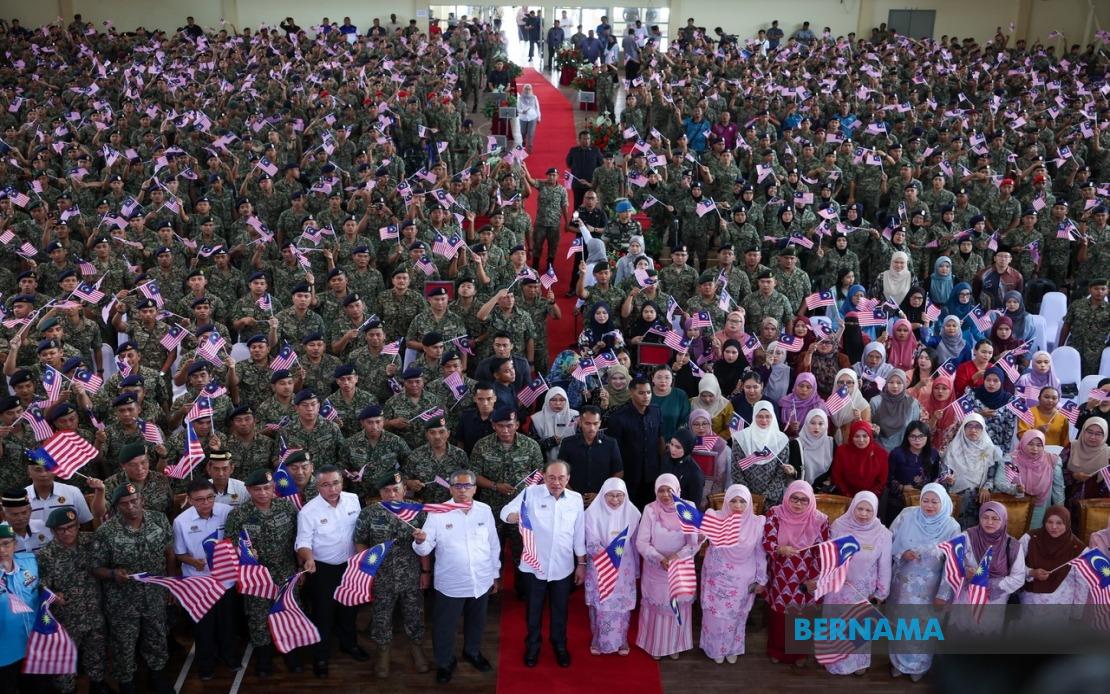
Prime Minister Datuk Seri Anwar Ibrahim moved to address mounting criticism over the government's approach to Bumiputera affairs, particularly regarding the interests of the Malay community, by highlighting a significant land initiative in the nation's capital. Speaking in Tampin on July 27, Anwar directly contested suggestions that his administration, which assumed office in 2022, has deprioritised Bumiputera protections. Instead, he framed his government's policies as fundamentally committed to strengthening the economic and land-holding position of Malays in an increasingly competitive urban landscape.
At the core of Anwar's defence is the reclamation and redesignation of the Bandar Malaysia site, a sprawling 480-acre property in Kuala Lumpur that had previously been held by Chinese interests and private companies. The Prime Minister characterised this move as a landmark correction of administrative failures under previous governments, arguing that regulations governing the land's use had been breached. His decision to recover the asset in 2023 represented, in his view, a decisive signal that his government would not tolerate violations of the legal framework protecting national interests, particularly where Bumiputera-linked entities were concerned.
The historical context Anwar provided underscores the scale of the challenge facing Malay landholding patterns in urban centres. He noted that since Malaysia's independence in 1957, no new Malay reserve land had been formally created in Kuala Lumpur, despite the capital's explosive growth and economic expansion. Instead, existing Malay-owned land parcels had been progressively sold off or transferred, reflecting broader trends of land concentration among non-Malay and foreign interests. This erosion of Malay land ownership in the capital has long been a sensitive political issue, touching on constitutional protections and the original post-independence social contract that safeguarded indigenous privileges. Anwar's framing of his action as correcting six decades of inaction adds weight to his argument that the MADANI government is reversing historical neglect.
The management structure Anwar chose for the recovered Bandar Malaysia site demonstrates his strategy of leveraging state-linked entities to preserve Bumiputera control. By placing the reclaimed land under the stewardship of Petronas and Khazanah Nasional—both major players in Malaysia's strategic economic architecture—Anwar ensured that the asset would remain under Malaysian control and, more specifically, under entities he characterised as Malay-dominated. This approach sidesteps direct government administration while maintaining the substance of state oversight. Within this broader reclaimed territory, the government formally designated 50 acres as Malay reserve land, creating one of the most valuable and strategically located Bumiputera land holdings in the nation.
The designation carries profound symbolic and practical weight. The 50-acre reserve sits within Kuala Lumpur's most expensive real estate zones, meaning the asset's potential value—whether for development, leasing, or long-term appreciation—far exceeds typical Malay reserve land elsewhere in Malaysia. This concentration of high-value land in government-controlled reserves could eventually support Bumiputera entrepreneurs, housing schemes, or commercial development, addressing long-standing grievances about unequal access to urban economic opportunities. For Malay communities and politically conscious observers, the gesture represents tangible action rather than mere rhetorical commitment to constitutional safeguards.
A crucial dimension of Anwar's account involves the role and tacit approval of his coalition partner, the Democratic Action Party (DAP). When the proposal reached the Cabinet, Anwar indicated that DAP Secretary-General Anthony Loke raised questions but ultimately accepted the rationale. Rather than framing this as compromise or capitulation by either party, Anwar presented it as a moment of rational consensus within a diverse government. His explanation to Loke focused on empirical data: Malay land holdings in Kuala Lumpur were objectively shrinking, and corrective action was administratively and constitutionally justified. Loke's acceptance, Anwar suggested, reflected an understanding that protecting Bumiputera interests was not a partisan issue but a foundational principle of the Malaysian state that partners across the political spectrum should support.
For Malaysia's federal political dynamics, this narrative matters significantly. The government comprises unlikely allies—the urban, secular, and often Bumiputera-skeptical DAP sits alongside UMNO, which has historically claimed to be the custodian of Malay and Islamic interests. Anwar's ability to present DAP as a willing partner in a Bumiputera initiative helps inoculate his government against perennial accusations that it has abandoned traditional constituencies. This positioning is particularly important as UMNO members have periodically questioned whether the Anwar-led coalition adequately protects constitutional provisions for Malays and Islam. By demonstrating Cabinet-level unity on a concrete Bumiputera action, Anwar reinforces his legitimacy as a leader capable of balancing inclusivity with constitutional fidelity.
The timing of Anwar's remarks carries additional context. Concerns about Bumiputera marginalisation have periodically resurfaced in Malaysian political discourse, especially in relation to the digital economy, foreign investment in technology, and urbanisation trends that have sometimes moved faster than Bumiputera participation mechanisms could accommodate. Some constituencies have expressed anxiety that younger Malay professionals or entrepreneurs face barriers to capital, networks, or land access relative to non-Bumiputera competitors. Anwar's emphasis on reclaiming and redesignating high-value urban land addresses these anxieties directly by demonstrating government action in one of the most economically consequential domains.
The structural design of placing the land under Petronas and Khazanah Nasional reflects broader patterns in Malaysian governance whereby the state leverages sovereign wealth and strategic asset managers to pursue policy objectives while maintaining operational distance from direct political pressures. Both entities bring professional management expertise and developmental capacity that a purely government-held reserve might lack. This approach also allows the state to develop the land commercially if needed, generating returns that could benefit Bumiputera communities through dividends, employment, or reinvestment in related programmes. The flexibility this model offers contrasts with traditional reserve land frameworks, which are typically restricted to Bumiputera ownership and are subject to rigid regulatory constraints.
For Southeast Asian observers watching Malaysia's approach to indigenous and ethnic economic protections, the Bandar Malaysia initiative illustrates how a multiethnic democracy can employ strategic asset recovery and land designation to address historical imbalances without dismantling core institutional relationships. Anwar's framing emphasises legality—regulations were violated, land was reclaimed—rather than appeals to ethnic primacy or anti-foreign sentiment, a rhetorical choice that attempts to position the action as technocratic rather than exclusionary. Whether this narrative persuades skeptics who question the durability or adequacy of Bumiputera protections remains an open question, but the tangible designation of premium urban land represents a departure from purely rhetorical commitment.

