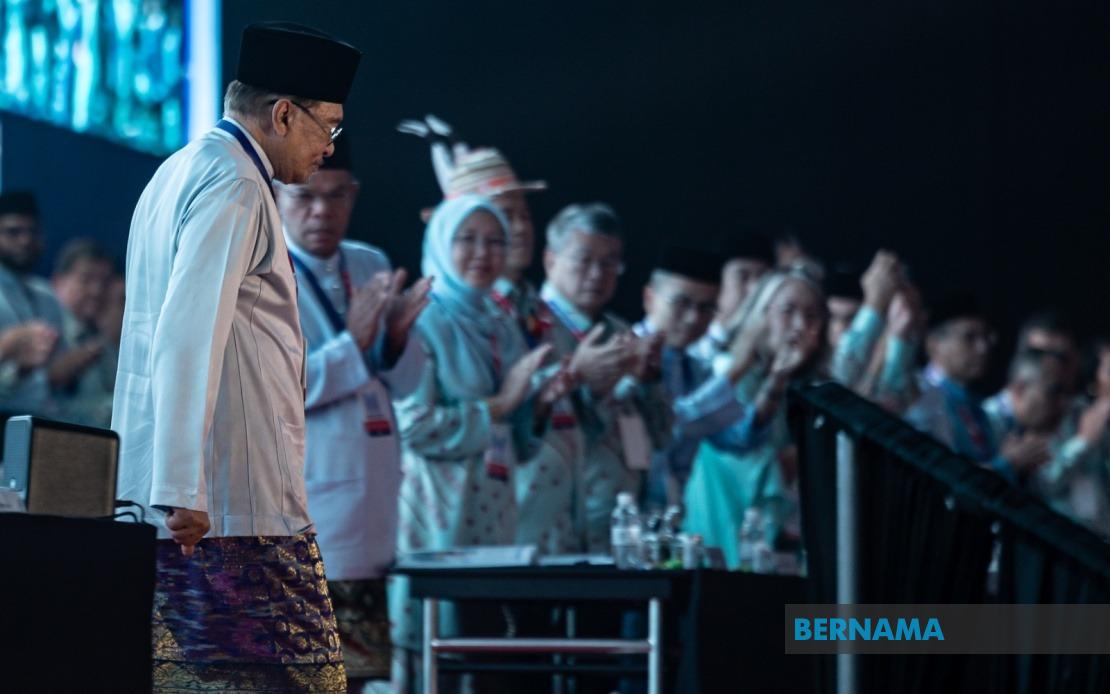
Prime Minister Datuk Seri Anwar Ibrahim has mounted a spirited defence of his administration's reform agenda, arguing that tangible progress should not be overlooked simply because activists and critics continue demanding faster and broader change. Speaking at PKR's 2026 National Congress in Melaka, Anwar acknowledged the tension between celebrating accomplishments and responding to pressure for continuous institutional overhaul, drawing a distinction between the two dynamics that often dominate Malaysian political discourse.
The Prime Minister emphasised that several significant legislative and administrative reforms have already been enacted since his administration took office roughly three years ago. These include amendments to the Audit Act 1957, reforms to the Parliamentary Service Act, passage of the Public Finance and Fiscal Responsibility Act 2023, creation of a Special Task Force on Agency Reform, and new legislation covering consumer credit protection and gig worker protections. Each of these measures represents long-standing gaps in Malaysia's regulatory framework that had accumulated over decades without resolution.
Anwar framed these achievements as particularly notable given the historical context. For six decades before his tenure, he observed, numerous institutional gaps and regulatory deficiencies persisted without being addressed by previous administrations. Against this backdrop, moving several major reform items from the drawing board to enacted legislation within three years represents a departure from the stagnation that previously characterised Malaysian governance. His point speaks to the challenge of transitioning from critique to implementation once in power.
However, Anwar balanced this defence with candour about the inherent difficulties in executing systemic change. He acknowledged that implementing reforms is inherently complex and that not every governmental action has proceeded flawlessly. This admission suggests recognition that Malaysian institutional change faces real obstacles—bureaucratic inertia, resource constraints, and the need to build consensus among multiple stakeholders all complicate rapid transformation.
A significant dimension of Anwar's argument concerns the political constraints of Malaysia's current Unity Government arrangement. As Pakatan Harapan chairman and principal coalition leader, Anwar explained that his party must negotiate with coalition partners to advance the reform agenda. The post-2022 election settlement that created the Unity Government requires consensus-building across ideologically diverse parties, each with distinct constituency interests and policy priorities. This coalition dynamic necessarily slows decision-making and requires compromise on reform scope and timing.
Anwar stressed that PH's position as the dominant coalition partner carries responsibility for the overall stability and effectiveness of government, which sometimes necessitates accepting slower progress on specific reform items. Coalition management, in his framing, is not a failure to pursue reforms but rather a realistic acknowledgement that governing requires negotiation. This reasoning will resonate with those who understand how Malaysian coalition politics functions, though critics may see it as an excuse for insufficient boldness.
The Prime Minister articulated a philosophical position on the pace of institutional change itself. He argued that transformation cannot be rushed; reforms require stable foundations and must be implemented in measured stages to ensure durability and proper institutionalisation. This staged approach reflects lessons learned from administrative change efforts globally, where rapid wholesale transformation often encounters implementation problems and resistance. By this logic, deliberate pace is not timidity but prudence.
Anwar invoked his own repeated messaging to party members about avoiding hasty action, suggesting that he has consistently cautioned against expecting instantaneous transformation across Malaysian institutions. This rhetorical consistency supports his current argument that gradualism is integral to his philosophical approach rather than a recent adaptation to political pressure. The challenge for his narrative is demonstrating that the pace chosen is actually optimal rather than simply convenient.
For Malaysian readers and Southeast Asian observers, Anwar's position illuminates a fundamental governance dilemma facing all reform-oriented administrations. The impulse to rapidly dismantle inherited institutional problems confronts practical constraints of political coalitions, bureaucratic capacity, and the need to build legitimacy for changes. Anwar's three-year record provides concrete data for evaluating whether his government is genuinely producing meaningful reform or using structural constraints as cover for insufficient ambition.
The regional context matters here as well. Across Southeast Asia, governments promising institutional overhaul routinely face similar tensions between reform advocates demanding immediate change and political leaders citing coalition dynamics, capacity limitations, and implementation complexity. How successfully Anwar navigates these pressures may influence expectations and strategies for reform movements elsewhere in the region.
Moving forward, Anwar committed to continuing the reform agenda within the government's capabilities and prevailing circumstances, with explicit attention to ensuring that enacted changes benefit citizens and strengthen institutions. This formulation leaves considerable space for interpretation about what constitutes adequate progress, suggesting that the debate between the government and its critics regarding reform pace is unlikely to resolve soon. The political energy expended on this argument itself reflects the significance Malaysian society places on institutional transformation.

