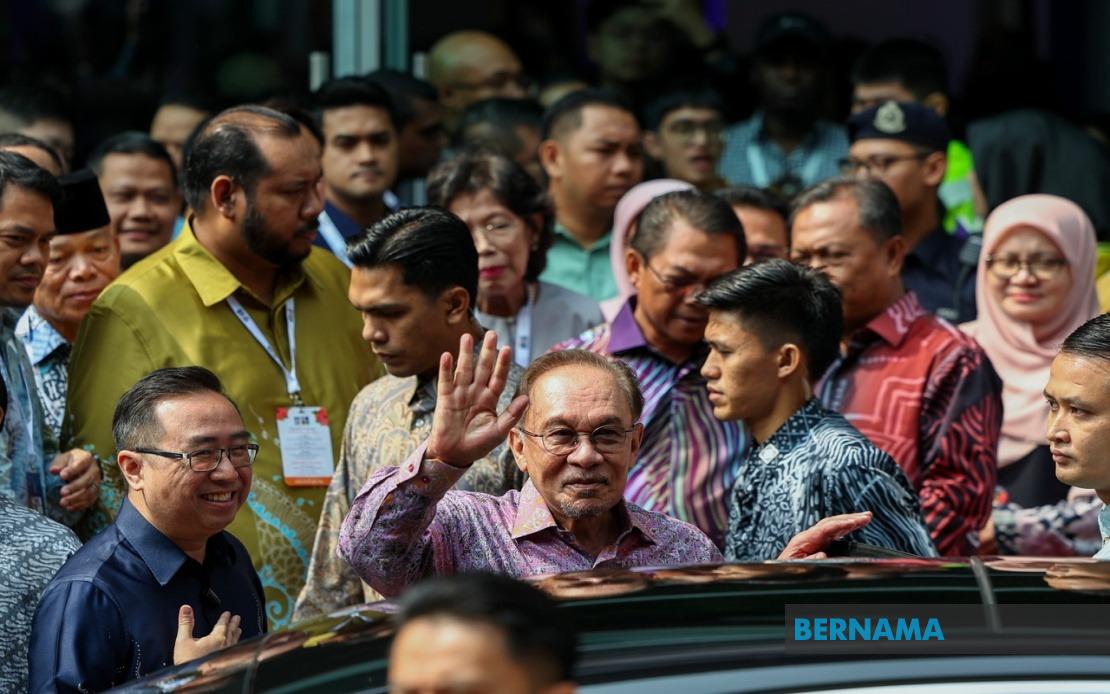
PKR president Datuk Seri Anwar Ibrahim has distanced himself from reports of an invitation to former deputy party leader Datuk Seri Mohamed Azmin Ali to return to the party, stating categorically that he was never briefed on such a move. The Prime Minister's remarks, made during his address at the opening of the National Innovation and Commercialisation Expo (NICE) 2026 at the Kuala Lumpur Convention Centre (KLCC) on Tuesday, suggest potential disconnect or miscommunication within PKR's leadership circles regarding membership recruitment efforts.
When pressed on the matter after the official ceremony, Anwar responded tersely that no information about Azmin's invitation had reached him. "Has anyone invited him? Was there an invitation? I was not informed," the Premier said, leaving open the possibility that party officials at lower echelons may have extended overtures without the party president's explicit approval or knowledge. The response raises questions about the degree of coordination within PKR's internal mechanisms as the party pursues what appears to be a strategic initiative to strengthen its membership base.
Azmin, who currently serves as secretary-general of Parti Pribumi Bersatu Malaysia (Bersatu), has made his position abundantly clear. In a statement issued on Tuesday, the former PKR deputy president rejected any possibility of returning to his old party, emphasising his commitment to Bersatu. His categorical denial effectively closes any immediate prospect of his defection, regardless of whether formal invitations have genuinely been extended. The stance underscores the durability of political realignments that occurred during Malaysia's tumultuous political transitions over recent years.
The Azmin situation, however, represents only one thread in a broader recruitment campaign that PKR appears to be orchestrating. According to multiple reports, the party has been actively courting several former members to rejoin its ranks, signalling an effort to rebuild membership following political defections and party-hopping that has characterised Malaysian politics in recent years. This strategic approach reflects the competitive dynamics of coalition politics in Malaysia, where numerical strength within parliamentary blocs carries substantial weight in negotiations and legislative voting.
Two notable figures have been identified as prospective returnees to PKR. Datuk Kamarudin Jaffar, formerly representing Bandar Tun Razak as an MP, and Datuk Mansor Othman, the previous Nibong Tebal MP, have reportedly been identified as targets for recruitment efforts. Both men's potential returns would add parliamentary experience and constituency-level networks to PKR's roster, factors that carry strategic value in Malaysian electoral politics where localised support and grassroots organisation remain critical to electoral success.
The party has already secured at least one notable confirmation of return. Datuk Dr Xavier Jayakumar, who previously held the position of PKR vice-president, has announced his decision to rejoin the party. His confirmed comeback represents a tangible success in the recruitment drive and suggests that PKR possesses sufficient institutional appeal to persuade some former members to reverse their earlier departures. Jayakumar's profile and previous experience within the party hierarchy could prove valuable to PKR's internal organisational structures.
These recruitment efforts must be understood within the context of Malaysia's coalition dynamics. PKR serves as a core component of the Pakatan Harapan alliance, which has been navigating a complex political landscape marked by shifting alliances and changing parliamentary mathematics. Strengthening PKR's internal membership base enhances the coalition's capacity to manage its own internal affairs while reinforcing its negotiating position within the broader opposition coalition structure. Each addition to the party roster represents not merely a nominal increase in membership but a contribution to the party's political leverage.
Anwar's apparent lack of awareness regarding the Azmin invitation carries subtle political significance. The statement could suggest that party officials are acting on their own initiative, or it may represent a deliberate political positioning by the Prime Minister to distance himself from potentially controversial recruitment efforts. In Malaysian political culture, such denials often serve strategic purposes, allowing leadership to maintain plausible deniability while lower-level operatives execute recruitment strategies. Whether genuine or calculated, the response indicates something worth monitoring within PKR's internal dynamics.
The broader pattern of defections and returns that characterises Malaysian politics reflects the instrumental nature of party affiliation in the country's political system. Politicians frequently move between parties in response to shifting political fortunes, policy disagreements, or career advancement opportunities. PKR's current recruitment push represents an attempt to consolidate its position and reclaim some of the ground lost through earlier departures. Success in such efforts depends not merely on extending invitations but on offering prospective returnees tangible incentives in terms of political position, electoral prospects, or factional influence within the party.
For Malaysian political observers, these developments underscore the ongoing fluidity within opposition politics and the constant recalibration of relationships and alignments that characterises the current electoral environment. The question of whether figures like Azmin, Kamarudin, and Mansor ultimately return to PKR will likely influence broader perceptions regarding the party's trajectory and the durability of Malaysian political coalitions. As the next general election cycle approaches, such membership dynamics will assume increasing importance in determining the configuration of parliamentary representation.

