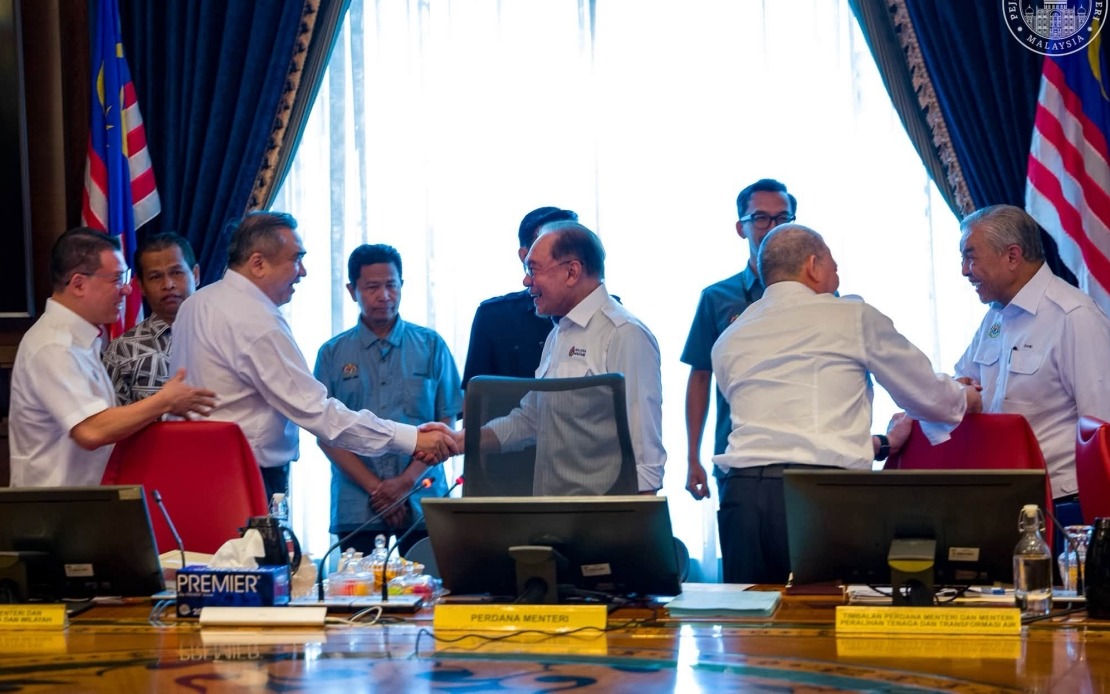
Prime Minister Datuk Seri Anwar Ibrahim has employed symbolism and traditional verse to reinforce the importance of cohesion within Malaysia's Federal Government, posting a four-line Malay pantun that celebrates friendship, discipline and collective decision-making on his official Facebook page. The message, accompanied by photographs from a Cabinet gathering featuring Deputy Prime Minister Datuk Seri Dr Ahmad Zahid Hamidi and Transport Minister Anthony Loke in convivial spirits, generated significant digital engagement with more than 11,500 likes within two hours and over 1,700 comments.
The Prime Minister's choice of medium—the traditional pantun, a classical form of Malay poetry—carries particular weight in the Malaysian political lexicon, where such cultural references often signal deeper messaging to attentive audiences. By anchoring his statement in this venerated literary tradition rather than issuing a direct political pronouncement, Anwar appears to have appealed to both sentiment and reason, prompting online commentators to respond in kind, with several users composing their own pantun in reply. This approach demonstrates a sophisticated understanding of how domestic audiences interpret leadership communication, particularly during periods of coalition strain.
The timing of this gesture proves significant. Malaysia's Federal Government comprises two historically opposed political camps—Pakatan Harapan under Anwar's leadership and Barisan Nasional helmed by Ahmad Zahid—that have maintained an uneasy partnership since 2022. This arrangement, while lending stability to governance, has always contained inherent tensions. The Negeri Sembilan state election, with voting set for August 1, represents a critical test of this relationship. Pakatan Harapan is fielding candidates for all 36 state seats, while Barisan Nasional contests 25 constituencies and has reportedly coordinated with Perikatan Nasional, complicating the picture further.
For Malaysian political observers, state elections under a Federal Unity Government structure present a peculiar challenge. While coalition partners remain bound by national governance agreements, electoral competition at the state level creates legitimate political rivalry. The competing parties must simultaneously maintain partnership stability at the federal level whilst vigorously pursuing electoral advantage in the state. This contradiction has generated public concern about whether such divided loyalties might fracture the federal administration, potentially destabilising the government and undermining policy implementation.
Anwar's pantun-based intervention appears calibrated to address precisely these anxieties. By publicly emphasising unity, solidarity and the value of consensus—rather than engaging in the specific political calculations of the Negeri Sembilan race—the Prime Minister has attempted to situate the upcoming election within a broader narrative of institutional responsibility. The accompanying Cabinet photographs, deliberately highlighting an atmosphere of camaraderie among senior ministers, reinforce this messaging by presenting an image of government functioning harmoniously despite electoral competition below.
The response from online commenters, marked by general approbation for the Prime Minister's "conciliatory tone and statesmanship," suggests that significant segments of the Malaysian public welcome such stabilising signals. In an environment where coalition fracture could trigger serious governance disruptions, the electorate appears receptive to leadership communication that prioritises continuity and cooperative spirit. This sentiment reflects broader Malaysian concern about political instability—a concern that has only intensified following years of governmental volatility and successive leadership crises.
The State Assembly dissolution on June 5 set a fixed timeline for the Negeri Sembilan contest, with early voting scheduled for July 28 and the Election Commission confirming August 1 as polling day. This compressed campaign period intensifies pressure on both Pakatan Harapan and Barisan Nasional to mobilise resources aggressively whilst maintaining the public facade of federal partnership. For coalition leadership, such contradictions require careful management. Anwar's poetic intervention represents one such management strategy, deploying cultural resonance and emotional appeal to counterbalance the divisive impulses inherent in electoral competition.
For Southeast Asian observers watching Malaysia's political evolution, the Negeri Sembilan election offers instructive lessons about maintaining coalition stability while permitting democratic competition. Few regional democracies have successfully managed similar arrangements without allowing state-level elections to destabilise national governance. Thailand's coalition governments have frequently collapsed under far less pressure, whilst Indonesia's complex coalition arrangements have generated periodic dysfunction. Malaysia's experiment therefore carries implications beyond national borders, potentially offering a model—or cautionary tale—for other Southeast Asian systems grappling with multi-party coalition governance.
The substantive policy implications of maintaining Federal Government stability warrant consideration. The Malaysian economy remains vulnerable to investor uncertainty about political durability. International observers monitoring governance quality scrutinise any signs of coalition breakdown, as such fractures typically precede currency volatility, credit rating adjustments and capital flight. By emphasising unity and consensus, Anwar is simultaneously addressing domestic political concerns and signalling to international markets that the Federal Government remains institutionally robust despite electoral competition.
Looking forward, the August 1 polling outcome will test whether Anwar's symbolic intervention effectively constrained coalition tensions. Should Pakatan Harapan achieve a decisive victory in Negeri Sembilan, questions may arise about whether Barisan Nasional's accommodation of Perikatan Nasional signals preparation for potential federal realignment. Conversely, a Barisan Nasional breakthrough might embolden demands from that coalition for enhanced federal representation. The pantun's effectiveness as a stabilising force will ultimately be measured not by its social media reception but by whether post-election cooperation remains intact and functional.

