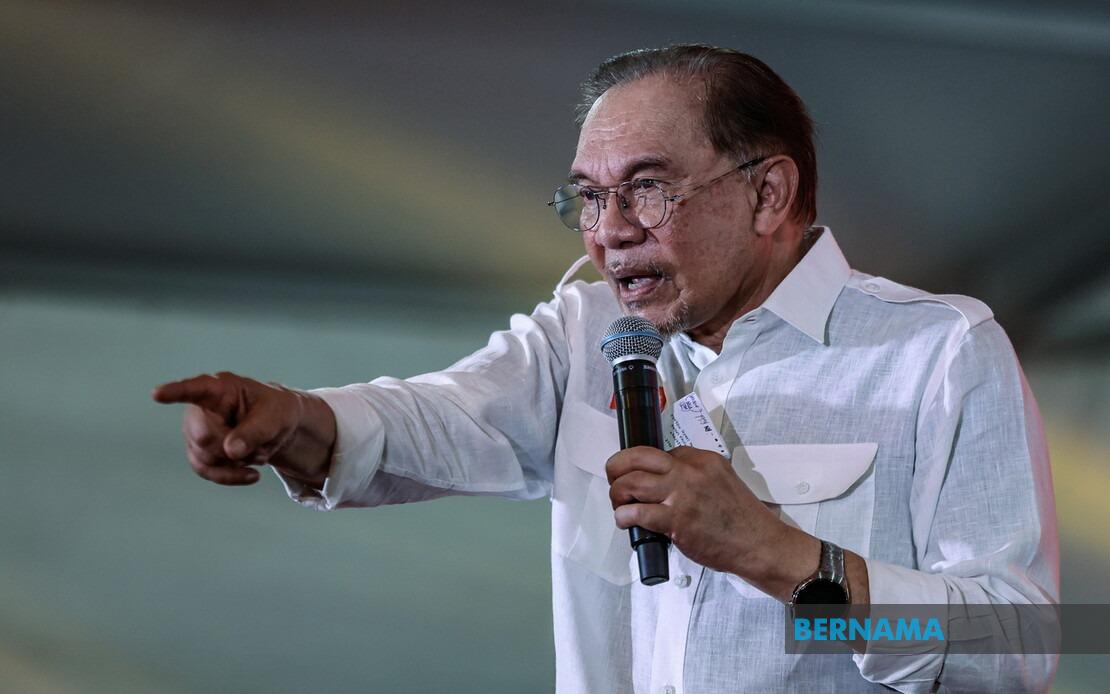
Prime Minister Datuk Seri Anwar Ibrahim has publicly expressed disappointment at what he characterises as unjustified political attacks from Kedah Menteri Besar Datuk Seri Muhammad Sanusi Md Nor, even as the Federal Government pursues an active development agenda for the northern state. Speaking at a Pakatan Harapan rally in Simpang Renggam on July 10, Anwar sought to distance himself from suggestions that Kedah, governed by the opposition PAS party, has been marginalised in federal planning and investment priorities.
The Prime Minister's remarks came in response to media reports in which Muhammad Sanusi had criticised Anwar's approach to governance, claiming the federal leader acts as though all Malaysian states are dependent on Kuala Lumpur since assuming office. The tone of the exchange underscores the tension between the federal administration and the PAS-led Kedah government, despite both supposedly working toward shared developmental objectives. As Pakatan Harapan chairman, Anwar sought to reframe the disagreement not as a reflection of unequal treatment but rather as a misunderstanding of his commitment to nationwide progress.
Anwar highlighted a concrete example of federal engagement with Kedah by referencing his visit to the state alongside Thailand's Prime Minister Anutin Charnvirakul. The two leaders jointly inaugurated a new road alignment connecting the Bukit Kayu Hitam Immigration, Customs, Quarantine and Security (ICQS) Complex with Thailand's Sadao Customs, Immigration and Quarantine facility. Rather than staging this cross-border infrastructure event in the federal capital, Anwar emphasised that the choice to hold it in this remote northern location demonstrated tangible prioritisation of Kedah's regional economic interests.
The new road infrastructure serves a strategic purpose within the broader framework of boosting bilateral trade and movement of goods across the Malaysia-Thailand border. By facilitating smoother passage between the two countries' customs facilities, the project aims to strengthen the border economy and generate employment and commercial opportunities for residents of both Kedah and neighbouring Perlis. Anwar's decision to invite a foreign leader to formally open the facility suggests the federal government views this corridor as significant enough to warrant high-level international ceremonial attention, signalling to investors and traders that Malaysia takes the development of this gateway seriously.
Defending his administrative philosophy, Anwar stressed that his responsibility extends to all Malaysians, not merely those in Pakatan Harapan-controlled territories. He acknowledged the apparent paradox of allocating substantial federal resources to opposition-governed states, explaining that electoral outcomes should not determine the distribution of development benefits. This position reflects a broader principle of administrative neutrality that Anwar has sought to articulate since coming to power, though critics from both government and opposition camps have questioned whether such neutrality is genuinely achievable within Malaysia's competitive political landscape.
The timing of Anwar's remarks coincided with an intensive campaign schedule in Johor ahead of state elections scheduled for the following day. The Prime Minister attended five separate events in the state to bolster Pakatan Harapan candidates and strengthen party machinery ahead of polling. This dual focus—addressing inter-governmental tensions while simultaneously campaigning for electoral advantage—illustrates the complex balancing act contemporary Malaysian politics demands of federal leaders, who must navigate both administrative responsibilities and partisan electoral imperatives.
Beyond the Kedah controversy, Anwar used the campaign platform to announce intentions regarding the Sumbangan Asas Rahmah (SARA) assistance programme. The government expressed plans to increase this basic assistance scheme provided that political stability endures and Pakatan Harapan retains electoral support. Such assistance programmes have become central to Malaysia's social safety net, particularly for lower-income households, and expansion signals either genuine commitment to poverty alleviation or a calculated effort to solidify voter loyalty through material incentives. Anwar attributed the feasibility of such increases to disciplined financial management and the elimination of leakage from government spending.
The reference to financial prudence and the absence of misappropriation reflects an ongoing emphasis within the current administration on distinguishing its approach from that of previous governments. This framing carries particular weight in Malaysia, where concerns about corruption and fiscal mismanagement have shaped electoral behaviour and public confidence in institutions. By linking increased social spending to tighter controls on government expenditure, Anwar attempts to position his administration as simultaneously compassionate and fiscally responsible.
The underlying dispute between Anwar and Muhammad Sanusi, whilst superficially about resource allocation and recognition, actually touches deeper questions about the nature of federalism in Malaysia and whether development should be treated as reward for political loyalty. Kedah's status as a PAS stronghold makes it a test case for whether the current federal coalition can govern in a genuinely inclusive manner or whether political competition inevitably translates into unequal treatment. The fact that Anwar felt compelled to publicly defend his record in Kedah suggests that perceptions of regional neglect carry real political consequences, even for states not directly controlled by his own coalition.
The Prime Minister's insistence that he has consistently worked to advance Kedah's development agenda requires scrutiny against measurable outcomes. Infrastructure projects, investment attraction, employment creation, and service delivery improvements offer concrete metrics against which such claims can be assessed. Without clear evidence of comparable federal attention and resources flowing to Kedah relative to Pakatan Harapan-governed states, Anwar's reassurances may remain largely rhetorical, potentially reinforcing rather than dispelling perceptions of partisan preferencing.
Looking forward, the relationship between the federal government and opposition-led states will likely remain a persistent tension point in Malaysian politics. The principle that development should transcend partisan lines is sound, but its consistent implementation requires genuine political will and mechanisms to insulate resource allocation from electoral considerations. The Anwar-Sanusi exchange, whilst apparently focused on specific grievances, actually reflects this broader structural challenge facing Malaysia's federal system as it attempts to balance competitive democracy with inclusive governance.

