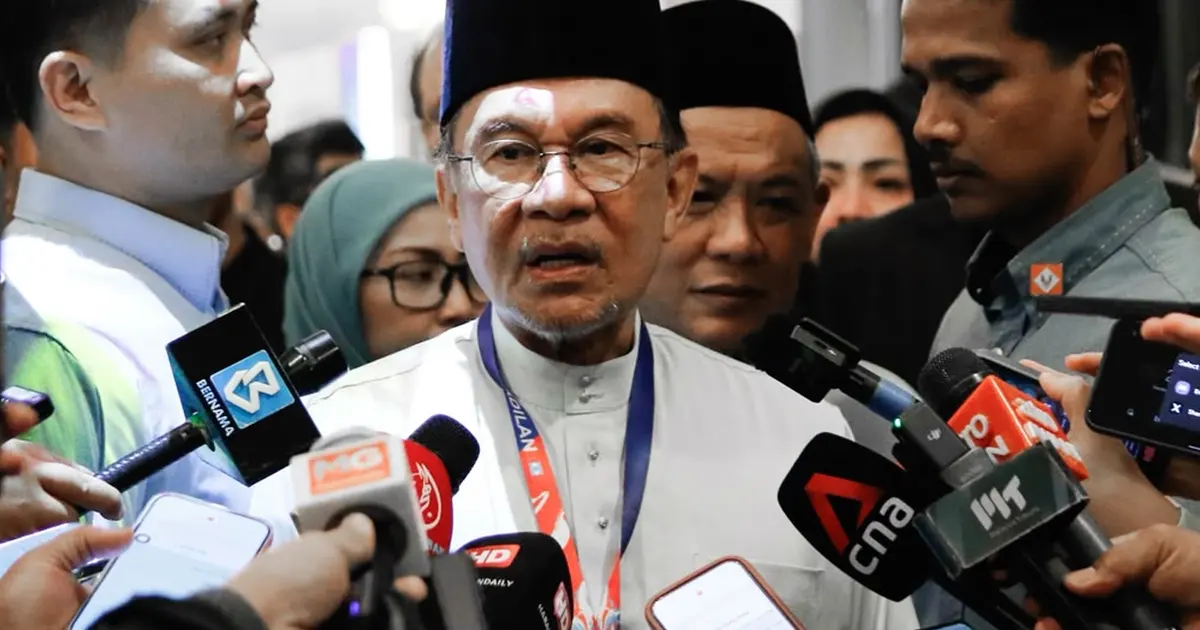
Prime Minister Anwar Ibrahim has pushed back against claims that he harbours trust difficulties with Deputy Prime Minister Zahid Hamidi, framing the recent controversy as a straightforward disagreement over perspective rather than evidence of a deeper interpersonal rift within the country's political leadership.
The prime minister's clarification came in response to comments made by Khairy Jamaluddin, the former Umno Youth chief, who aired his observations during a podcast discussion. Rather than acknowledging any underlying tension between the two senior figures, Anwar characterised the matter as a natural difference in how political actors interpret complex governance issues—a distinction that carries significance given ongoing scrutiny of coalition stability.
Anwar's statement reflects a calculated effort to compartmentalise the recent commentary and prevent it from casting doubt on the operational coherence of Malaysia's federal administration. The timing of such clarifications matters considerably in a coalition environment where perceptions of internal harmony directly influence parliamentary arithmetic and investor confidence. By emphasising that divergent views do not equate to fractured relationships, the prime minister sought to neutralise potential narratives suggesting governmental dysfunction.
Khairy Jamaluddin's podcast intervention represents a notable intervention from a prominent Umno figure with significant influence within party circles and among younger urban constituencies. His willingness to articulate concerns publicly, even framed diplomatically, underscores the delicate balancing act required in Malaysia's multiparty governing arrangement. The intervention occurred against a backdrop of ongoing negotiations and coalition management challenges that have periodically tested the unity of the Pakatan Harapan and Barisan Nasional partnership.
The distinction Anwar drew between personal trust deficits and analytical disagreements carries practical implications for Malaysia's political trajectory. Should observers interpret such differences as symptomatic of deeper fractures, it could embolden opposition elements and complicate legislative planning. Conversely, if the government successfully frames these moments as normal policy discourse within a functional partnership, it preserves flexibility for continued cooperation on priority legislation affecting the Malaysian economy and public welfare.
For regional observers and international stakeholders monitoring Malaysian governance, the exchange illustrates the complexity inherent in coalition-based systems where multiple parties must navigate competing interests while maintaining sufficient cohesion for effective administration. The stability narrative remains crucial for Malaysia's economic positioning in Southeast Asia, particularly as the country pursues infrastructure development, foreign direct investment, and trade relationship strengthening.
Anwar's framing also reflects broader political communication strategies employed by leaders managing diverse coalitions across Asia. Rather than viewing every instance of public disagreement as indicative of systemic breakdown, sophisticated political operators increasingly emphasise that plural democracies naturally generate competing perspectives—a normalisation that can prove valuable during periods of external economic or geopolitical pressure.
The Zahid-Anwar relationship itself carries substantial historical weight, given previous tensions during earlier governmental configurations and the deputy prime minister's complex political journey spanning both opposition and government roles. Their capacity to work collaboratively despite this history has been presented as evidence of Malaysia's democratic maturation and the ruling coalition's commitment to pragmatic governance over personal animosity.
Khairy Jamaluddin's position as a former Umno Youth leader whose career has navigated multiple political configurations gives his commentary particular resonance within party structures. His podcast observations, whatever their precise nature, likely reflect broader conversations occurring within Umno ranks regarding coalition dynamics and positioning—conversations that invariably surface periodically in multiparty arrangements.
Looking forward, how the government responds to future public commentary from coalition figures will significantly shape perceptions of internal stability. The prime minister's approach of engaging directly with such concerns rather than dismissing them outright suggests a communication strategy aimed at transparency while maintaining unified public positioning. This balance proves essential for managing parliamentary support, particularly when coalition members hold opinions that diverge from core government narratives.
For Malaysian constituencies and stakeholders invested in political stability, such clarifications serve important functions in distinguishing between normal policy discourse and genuine governance crises. The ability to accommodate differing viewpoints while maintaining operational cohesion represents a maturity marker for democratic institutions and coalition management that extends beyond Malaysia's immediate political context.

