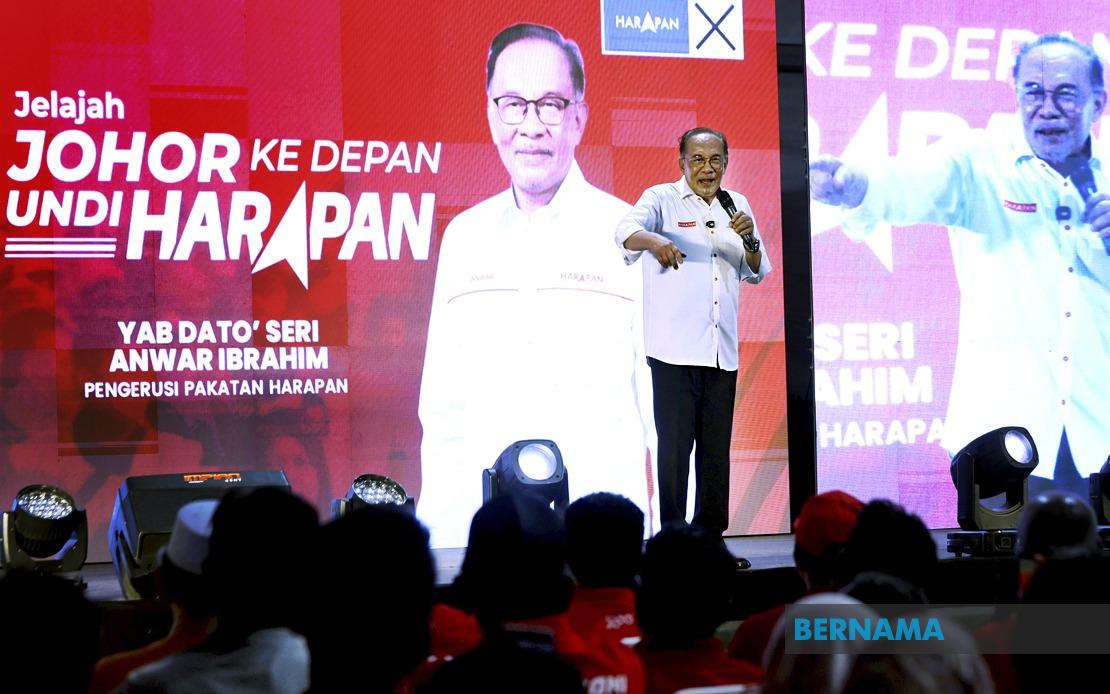
Prime Minister Datuk Seri Anwar Ibrahim has issued an unequivocal warning that Malaysia's period of systematic plunder and faction-based politics designed to benefit the privileged few has ended. Speaking during a campaign event in Muar for the forthcoming Johor state election, Anwar stressed that the MADANI administration remains resolute in its mission to establish transparent governance that transcends racial and communal boundaries. This declaration arrives at a critical juncture, as the state prepares for polling on July 11, with voters across 56 constituencies deciding the direction of Johor's leadership over the coming years.
The Prime Minister's remarks underscored a fundamental shift in Malaysia's political direction since the MADANI coalition assumed office. Rather than permitting the continuation of practices where officials exploit public resources for personal advancement, Anwar's government has positioned itself as a guardian against institutional corruption. He articulated the transformation as a systematic purge of administrative mechanisms that have enabled entrenched wrongdoing, ensuring that public funds are deployed for genuine public benefit rather than diverted through nepotistic networks or contractual favours awarded to connected business interests.
Anwar's language throughout the Sungai Mati programme deliberately rejected the notion that leadership quality correlates with ethnicity or religious identity. By explicitly stating his desire for capable, incorruptible leaders across all communities—whether Malay, Chinese, or otherwise—the Prime Minister attempted to reframe the anti-corruption agenda as a universal principle rather than a targeted campaign against any specific group. This rhetorical approach directly counters opposition narratives that seek to weaponise communal sentiment as a shield against accountability.
The practice of leveraging governmental authority to enrich family members and award contracts to associates has long represented a structural vulnerability in Malaysia's governance framework. Anwar characterised this as "the culture of plunder," a characterisation that reflects growing public frustration with arrangements where political office becomes a pathway to personal wealth accumulation. His commitment to discontinuing such practices signals an attempt to restore public confidence in institutional integrity, a prerequisite for sustainable economic development and international credibility.
A significant dimension of Anwar's message concerns the immunity structures that have historically protected powerful figures from accountability. His explicit assurance that no individual would receive governmental protection if implicated in corrupt conduct represents a notable departure from previous administrations. This pledge carries particular weight given Malaysia's history of high-profile figures escaping consequences through political patronage networks. For ordinary citizens, this represents either a genuine commitment to equal justice or a rhetorical flourish that warrants scrutiny based on implementation.
The Prime Minister's framing of opposition activities as driven by personal motivations to reclaim federal control suggests an understanding that anti-corruption efforts have become contested political terrain. Rather than accepting such initiatives at face value, opposition actors characterise them as selective prosecution designed to eliminate political rivals while protecting allied interests. This dynamic reflects deeper scepticism about whether any administration can credibly investigate its own members while maintaining prosecutorial impartiality.
Anwar's campaign activities across Johor—completing 15 engagements across two days before the state election—demonstrate the centrality of governance integrity to the MADANI coalition's electoral messaging. By emphasising ethical leadership and rejecting patronage politics, the government appeals to voters concerned about institutional decay while differentiating itself from predecessors. The presence of Penang Chief Minister Chow Kon Yeow and Ledang MP Syed Ibrahim Syed Noh underscored the multi-state coalition commitment to this message.
For Malaysian voters, particularly those in Johor's 56 contested seats, evaluating these commitments requires examining concrete outcomes rather than campaign rhetoric alone. The forthcoming state election offers an opportunity to assess whether constituencies prioritise leaders based on demonstrated competence and integrity or alternatively reward those who mobilise communal anxieties. Anwar's explicit instruction that voters "reject leaders who lacked integrity" implicitly endorses this evaluative standard.
The broader Southeast Asian context adds complexity to Malaysia's anti-corruption trajectory. Regional autocracies frequently employ anti-corruption campaigns as mechanisms for consolidating power, eliminating rivals under the guise of justice. Conversely, genuine institutional reform in countries like Indonesia demonstrates that meaningful progress remains possible when political leadership commits sustained resources to enforcement mechanisms and public accountability. Malaysia's trajectory will depend substantially on whether the MADANI government sustains these commitments beyond the immediate electoral cycle.
The Johor state election itself represents a critical test case. With 172 candidates contesting across the 56 seats, voters must differentiate between competing visions of governance. Early voting scheduled for July 7 precedes main polling on July 11, providing additional logistics complexity. The outcome will indicate whether Malaysian electorates genuinely embrace integrity-centred leadership or whether other considerations—including patronage promises, communal identity, or economic distributions—remain decisive in electoral calculations.
Standing at this inflection point, the efficacy of Anwar's anti-corruption commitments ultimately rests on institutional execution rather than rhetorical flourish. Independent investigatory bodies, judicial impartiality, and transparent prosecution decisions will determine whether this represents transformative governance reform or conventional political theatre. For Malaysia's development trajectory and regional standing, the distinction matters considerably.

