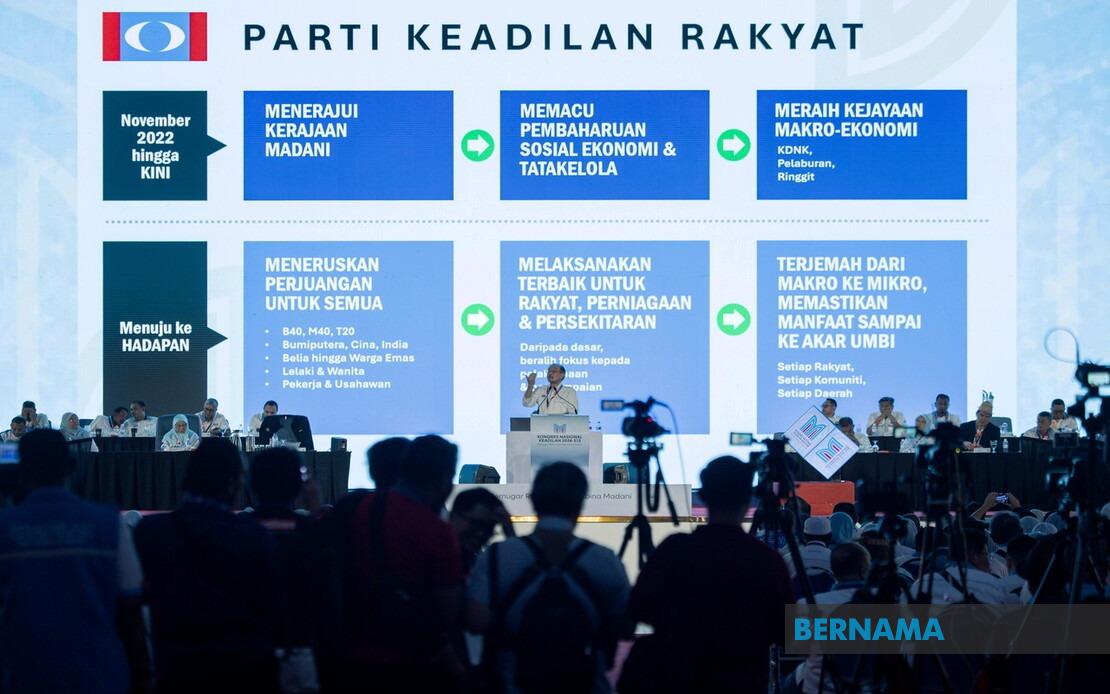
Prime Minister Datuk Seri Anwar Ibrahim has handed Home Minister Datuk Seri Saifuddin Nasution Ismail complete authority to discharge the duties of PKR's deputy president, a decision unveiled during the party's national congress in Melaka on August 16. The move follows an earlier determination by the party's Central Leadership Council in early August to grant deputy president Nurul Izzah Anwar a temporary leave of absence, necessitating someone to assume her responsibilities during this period.
In his address at the PKR National Congress 2026 held at the Melaka International Trade Centre in Ayer Keroh, Anwar characterised the additional responsibility as substantial but essential. He described Saifuddin Nasution as a longstanding associate whose loyalty and understanding of his working methods made him the ideal candidate to maintain continuity in the party's operations. The Prime Minister appealed to the broader PKR membership to extend their complete backing and unwavering allegiance to Saifuddin Nasution as he embarks on this interim assignment, framing unified support as critical to the party's organisational effectiveness.
The appointment signals Anwar's confidence in Saifuddin Nasution's administrative capacity at a time when PKR faces internal challenges and electoral pressures. Beyond this structural adjustment, Anwar announced complementary leadership appointments designed to strengthen the party's institutional framework. Fellow vice-president Datuk Seri Amirudin Shari has been designated as the party's election director, positioning him to oversee campaign strategy and grassroots mobilisation efforts. Separately, Tengku Datuk Seri Zafrul Tengku Abdul Aziz has been appointed as coordinator within the Prime Minister's Office, establishing a direct liaison between PKR's upper echelons and federal government machinery.
These appointments reflect a broader restructuring initiative aimed at clarifying responsibility lines and optimising resource deployment across PKR's sprawling organisational structure. The staggered leadership assignments suggest Anwar is attempting to balance administrative burden while concentrating functional expertise in specific individuals. This approach mirrors common practice in political parties confronting electoral setbacks, wherein fresh assignments occasionally accompany personnel shifts to signal renewed organisational commitment and strategic recalibration.
The reshuffle becomes particularly significant against the backdrop of PKR's recent electoral performance. The party suffered considerable losses during the Negeri Sembilan state election held on August 1, an outcome that triggered internal discontent and calls for accountability among state division leaders. Six Negeri Sembilan PKR division chiefs formally demanded a reassessment of Datuk Seri Aminuddin Harun's position as chairman of the Negeri Sembilan PKR State Leadership Council, implying that some members attributed the electoral defeat directly to state-level leadership failures.
Anwar has intervened to recalibrate Aminuddin's portfolio rather than accede to demands for his removal. The Prime Minister has directed the former Negeri Sembilan Menteri Besar to concentrate fully on his vice-presidential role and on cadre development initiatives intended to cultivate emerging PKR talent across hierarchical levels. Anwar emphasised that Aminuddin's substantial experience in state governance positions him uniquely to mentor younger party members and strengthen PKR's organisational capacity through structured training programmes. This strategic redeployment seeks to retain experienced personnel whilst addressing grievances through functional realignment.
Crucially, Anwar has committed to personally addressing the substantive concerns raised by Negeri Sembilan division chiefs, indicating that the matter remains sufficiently sensitive to warrant the Prime Minister's direct involvement. His acknowledgment of their grievances, coupled with the decision to reassign rather than dismiss Aminuddin, suggests an effort to balance competing organisational pressures—retaining experienced cadres whilst responding to rank-and-file frustration with electoral performance. However, this calibrated approach may prove insufficient if internal factions perceive the response as inadequately addressing accountability concerns.
Anwar's framing of the Negeri Sembilan defeat as a collective responsibility rather than an individual failure represents a deliberate rhetorical choice aimed at mitigating factional conflict. By emphasising that the party collectively shoulders responsibility for electoral losses, he attempts to shift conversation away from personalised blame toward systemic improvement. Yet this institutionalised accountability, whilst theoretically compelling, may ring hollow to grassroots members who perceive obvious failures in state-level strategy or execution. The tension between collective responsibility and individual accountability remains unresolved within PKR's internal discourse.
For Malaysian observers, these internal PKR adjustments carry broader implications for federal governance and coalition stability. The assignments of leadership positions to individuals already holding ministerial portfolios—particularly Saifuddin Nasution's elevation despite already discharging Home Ministry duties—underscores ongoing tension between party management and government administration. As coalition partner to Pakatan Harapan and key component of Malaysia's governing structure, PKR's internal cohesion directly influences coalition dynamics and government effectiveness. Leadership volatility or widespread factional discord could undermine governance capacity across multiple portfolios.
The temporary nature of Nurul Izzah's absence and Saifuddin Nasution's interim mandate leaves open questions about succession planning and long-term deputy leadership arrangements. PKR has not indicated whether Nurul Izzah's leave represents a prelude to permanent succession, a therapeutic absence, or another configuration entirely. This ambiguity introduces uncertainty regarding the party's leadership trajectory at a sensitive moment when electoral performance concerns dominate internal conversation and factional dynamics remain volatile.
Looking ahead, the effectiveness of these appointments in stabilising PKR and reversing recent electoral setbacks will determine whether Anwar's restructuring constitutes meaningful institutional reform or merely tactical repositioning. The party confronts a delicate balancing act—implementing changes sufficient to satisfy members demanding accountability whilst retaining experienced personnel whose departures could accelerate institutional erosion. Success requires not merely administrative rearrangement but genuine improvement in campaign effectiveness, membership engagement, and electoral competitiveness across diverse constituencies and demographic segments.

