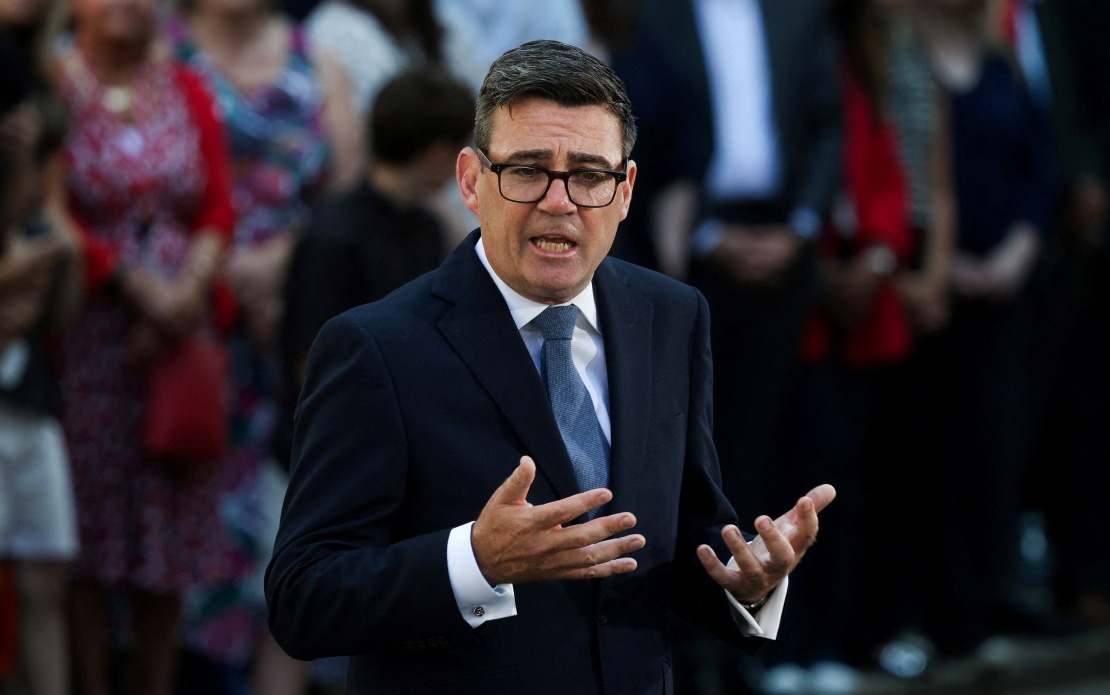
Prime Minister Datuk Seri Anwar Ibrahim has formally congratulated Andy Burnham following his appointment as the United Kingdom's seventh prime minister in a decade, signalling Malaysia's readiness to deepen strategic cooperation with Britain under new leadership. In a statement released through social media on July 20, Anwar outlined his vision for advancing the Malaysia-UK partnership across multiple sectors, positioning the transition as a fresh opportunity for both nations to strengthen longstanding ties.
The Malaysian premier expressed particular enthusiasm about collaborating with Burnham to finalise a Digital Trade Agreement, a priority that reflects both countries' ambitions in the digital economy. Beyond commerce, Anwar identified artificial intelligence, digitalisation, clean energy and defence as critical areas for enhanced partnership, demonstrating Malaysia's strategic interest in aligning with Britain across technology, sustainability and security domains that are increasingly central to regional stability.
Burnham officially assumed office on Monday after being elected Labour Party leader on Friday, following Keir Starmer's formal resignation at Buckingham Palace. This transition marks the seventh change in British prime ministerial leadership within a decade, underscoring the political volatility that has characterised Westminster politics since the 2016 Brexit referendum. For Malaysia, Burnham's appointment presents both continuity challenges and fresh diplomatic opportunities, as incoming administrations typically review inherited agreements and recalibrate foreign policy priorities.
Anwar notably praised Burnham's candour regarding Britain's initial handling of the Gaza crisis, acknowledging the new prime minister's willingness to acknowledge that the United Kingdom's early response had been insufficient in addressing humanitarian concerns. This recognition carries weight in Malaysia, where the Palestinian issue commands deep public support and where government messaging on Middle Eastern affairs significantly influences domestic political sentiment. By highlighting Burnham's moral clarity on Gaza and his calls for increased pressure on the Israeli regime, Anwar positioned the relationship as one grounded in shared values regarding international justice and humanitarian responsibility.
The timing of Anwar's overture is strategically significant, as 2025 will commemorate the 70th anniversary of Malaysia-UK diplomatic relations. This milestone provides a natural inflection point for both governments to reaffirm commitment to their historical partnership while establishing a forward-looking agenda. Malaysia, as a former British colony, maintains deep institutional connections with the United Kingdom through legal systems, educational networks and defence partnerships. These historical foundations offer stability even as contemporary relationships navigate new geopolitical and economic realities.
Anwar's message also extended gratitude to outgoing Prime Minister Keir Starmer, acknowledging his contributions to Malaysia-UK cooperation throughout his tenure. This diplomatic courtesy serves multiple purposes: it maintains constructive relations with the departing leader, demonstrates Malaysia's respect for institutional continuity, and signals to the international community that Malaysia conducts foreign relations with professionalism and grace regardless of which party holds power in London. Such measured engagement enhances Malaysia's diplomatic standing and creates goodwill that transcends individual administrations.
The emphasis on digital trade and artificial intelligence reflects contemporary economic realities facing both nations. The UK, seeking to establish itself as a global technology hub post-Brexit, views partnerships with advanced Southeast Asian economies as essential to remaining competitive. Malaysia similarly recognises that participation in digital trade frameworks and AI development is crucial for maintaining its regional economic leadership and attracting technology investment that can generate high-value employment.
Defence cooperation mentioned in Anwar's statement carries particular relevance given evolving security dynamics in Asia-Pacific. Britain has substantially increased its military presence and commitments in the Indo-Pacific region in recent years, positioning itself as a counterbalance to Chinese assertiveness. Malaysia, navigating complex relationships with Beijing, Washington and New Delhi, values partnerships with diverse security providers that enhance its strategic autonomy. Deeper defence collaboration with Britain could include intelligence sharing, joint exercises, naval cooperation and technology transfer that strengthens Malaysian security capabilities.
Clean energy emerges as another natural area for partnership, as both nations have committed to net-zero carbon targets. Malaysia possesses significant potential in renewable energy development, particularly solar and offshore wind, while Britain leads in emerging green technologies. Collaboration could facilitate knowledge transfer, attract British investment in Malaysian renewable projects, and position both countries advantageously within global decarbonisation efforts that increasingly influence trade and investment decisions.
The broader context suggests that Malaysia seeks to maintain its role as a bridge between the Western world and Asia, cultivating relationships that serve national interests without excessive alignment with any single power. By promptly engaging the new British administration, Anwar reinforces Malaysia's commitment to diversified international partnerships and positions the country to benefit from Britain's renewed emphasis on Indo-Pacific engagement. This diplomatic initiative reflects Malaysia's sophisticated understanding that managing great power competition requires active relationship-building with multiple partners.

