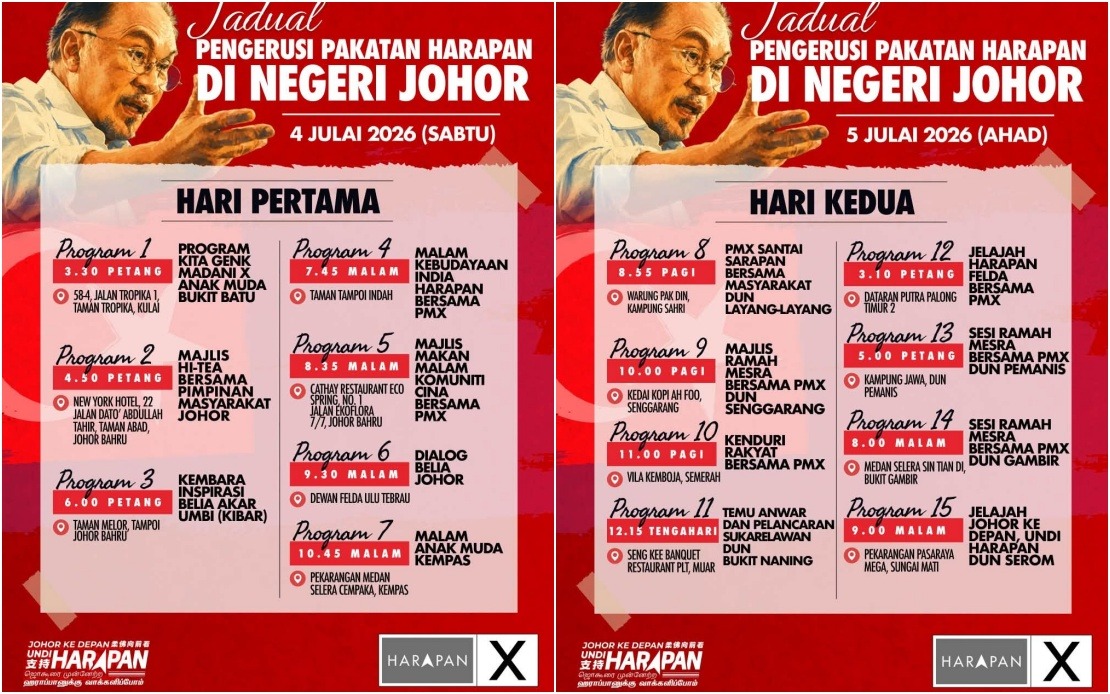
Pakatan Harapan chairman Datuk Seri Anwar Ibrahim is undertaking an exhaustive campaign sweep through Johor over the coming weekend, with plans to participate in 15 separate programmes designed to energise the coalition's base and consolidate voter backing for its 56 candidates in the 16th Johor state election. The intensive schedule underscores the high stakes for PH in a state that remains politically competitive and strategically crucial to the coalition's national aspirations.
Through a Facebook announcement, Anwar extended a public invitation to Johor voters to attend the gatherings, signalling PH's confidence in mobilising grassroots participation. His message—"Insya-Allah, I'll be in Johor tomorrow and Sunday to support the candidates and HARAPAN machinery. I invite everyone in Johor to join us"—reflects the coalition's emphasis on broad community engagement rather than closed-door electioneering. This approach suggests PH leadership recognises the importance of demonstrating visible momentum and direct leader-to-voter interaction in the final fortnight before polling day.
The Saturday itinerary reveals a carefully choreographed strategy targeting diverse demographic segments across the state. Beginning at 3.30 pm with the Kita Genk MADANI x Anak Muda Bukit Batu programme in Kulai, Anwar will immediately pivot to community engagement through a high-tea with local leaders. The sequence continues with youth-focused events at Tampoi and culturally segmented gatherings—an Indian Cultural Night and Chinese Community Dinner—both explicitly branding these as occasions with "PMX," likely referring to Prime Minister Anwar Ibrahim's earlier role. This deliberate intercommunal scheduling reflects PH's strategy to present itself as an inclusive, multi-ethnic coalition capable of serving all communities.
The evening commitments grow increasingly concentrated, with four programmes crammed between 7.45 pm and 10.45 pm. This density suggests Anwar's team is maximising coverage across multiple constituencies and community centres simultaneously, or that the schedule accounts for variable crowd sizes and programme lengths. The final event, the Anak Muda Kempas Night in Kempas at 10.45 pm, indicates Anwar's willingness to maintain engagement into late hours—a physical and political statement about commitment to reaching voters in outlying areas.
Sunday's agenda begins considerably earlier, with a breakfast gathering at Warung Pak Din in Kampung Sahri at 8.55 am, signalling an attempt to capture the grassroots, morning-oriented segment of the electorate. The subsequent Meet-and-Greet at Dewan Undangan Negeri Senggarang at 10 am provides structured opportunity for constituent interaction, while the kenduri rakyat (communal feast) in Semerah at 11 am continues PH's emphasis on convivial, food-centred community bonding. The launch of the Bukit Naning Volunteers programme introduces an organisational dimension, suggesting PH is attempting to formalise volunteer networks that can sustain ground operations beyond the campaign period.
The afternoon programmes—including a tour of Felda settlements and constituency-specific sessions—underscore PH's focus on rural and semi-rural constituencies where traditional constituencies and established social structures remain influential. For Malaysian campaigners, FELDA settlements have historically represented an important but contested voting bloc, with traditional government-aligned parties maintaining historical advantages. By explicitly including Felda tour stops, Anwar signals PH's intent to contest these areas seriously rather than conceding them by default. The Jelajah Johor Ke Depan, Undi Harapan DUN Serom finale at Sungai Mati at 9 pm suggests the weekend campaign mirrors the Saturday pattern, compressing multiple events into evening hours.
The scale of Anwar's personal commitment—15 programmes across two days—carries symbolic weight beyond mere vote-counting logic. His visible presence and physical endurance become campaign narratives in themselves, demonstrating to PH supporters and wavering voters that the leadership prioritises Johor's contest and remains energetically invested in securing victory. In Malaysian politics, where personality-driven campaigns and leader charisma substantially influence voter behaviour, Anwar's high-visibility weekend carries strategic importance.
The election calendar adds urgency to this campaigning intensity. With voting scheduled for July 11 and early voting on July 7, the weekend represents a critical window in the final two weeks of campaigning when voter attention peaks and undecided voters become receptive to direct appeals. Johor's election occurs within Malaysia's broader political context, where state-level contests frequently serve as barometers of federal political sentiment. A strong PH performance in Johor would reinforce the coalition's credentials nationally, while underperformance would invite questions about grassroots erosion.
For Johor specifically, the campaign schedule concentrates on constituencies spanning the state's diverse geography and demographics—from Kulai's urban-industrial zones to rural Felda settlements to established Chinese and Indian community strongholds. This geographic and demographic diversity requires precisely the kind of multi-targeted, leader-intensive campaign approach Anwar is executing. PH's strategy appears premised on the assumption that personalised engagement from the party chairman carries sufficient electoral value to justify the logistical demands and physical toll of a 15-programme weekend.
The emphasis on youth programming—evident in events like "Anak Muda" gatherings and youth dialogue sessions—reflects PH's recognition that younger voters represent both an opportunity and a challenge. Youth typically exhibit lower turnout rates but possess higher volatility in voting behaviour, making targeted engagement efforts necessary. By dedicating multiple youth-focused platforms to substantive dialogue rather than mere rally attendance, PH signals its intention to present policy substance and vision for younger voter segments who may prioritise governance capacity over personality or historical party loyalty.
For Southeast Asian observers and Malaysian political analysts, Anwar's intensive Johor campaign exemplifies how dominant coalition leaders deploy their time and political capital during critical state contests. The strategy reveals assumptions about the continued relevance of direct leader engagement in an era of social media and digital campaigning—suggesting that despite digital tools' proliferation, face-to-face encounters with senior political figures retain meaningful persuasive power among Malaysian voters across multiple demographic segments.
The 56 PH candidates competing across Johor's constituencies benefit materially from association with national leadership's visible support. Candidates in competitive seats gain campaign momentum and media attention from their chairman's presence, while less competitive candidates receive symbolic affirmation that the party invests in their areas despite limited realistic victory prospects. This approach reinforces internal party cohesion by ensuring no candidate or constituency feels entirely abandoned by central leadership.
Ultimately, Anwar's Johor weekend campaign represents a high-intensity, geographically dispersed, demographically targeted effort to consolidate PH support, persuade swing voters, and energise volunteer networks in a state election with genuine implications for Malaysian political trajectories. Whether this investment yields proportionate electoral returns will become evident when Johor voters cast ballots on July 11.

