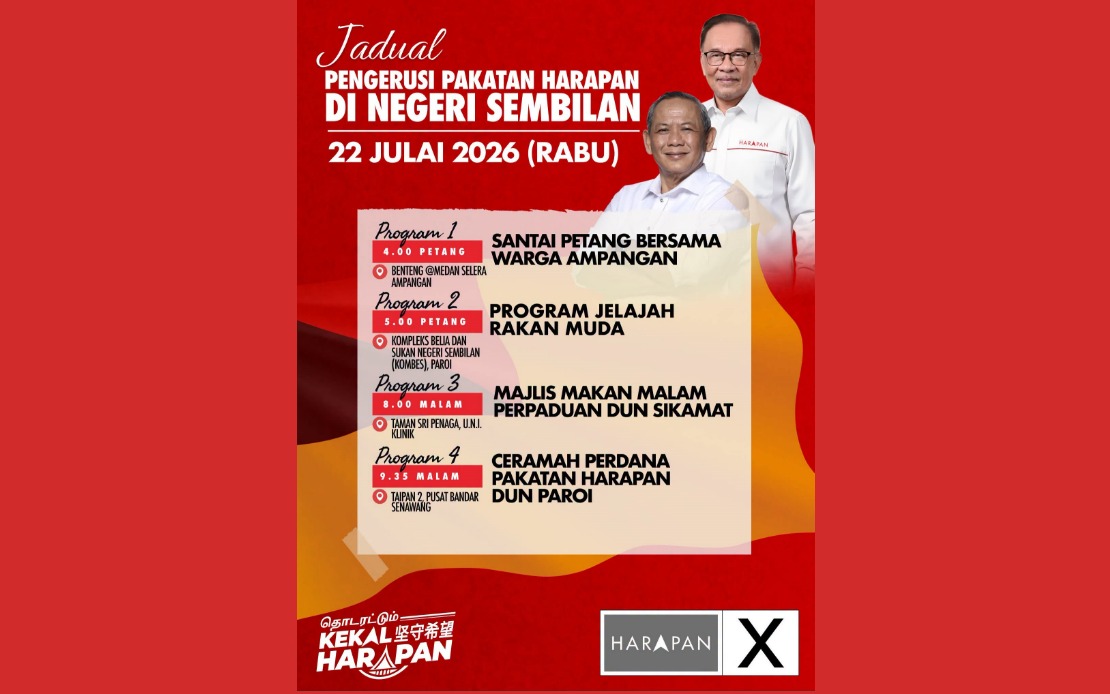
Prime Minister Datuk Seri Anwar Ibrahim is embarking on an intensive campaign tour across Negeri Sembilan on Monday as Pakatan Harapan (PH) seeks to consolidate its political momentum during the ongoing state election campaign. The coalition's campaign efforts are entering their crucial middle phase, and Anwar's personal involvement signals the strategic importance PH places on maintaining control of the state government under incumbent Menteri Besar Datuk Seri Aminuddin Harun.
Anwar's itinerary spans four constituencies—Ampangan, Paroi, Sikamat and Senawang—with a carefully sequenced schedule of community engagement, youth-focused programmes and a major coalition rally. The timing reflects a deliberate strategy to maximise voter exposure during what typically represents a pivotal juncture in state election campaigns. His day begins at 4 pm with 'Santai Petang Bersama Warga Ampangan' at Benteng @ Medan Selera Ampangan, before transitioning to the 'Jelajah Rakan Muda' youth engagement at the Negeri Sembilan Youth and Sports Complex in Paroi at 5 pm.
The campaign schedule then intensifies with a constituency-level unity dinner in Sikamat, designed to bring together party machinery and community leaders in a focused setting. The evening culminates with a large-scale PH mega 'ceramah' at Pusat Bandar Senawang, where Anwar is expected to address a substantial gathering of supporters and uncommitted voters. These varied formats—from intimate community sessions to mass rallies—reflect the coalition's multifaceted approach to voter outreach during the fifth day of the official campaign period.
Anwar's direct participation carries particular significance as PKR president and sitting Prime Minister. His presence at these events provides tangible endorsement of PH's local candidates and reinforces the national government's commitment to Negeri Sembilan's development. For voters, such high-profile visits often carry symbolic weight, signalling that their state remains a priority for the federal administration. This is particularly important in state elections, where local concerns frequently dominate voter decision-making, and the question of whether a particular state can maintain productive relations with the federal government becomes crucial.
The campaign also serves as an opportunity for PH to amplify its recently unveiled state-level manifesto, launched earlier in the week. The coalition's 10-key commitments focus on advancing Negeri Sembilan's development trajectory while emphasising inclusive governance principles. By having Anwar elaborate on these commitments in direct engagement with voters, PH can move beyond generic policy statements and contextualise its promises within the specific circumstances and aspirations of each constituency.
PH's electoral strategy in the 16th Negeri Sembilan state election encompasses all 36 state seats, with the coalition distributing candidacies among its three primary components: 16 seats allocated to PKR, 11 to DAP and nine to Amanah. This allocation reflects internal negotiations within the coalition and attempts to balance representation while maintaining electoral competitiveness. Each component brings distinct voter bases and regional strengths, and the coordination of messaging across these parties during Anwar's campaign appearance underscores the coalition's effort to present a unified front despite inherent internal tensions.
The election timeline is now crystallising, with the Election Commission having scheduled early voting for July 28, followed by the main polling day on August 1. This compressed calendar means that remaining campaign days are increasingly valuable, and Anwar's decision to deploy his time and political capital in Negeri Sembilan reflects strategic calculations about where the election may be decided. States with mixed urban-rural demographics like Negeri Sembilan often produce closely contested results, making systematic ground campaigns essential.
For Malaysian observers, the Negeri Sembilan contest carries broader implications beyond the state itself. The election serves as a mid-term test of PH's popularity at the state level, offering indicators of whether the federal coalition can maintain electoral relevance in peninsular state contests. The results will also provide feedback about voter perceptions of Anwar Ibrahim's premiership, which is still in its relatively early phases. Strong performance in Negeri Sembilan would reinforce PH's claims to sustained voter confidence, while setbacks might suggest emerging challenges to the coalition's political standing.
The appearance also reflects the competitive pressures PH faces in this particular contest. While the coalition currently governs Negeri Sembilan, opposition parties—particularly Barisan Nasional and Perikatan Nasional—will contest vigorously. The fragmented opposition landscape in recent Malaysian politics has created opportunities for incumbent coalitions to retain state power, but only with sustained campaign effort and effective voter mobilisation. Anwar's personal involvement signals that PH recognises this cannot be taken for granted and that deliberate, high-profile campaign presence remains essential to electoral success even for incumbent administrations.
The integration of youth-focused programming into the campaign schedule also reflects demographic considerations. Younger voters, while occasionally overlooked in traditional analysis of Malaysian politics, represent a growing segment of the electorate and are often more responsive to direct engagement by national political figures. The 'Jelajah Rakan Muda' programme specifically targets this demographic, recognising that youth participation will materially influence the final outcome on August 1.
As the campaign enters its second week, the intensity of effort being expended by major party leaders—as evidenced by Anwar's commitment of his Monday schedule—indicates that all major political actors recognise Negeri Sembilan as genuinely competitive. The state's position as a traditional swing state in Malaysian politics, combined with its intermediate size and demographic diversity, makes it both a prize worth fighting for and a reliable predictor of broader electoral trends. The campaign activities unfolding in Ampangan, Paroi, Sikamat and Senawang this week will contribute materially to determining not just which coalition governs the state after August 1, but also what voters' verdict means for Malaysian politics more broadly.

