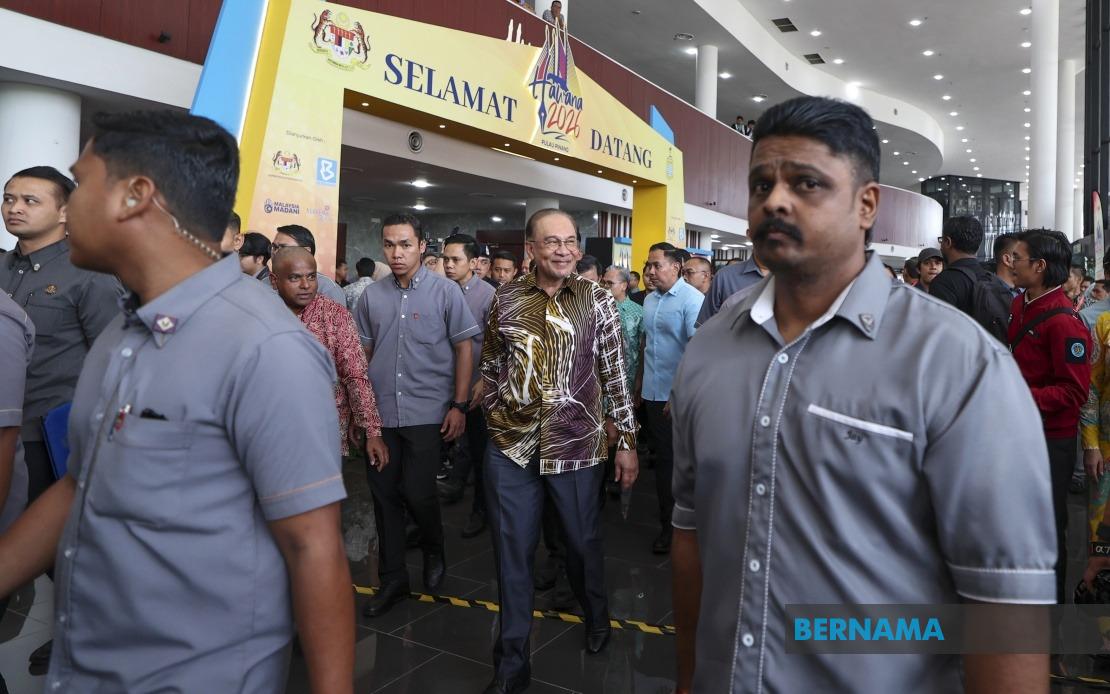
Prime Minister Datuk Seri Anwar Ibrahim travelled to Penang on June 20 to formally inaugurate the centrepiece event of Malaysia's National Journalists' Day 2026 celebration, arriving at the PICCA Convention Centre @ Butterworth Arena in the early afternoon. The visit underscores the government's commitment to recognising the critical role that professional journalism plays in maintaining democratic discourse and public trust, particularly at a time when media credibility faces mounting challenges globally. Anwar's attendance, alongside high-ranking federal and state officials, signals the political importance assigned to the annual gathering of the nation's news and broadcasting fraternity.
The Prime Minister was formally received upon arrival by Penang Chief Minister Chow Kon Yeow, Communications Minister Datuk Fahmi Fadzil, and Communications Ministry secretary-general Datuk Abdul Halim Hamzah, reflecting the multi-level government engagement with the event. Before proceeding to the main ceremony, Anwar took time to tour the exhibition booths and dedicated photo gallery showcasing the work and contributions of Malaysian journalists, demonstrating a hands-on engagement with the profession's achievements and current landscape.
The gathering drew substantial participation from Malaysia's media establishment, with Malaysian National News Agency (Bernama) chairman Datuk Seri Wong Chun Wai, chief executive officer Datin Paduka Nur-ul Afida Kamaludin, and editor-in-chief Arul Rajoo Durar Raj all present. This representation underscores Bernama's central role as the implementing agency for the event under the auspices of the Ministry of Communications. The presence of these senior figures, combined with project director Mohd Shukri Ishak, reflects the organisational infrastructure and senior-level attention devoted to what has become a flagship occasion for the Malaysian media sector.
What distinguishes the 2026 iteration of HAWANA is its deliberate internationalisation, with the event serving as a regional platform that brings together delegations from across Southeast Asia and beyond. Timor-Leste sent representation at the cabinet secretary level, including Secretary of State for Social Communication Expedito Loro Dias Ximenes and the leadership of its national news agency Agencia Noticiosa de Timor-Leste (TATOLI). Cambodia dispatched an Undersecretary of State from its Ministry of Information in the form of Prak Thaveak Amida, while Laos contributed Phuangpasert Keosouvanh, the Permanent Secretary of its Cabinet Office at the Ministry of Technology and Communications. This ASEAN-wide participation reflects growing regional recognition of the importance of strengthening journalistic standards and cross-border media cooperation.
The international dimension extended beyond ASEAN capitals, with delegates from major regional news agencies including Indonesia's Antara News Agency, Vietnam News Agency (VNA), and China's Xinhua News Agency attending the event. Professional journalist associations from the region, including Indonesia's Ikatan Wartawan Indonesia (PWI) and the bilateral Malaysian-Indonesian journalists' association Ikatan Setiakawan Wartawan Malaysia-Indonesia (ISWAMI), also sent representatives. This broad attendance from both state and non-state media institutions indicates that HAWANA has evolved into more than a national occasion; it now functions as a significant convening space for regional media dialogue and collaboration.
Central to Anwar's role at the ceremony was the presentation of the HAWANA Award and Special HAWANA Award, honouring individuals deemed to have made exceptional contributions to the practice of journalism and the development of informed public discourse. The awards represent the government's formal acknowledgement of journalistic excellence and dedication to the profession's fundamental values. Simultaneously, Anwar oversaw the distribution of contributions from the Kasih@HAWANA Fund to media veterans in need, a welfare initiative that addresses the economic vulnerabilities of practitioners, particularly those from earlier generations who may lack adequate retirement security or face unforeseen hardship.
The 2026 celebration proceeded under the thematic banner 'Media Integrity Strengthens Credibility', a framing that carries significant contemporary relevance. In an era marked by misinformation, deepfakes, and erosion of public confidence in established media institutions, the emphasis on integrity represents an implicit acknowledgement of the profession's struggle to maintain legitimacy. The theme suggests a deliberate positioning of professional journalism as a bulwark against information disorder, and signals to both media practitioners and the public that questions of accuracy, transparency, and ethical conduct remain central to the sector's value proposition and social mandate.
The event attracted approximately 1,000 media practitioners from Malaysia and overseas, transforming the Butterworth venue into a de facto industry convention. The scale of participation indicates robust engagement from the working press, broadcasters, digital media operators, and journalism educators, suggesting that HAWANA continues to draw serious professional commitment despite competition for attention and resources in an increasingly fragmented media landscape. The concentration of practitioners within a shared space creates opportunities for networking, skill-sharing, and collective reflection on industry challenges and opportunities.
Organised by the Ministry of Communications through Bernama's implementation, HAWANA operates as an instrument of state policy aimed at celebrating and reinforcing professional media culture. The event functions simultaneously as a recognition ceremony, professional development forum, and diplomatic platform for regional media cooperation. By bringing together journalists from multiple countries and political systems, the gathering implicitly affirms the value of cross-border professional networks and shared understandings of journalism's role in democratic and pluralistic societies, even as individual nations grapple with distinct challenges regarding press freedom, regulatory frameworks, and media ownership concentration.
The emphasis on HAWANA as a platform for generating fresh ideas and charting the trajectory of contemporary journalism reflects broader industry anxieties about journalism's sustainability and relevance in rapidly evolving media ecosystems. The deliberate framing of HAWANA as strategic and forward-looking suggests awareness among event organisers that journalism faces existential questions about funding models, audience engagement, and the relationship between traditional and digital news distribution. By positioning the gathering as a venue for creative thinking about journalism's future, event architects acknowledge that professional survival depends not merely on honouring past achievements but on grappling with structural transformations reshaping the information environment.
For Malaysian observers and Southeast Asian counterparts, the HAWANA 2026 gathering carries significance beyond ceremonial recognition of media professionals. It represents an attempt by governments and institutions across the region to reassert the importance of professionally-produced news and analysis at a moment when technological disruption and commercial pressures threaten traditional journalism's viability. The participation of officials from multiple ASEAN governments signals that media development and journalistic standards are gaining recognition as matters of regional strategic importance, worthy of high-level diplomatic engagement and institutional investment alongside traditional security and economic cooperation initiatives.

