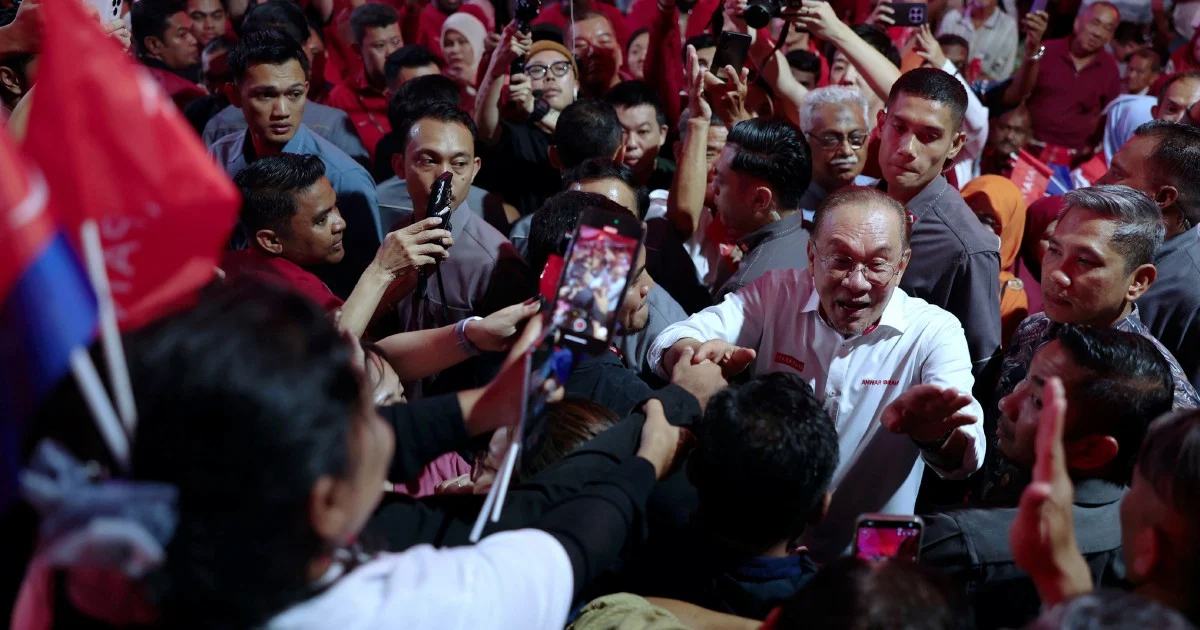
Pakatan Harapan's strategic push into Johor took concrete form when coalition chairman Datuk Seri Anwar Ibrahim formally introduced the opposition's complete candidate lineup of 56 aspirants for the state election set for July 11. The announcement, made at Tangkak, represents a critical juncture for the bloc as it seeks to expand its political footprint beyond its traditional strongholds and challenge the incumbent Barisan Nasional administration that has held sway over Malaysia's southern gateway for decades.
The unveiling ceremony underscores Pakatan Harapan's determination to mount a serious electoral challenge in Johor, a state whose electoral dynamics carry weight well beyond its regional significance. Control of Johor, with its substantial parliamentary and legislative representation, would substantially alter the balance of power in national politics and signal a significant shift in voter sentiment across Southeast Asia's most developed state. The coalition's decision to field a full complement of candidates across all contested seats demonstrates a comprehensive approach rather than a selective engagement strategy.
For Malaysian observers, the Johor election holds particular importance given the state's economic influence and demographic complexity. Home to major industrial zones, the Port of Tanjung Pelepas, and significant urban centres beyond Kuala Lumpur, Johor represents a microcosm of Malaysia's diverse voter base spanning professionals, industrial workers, small traders, and rural communities. The composition of Pakatan Harapan's 56-candidate slate will likely reveal the coalition's strategic thinking regarding which constituencies warrant its strongest resources and messaging emphasis.
Anwar Ibrahim's personal involvement in the candidate unveiling carries symbolic weight within Malaysian politics. As the architect of Pakatan Harapan's electoral strategy and head of the bloc, his direct participation signals the coalition's commitment to this campaign. The choice of Tangkak as the venue—a constituency with its own electoral significance—suggests deliberate positioning of the campaign narrative and the symbolic importance the coalition attaches to this particular contest.
The seven-month runway until the July 11 election provides substantial time for campaign consolidation, candidate ground-work, and coalition messaging refinement. This extended timeline contrasts with snap elections or hastily called contests, allowing voters sustained exposure to campaign narratives and candidate profiles. For Pakatan Harapan, this duration permits thorough introduction of its candidate slate to constituencies, cultivation of grassroots support networks, and articulation of policy alternatives to the incumbent administration.
From a regional perspective, a Johor contest involving a rejuvenated opposition presents interesting parallels to electoral dynamics across Southeast Asia. Thailand, Indonesia, and the Philippines have all witnessed opposition coalitions attempting to challenge entrenched political establishments. The mechanisms Pakatan Harapan employs in Johor—candidate coordination, messaging consistency across a multi-ethnic coalition, and resource mobilization—reflect contemporary opposition politics across the region seeking to overcome structural advantages held by governing coalitions.
The 56-candidate commitment also illuminates intra-coalition negotiations within Pakatan Harapan itself. The distribution of nominations among constituent parties—the Democratic Action Party (DAP), Malaysian United Indigenous Party (Bersatu), People's Justice Party (PKR), and Amanah—reflects delicate balancing of factional interests while maintaining coalition cohesion. Constituencies reserved for particular parties and the placement of high-profile candidates become crucial indicators of coalition strategy and internal power dynamics.
For Johor voters, the unveiling marks the formal commencement of competitive candidate evaluation. Voters will assess the qualifications, track records, and policy positions of both Pakatan Harapan candidates and their Barisan Nasional counterparts across the coming months. Issues pertinent to Johor's electorate—economic development priorities, healthcare access, education quality, and infrastructure advancement—will likely dominate campaign discourse as candidates compete for attention and endorsements.
The election campaign in Johor also occurs within Malaysia's broader political recalibration following shifts in federal politics. Any changes in voter sentiment at the national level, economic conditions affecting household income and employment, or developments in governance perception since previous elections will influence Johor voters' electoral calculus. The state election thus functions partly as a referendum on political satisfaction beyond state-specific issues.
Packatan Harapan's comprehensive candidate slate represents a substantial organizational undertaking requiring coordination across multiple parties, vetting processes, and campaign support infrastructure. Successfully managing 56 campaigns simultaneously across diverse constituencies demands sophisticated campaign architecture, resource allocation mechanisms, and consistent messaging while permitting necessary localization for constituency-specific concerns.
The implications of this candidacy announcement extend beyond electoral mathematics to encompass Malaysia's democracy itself. Competitive elections featuring substantive opposition presence strengthen democratic processes through vigorous scrutiny of governance, policy alternatives, and accountability mechanisms. Johor's July 11 election will test voter appetite for political alternatives and assess whether conditions favour opposition advancement or incumbent consolidation in Malaysia's complex political landscape.
Looking forward, the coherence of Pakatan Harapan's campaign execution, the resonance of its policy messaging, and the credibility of its candidate slate across Johor's diverse regions will determine electoral outcomes. The candidate unveiling ceremony marks a symbolic beginning rather than campaign conclusion, setting the stage for months of intensive political engagement that will reshape Malaysian political calculations.

