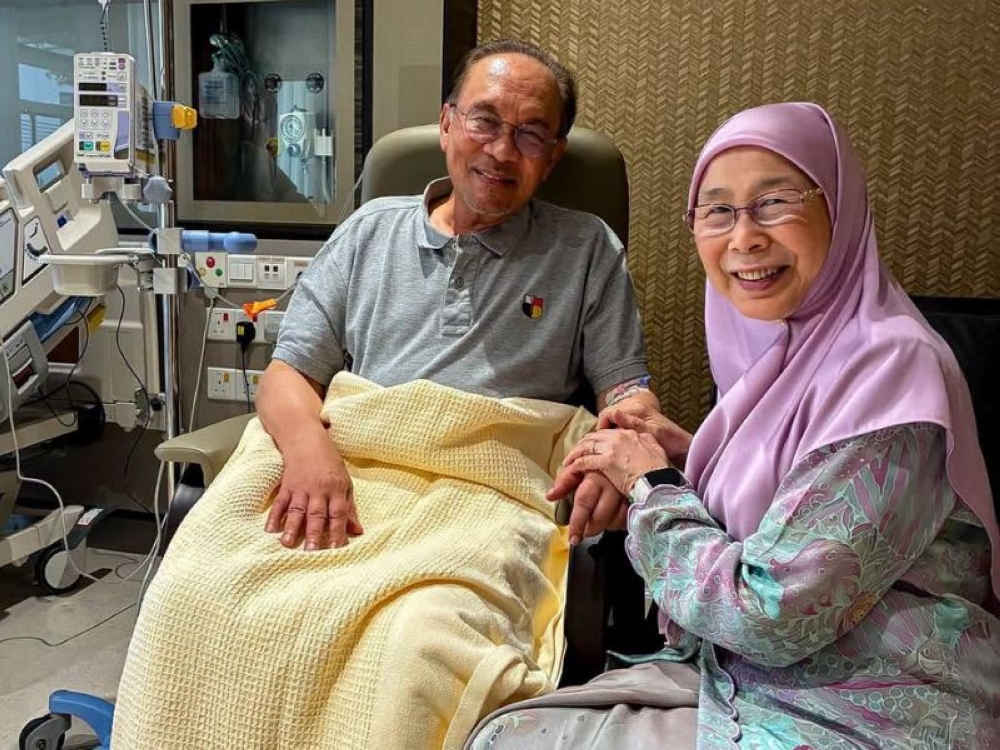
Prime Minister Datuk Seri Anwar Ibrahim is poised to return home on Monday after completing a planned laparoscopic procedure at hospital, marking the conclusion of a brief medical treatment that has seen the nation's leader step back from public duties over the weekend. The confirmation came from his wife, Datin Seri Dr Wan Azizah Wan Ismail, who indicated that medical professionals have cleared the Prime Minister for discharge following what is considered a routine surgical intervention.
The decision to undergo elective laparoscopic surgery—a minimally invasive operative technique employing small incisions and specialised instruments—demonstrates a proactive approach to healthcare management by the nation's top political leader. Such procedures, which fall under the category of planned rather than emergency interventions, typically allow for faster patient recovery compared to traditional open surgery methods. The choice of timing and surgical approach reflects careful medical planning to minimise disruption to the country's governance structure.
For Malaysian observers and international analysts tracking the stability of Southeast Asia's political landscape, the Prime Minister's scheduled return to full duties signals continuity in the government's operations. Anwar Ibrahim's swift anticipated recovery from the laparoscopic intervention underscores the effectiveness of modern surgical techniques in allowing high-ranking officials to maintain their capacity to lead with minimal downtime. The procedure represents the kind of health maintenance that many senior government figures pursue while in office to preserve long-term fitness for demanding leadership roles.
Laparoscopic surgery has become the preferred methodology for numerous abdominal and pelvic interventions across Malaysian healthcare facilities and internationally. The technique's advantages—including reduced tissue trauma, diminished postoperative discomfort, and accelerated rehabilitation—make it an increasingly common choice for elective procedures. The Prime Minister's selection of this approach reflects contemporary medical standards being applied within Malaysia's healthcare system for high-level government personnel.
The announcement through Datin Seri Dr Wan Azizah Wan Ismail maintains transparency regarding the nation's leadership during a period when the Prime Minister was temporarily managing his health. Such communication helps reassure both domestic constituencies and international partners that any gaps in the Prime Minister's direct involvement in daily governance were both anticipated and brief. The clarity provided by his family demonstrates a balance between maintaining appropriate privacy regarding personal medical matters while keeping the public informed about continuity of leadership.
For the machinery of government, the Prime Minister's expected return represents a resumption of full executive authority after a predictable interruption. During his recovery period, deputy leaders and relevant ministers would have maintained the functioning of essential state operations, ensuring that policy implementation and administrative decision-making proceeded without significant obstacles. Such institutional resilience, where government structures can function effectively during temporary absences of the top official, reflects the maturity of Malaysia's bureaucratic systems.
The timing of the surgical procedure during Malaysia's ordinary parliamentary calendar—rather than during critical legislative sessions or international diplomatic engagements—demonstrates considered planning. Scheduling elective procedures around the nation's political calendar represents sound governance practice, ensuring that the Prime Minister's absence does not coincide with moments requiring his direct involvement in consequential national decisions or high-stakes regional negotiations.
From a regional perspective, the Prime Minister's swift recovery and return to duty carries implications for Malaysia's continued engagement with neighbouring Southeast Asian nations and broader international commitments. Political stability at the apex of government, demonstrated through predictable and professionally managed health interventions, contributes to investor confidence and regional diplomatic assurance. Nations throughout the region, many grappling with their own leadership transitions and political uncertainties, observe how Malaysia manages continuity within its executive branch.
The deployment of laparoscopic surgical methods for the Prime Minister's treatment also reflects Malaysia's capacity to provide world-class medical interventions for its highest officials within domestic healthcare facilities. This capability, whether utilised by government leaders or available to the broader population, represents an important dimension of the nation's healthcare infrastructure and technological advancement. The confidence demonstrated in local surgical expertise, rather than seeking treatment abroad, carries subtle significance regarding the quality of Malaysia's medical sector.
As the Prime Minister prepares to resume his full schedule of executive duties following hospitalisation, continuity of policy direction and strategic initiatives should proceed without major interruption. His wife's confirmation of the anticipated discharge provides the definitive timeline that government agencies, parliamentary procedures, and international partners require for coordination purposes. The managed nature of this medical episode—anticipated, completed according to plan, and resolved swiftly—exemplifies how contemporary healthcare enables political leaders to maintain their capacity for sustained governance despite the inevitable physiological demands of office.
The coming days will determine whether the Prime Minister's recovery proceeds smoothly and whether he can rapidly return to the full intensity of his executive responsibilities. Such episodes, though individually routine, form part of the broader backdrop against which Malaysia's political stability and governmental effectiveness are assessed both domestically and internationally.

