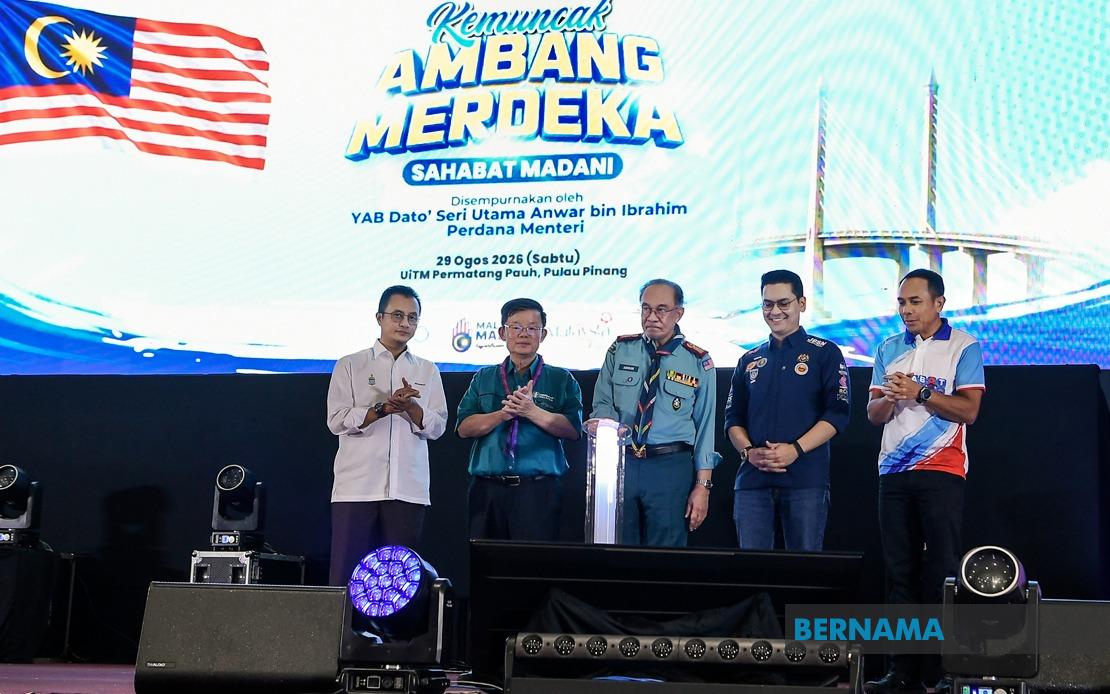
Prime Minister Datuk Seri Anwar Ibrahim has formally inaugurated Sahabat MADANI, a nationwide volunteer movement that represents a coordinated effort to harness grassroots participation in national development. The launch took place at Universiti Teknologi MARA (UiTM) Permatang Pauh in Bukit Mertajam during the Ambang Merdeka Sahabat MADANI 2026 programme, coinciding with Malaysia's National Day commemorations. The initiative has already demonstrated significant traction, with 11,060 volunteers registered across the country since its announcement, signalling substantial public interest in structured community engagement.
At its core, Sahabat MADANI represents an institutional framework for channelling volunteer energy toward concrete social objectives. The Implementation Coordination Unit of the Prime Minister's Department (ICU JPM) describes the movement as more than symbolic activism, instead positioning it as a mechanism to deliver tangible benefits to vulnerable populations. The initiative's scope encompasses supporting economically disadvantaged groups, intervening in youth dropout crises through educational rehabilitation, creating livelihood pathways for young people through employment and entrepreneurship programmes, and mobilizing rapid community response during emergencies and natural disasters. This multi-faceted approach suggests the government views volunteering not as supplementary charitable work but as integral infrastructure for social service delivery.
The philosophical underpinning of Sahabat MADANI extends beyond conventional notions of welfare provision. The movement explicitly emphasises mutual respect and cross-cultural participation, deliberately positioning itself as a bridge across Malaysia's diverse ethnic, religious and socioeconomic communities. This architecture reflects broader governance ambitions articulated through the Malaysia MADANI framework, which centres on inclusive prosperity and collective wellbeing. By creating structured opportunities for citizens from different backgrounds to work collaboratively on shared challenges, the initiative addresses a persistent concern in Malaysian public discourse: whether national unity can transcend ceremonial rhetoric to become embedded in everyday practice.
The volunteer network's operational model relies on coordination between three distinct constituencies: government agencies, registered volunteers, and local communities. This triangular structure distinguishes Sahabat MADANI from purely grassroots volunteering arrangements. The ICU JPM emphasises that services and interventions are responsive to communities' actual needs rather than predetermined by bureaucratic directives, suggesting a bottom-up intelligence gathering mechanism. The emphasis on transparency and measurable results indicates accountability mechanisms intended to prevent the volunteer infrastructure from becoming merely symbolic or captured by particular interests.
For Southeast Asian observers, the scale and speed of Sahabat MADANI's uptake warrants examination. Within a short timeframe, the movement mobilised over 11,000 registered participants, suggesting either sophisticated recruitment infrastructure or genuine organic interest in structured volunteering opportunities. The figure itself—11,060—indicates precise registration tracking and suggests the initiative employs digital platforms for volunteer management and coordination. This technological dimension may enable the movement to operate at greater scale and efficiency than traditional volunteer organisations, while also creating data streams that could inform policy refinement.
The timing of Sahabat MADANI's launch carries strategic significance. Positioned during National Day celebrations, the initiative frames volunteerism as an expression of patriotic obligation and independence, connecting individual service to national renewal. This rhetorical strategy potentially reframes the relationship between citizens and state: rather than passively receiving government services, Malaysians are invited to become active agents in their own welfare and community development. The ICU JPM's statement explicitly appeals to young people to reject divisive sentiments and channel their capabilities toward constructive ends, suggesting the initiative targets generational concerns about polarisation and social fragmentation.
The initiative's focus on economic opportunity creation reflects pragmatic understanding of Malaysia's development challenges. By creating pathways for youth employment and business development through volunteer networks, Sahabat MADANI potentially addresses underemployment and skills development gaps that conventional policy instruments have struggled to resolve. The emphasis on supporting vulnerable groups and dropout intervention suggests the movement acknowledges systemic failures that require community-level solutions beyond formal institutional capacity. This approach has implications for how Southeast Asian governments conceptualise social safety nets, potentially demonstrating alternative models that leverage distributed citizen participation.
Sahabat MADANI's anti-corruption dimension deserves particular attention in the Malaysian context. The ICU JPM explicitly identifies combating corruption as among the initiative's objectives, implying that volunteer mobilisation serves not only service delivery but also institutional reform. This framing suggests corruption is understood as a collective action problem susceptible to community-level intervention, not merely a technical enforcement challenge. If volunteer networks can establish social accountability mechanisms and monitor resource distribution, they may contribute to governance improvements that formal anti-corruption institutions alone cannot achieve.
The cross-community cooperation emphasis within Sahabat MADANI addresses a persistent concern in Malaysian political economy: whether plural societies can sustain inclusive development frameworks or whether competition for resources inevitably fractures along identity lines. By creating structured, purpose-driven contact opportunities across ethnic and religious boundaries, the initiative potentially generates social capital that resists divisive political mobilisation. However, success depends on whether volunteer experiences translate into sustained community relationships or remain episodic encounters that leave underlying tensions unaddressed.
For regional governance trends, Sahabat MADANI represents an interesting case study in state-orchestrated volunteerism. Unlike purely civil society volunteering, this movement operates within government coordination frameworks and explicitly advances state-defined development objectives. This hybrid model differs from both market-driven social enterprise approaches and autonomous civil society activism. Understanding whether such state-embedded volunteer movements generate authentic grassroots engagement or function primarily as implementation vehicles for government programmes remains an open question that will develop as the initiative matures.
The practical effectiveness of Sahabat MADANI will ultimately depend on whether 11,060 registered volunteers translate into sustained service provision and whether coordinated government-volunteer-community partnerships genuinely improve outcomes for target populations. The movement's success metrics should extend beyond volunteer registration figures to encompass whether participating communities experience improved economic opportunities, whether youth retention in education improves, and whether cross-community relations substantively strengthen. These measures will determine whether Sahabat MADANI becomes an enduring institutional innovation or remains a time-limited mobilisation effort.

