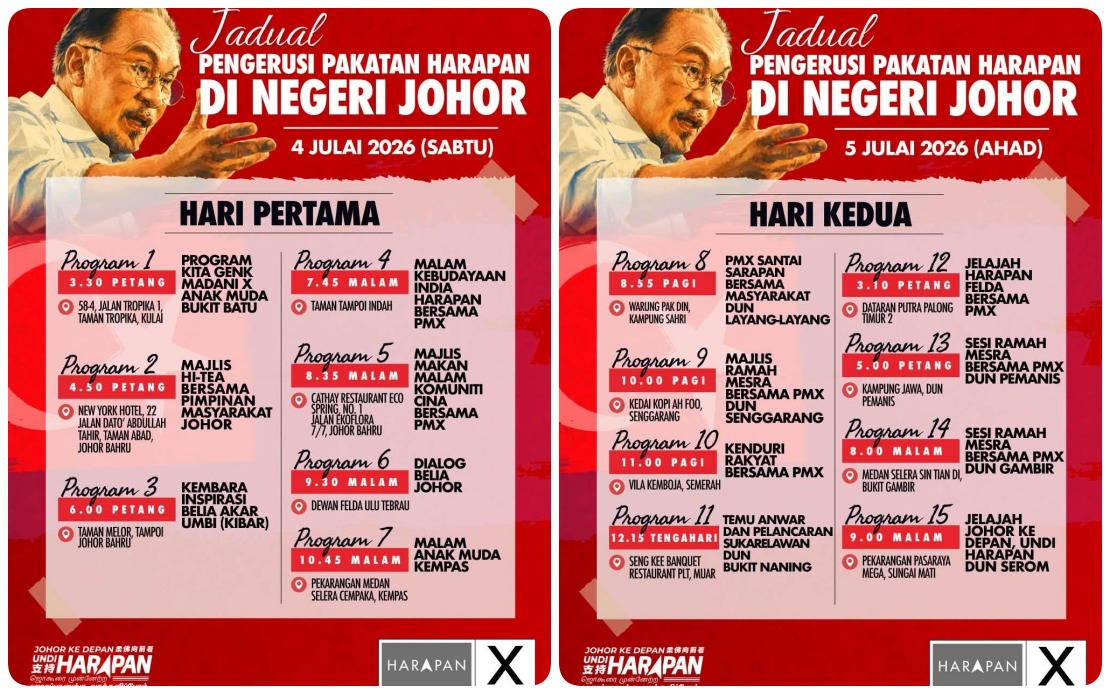
Prime Minister Datuk Seri Anwar Ibrahim is ramping up Pakatan Harapan's campaign machinery in Johor with an intensive schedule of seven engagement programmes throughout the state today, signalling the coalition's determination to consolidate support before the 16th Johor state election on July 11. The comprehensive itinerary, posted on the PM's official Facebook page, underscores the coalition's strategy of maintaining high-visibility leadership presence in the crucial southern state, where electoral momentum could significantly influence national political trajectories.
The campaign schedule reflects a carefully calibrated approach to voter engagement across multiple demographic segments. Beginning with direct voter interaction sessions, Anwar's day progresses to more formal community networking at a high tea reception with Johor's community leaders at a hotel in Johor Bahru at 4.50 pm. This segment of the itinerary is designed to reach influential figures and established stakeholders across various professional sectors, acknowledging that electoral success often hinges on securing backing from community opinion-formers alongside grassroots support.
Youth mobilisation features prominently in today's schedule, with a dedicated Johor Youth Dialogue session planned at Felda Ulu Tebrau Hall at 9.30 pm. This programming choice reflects broader recognition within PH that younger voters—often characterised as more volatile and harder to energise—require targeted messaging and direct leader engagement. Anwar's personal participation in youth-focused forums signals institutional commitment to bridging generational divides that have complicated opposition coalition fortunes in previous electoral cycles across the region.
The intensity of the campaign schedule is notable given Anwar's additional responsibilities as sitting Prime Minister. His continued personal involvement in state-level campaigning underscores the strategic importance PH assigns to Johor, a state whose political complexion has shifted considerably in recent years and where the coalition faces meaningful competition from both Perikatan Nasional and incumbent Barisan Nasional elements. The seven programmes scheduled for today will be followed by eight additional events tomorrow, suggesting a sustained push to maximise the coalition's visibility and reach across diverse constituencies.
Pakatan Harapan's candidate slate demonstrates the coalition's internal balance and collaborative structure in pursuing the Johor mandate. Across all 56 state assembly seats, PKR fields 20 candidates, Amanah contributes 19, and DAP provides 17 representatives. This distribution reflects negotiated power-sharing agreements that have characterised the coalition since its formation, though internal frictions over seat allocation and candidate selection have periodically tested unity. The unified candidacy across all 56 seats, however, indicates that PH remains committed to a comprehensive challenge rather than a selective approach.
The broader electoral context encompasses 172 total candidates contesting these 56 seats, fragmentation that suggests competitive three-way contests in numerous districts. Early voting scheduled for July 7 provides logistical opportunities for working voters and essential personnel, while the main poll occurs on July 11. This calendar gives PH approximately one week from the opening of the campaign calendar to consolidate support and counter opposition messaging.
Johor's political significance extends beyond its 56 assembly seats. The state has historically served as a political bellwether for Malaysian national sentiments, and its electoral outcomes frequently influence broader coalition dynamics and perceptions of momentum heading into potential federal political realignments. A strong PH performance here could strengthen the coalition's positioning ahead of potential mid-term electoral calculations, while a disappointing result might embolden political rivals and complicate federal coalition management.
The campaign's multi-layered approach—combining high-visibility leader presence, structured community engagement, and targeted youth outreach—reflects lessons learned from previous electoral contests across Southeast Asia where mobilisation density and leadership visibility have demonstrated measurable electoral returns. Anwar's personal investment of time across diverse event typologies suggests PH strategists believe the state remains contestable and that concentrated effort can shift marginal seats.
The coalition faces a challenging political environment characterised by fragmented voter preferences, competing claims on Bumiputera support, and questions about PH's economic management record. Nevertheless, the intensity of today's and tomorrow's campaign schedule signals institutional confidence that sustained engagement and direct leader accessibility can persuade undecided voters and reinvigorate party machinery. The seven programmes today represent more than routine campaign activities—they embody PH's strategic judgment that Johor represents both an opportunity for consolidation and a potential vulnerability requiring sustained senior-level attention.

