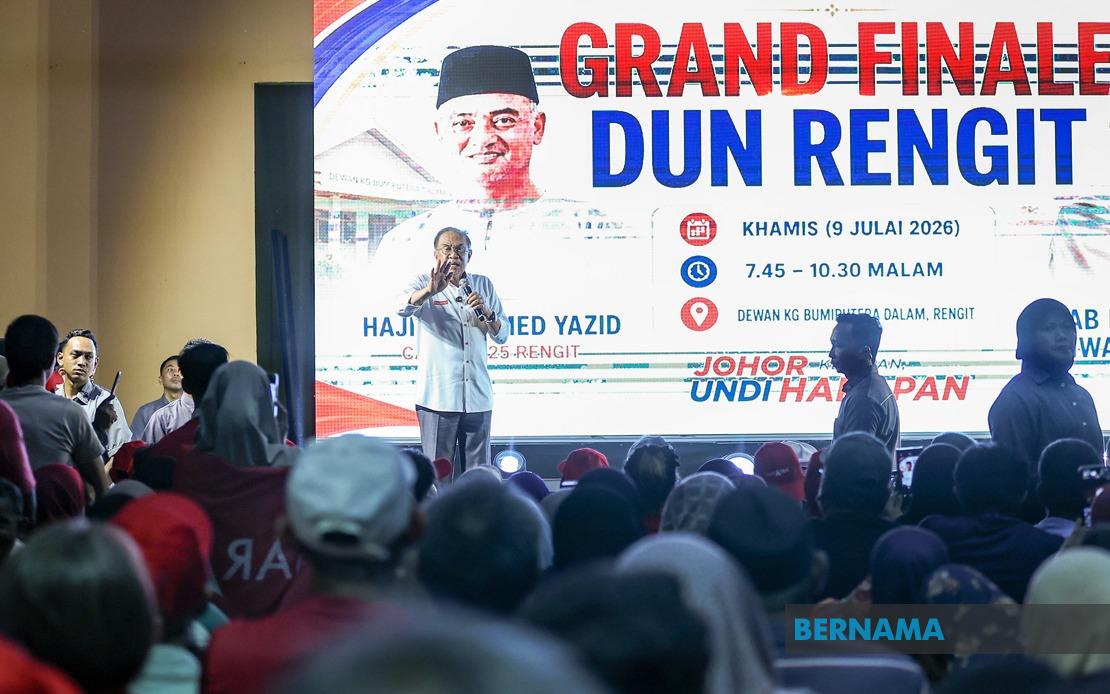
Prime Minister Datuk Seri Anwar Ibrahim has committed to tackling entrenched infrastructure deficiencies in Rengit, pledging that the constituency will receive urgent attention to resolve persistent gaps in healthcare provision and water distribution. Speaking at a Pakatan Harapan campaign event in Batu Pahat on July 9, Anwar characterised these challenges as inconsistent with Johor's aspirations as a developed state, positioning infrastructure renewal as a moral and developmental imperative rather than mere electoral promise.
The prime minister framed access to clean water and functional healthcare as fundamental entitlements that transcend political cycles and should command unwavering government commitment. His remarks underscored a philosophy that basic services cannot be neglected or deferred, setting a rhetorical standard that extends beyond Rengit to other communities facing similar deprivations across Malaysia. This framing is significant for constituencies nationwide that grapple with ageing infrastructure and inconsistent service delivery, as it elevates these concerns from local grievances to matters of state responsibility and national development priorities.
Anwar's emphasis on the quality of healthcare infrastructure carried particular weight, employing the memorable phrase that clinics should treat the sick rather than themselves requiring treatment. This vivid characterisation highlights the practical reality facing many rural and semi-urban Malaysian communities where medical facilities operate below acceptable standards. The statement implicitly critiques years of underinvestment and maintenance backlogs in peripheral health centres, acknowledging that infrastructure decay undermines healthcare delivery regardless of the calibre of medical personnel deployed to these facilities.
The campaign event represented one of three concurrent PH engagements across Johor on the evening, demonstrating the intensity of the coalition's mobilisation ahead of the 16th state election scheduled for Saturday. The multi-location strategy reflected the coalition's commitment to reaching diverse voter bases and consolidating support across constituencies with varying demographic compositions. Such concentrated campaigning typically indicates competitive races where marginal shifts in voter sentiment could determine outcomes, particularly in constituencies like Rengit where swing voters may prove decisive.
Sri Gading MP and Johor Amanah chairman Aminolhuda Hassan's presence alongside PH candidate for Rengit Yazid Abu Bakar underscored the coalition's internal alignment and candidate validation mechanisms. Aminolhuda's dual role as a federal parliamentarian and state party chairman positioned him as a bridge between national and state-level political structures, reinforcing messaging that voting for PH at state level would strengthen connections to federal development resources and policy implementation. This layering of political authority is a standard campaign technique designed to persuade voters that local decisions carry national implications.
Beyond specific infrastructure commitments, Anwar articulated a broader development philosophy prioritising essential services as foundational to competitive governance. By grouping water supply, housing, education and healthcare as interconnected priorities, the prime minister positioned these domains as mutually reinforcing elements of state capacity. This systems-based approach resonates with development theory emphasizing that individual infrastructure improvements yield diminishing returns unless embedded within comprehensive service ecosystems that address multiple citizen needs simultaneously.
Anwar's appeal to government officials and community leaders to exercise their positions with integrity addressed a persistent Malaysian governance challenge: the perception that power confers personal privilege rather than custodial responsibility. By explicitly cautioning against positional abuse, he acknowledged public cynicism regarding official conduct while potentially signalling that a future PH-led Johor government would implement accountability mechanisms and transparency standards. Such rhetoric can influence vote calculations among citizens prioritising governance quality over ideological alignment or patronage networks.
The prime minister's counsel to voters to elect representatives aligned with the Federal Government merits close examination, as it contains an implicit threat regarding development resource allocation. The suggestion that PH-aligned state representatives would facilitate more efficient development implementation implicitly signals that non-aligned representatives might struggle to secure federal funding or administrative cooperation. This coercive messaging, while standard in Malaysian electoral politics, reinforces the centralisation of development authority at the federal level and the dependency of state governments on federal goodwill regardless of their own revenue bases or policy capacities.
Pakatan Harapan's comprehensive contest of all 56 seats represented an ambitious and resource-intensive campaign strategy, with 20 candidates from PKR, 19 from Amanah and 17 from DAP reflecting negotiated seat allocations within the coalition. These distribution patterns suggest careful calculations regarding which party fielded candidates in constituencies where they possessed strongest support infrastructure and voter identification networks. The absence of independent or non-PH candidates in these arrangements indicates high party discipline and coalition cohesion, though it also raises questions regarding voter choice limitations and competitive dynamism within the electoral marketplace.
With 172 total candidates competing across 56 seats, the election averaged three candidates per constituency, suggesting moderate electoral fragmentation. This ratio provides meaningful voter choice without excessive ballot dilution, though it indicates significant non-PH contestation likely from Barisan Nasional and independent candidates. The competitive density varies considerably across constituencies; some seats may feature only two serious contenders while others host more complex multi-way contests affecting strategic voting calculations and coalition viability.
For Malaysian observers monitoring state election trends, the Johor contest provides important indicators regarding urban-rural political dynamics, the Anwar-era PH coalition's consolidation of support, and whether state-level infrastructure grievances translate into electoral punishment or reward. Rengit's status as a contested constituency with documented infrastructure deficiencies makes it a bellwether for how voters weigh policy commitments against historical delivery records. The prime minister's detailed attention to this specific location signals strategic importance while creating measurable expectations that subsequent government performance will be evaluated against pledged improvements.

