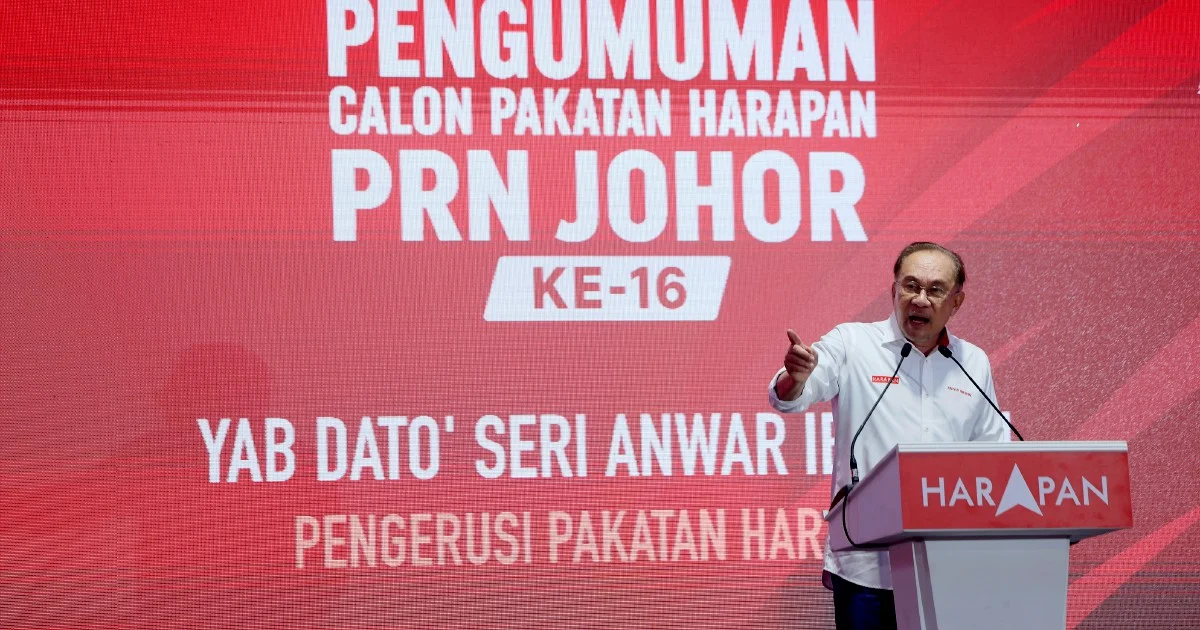
Prime Minister Datuk Seri Anwar Ibrahim has challenged the Johor state government to independently verify longstanding complaints that the prosperous state has been shortchanged in federal revenue distributions under previous administrations. Speaking in Tangkak, Anwar encouraged state executive councillors to conduct a thorough investigation into claims that Johor did not secure its proportionate share of national funds, directing particular scrutiny at both the Barisan Nasional and Perikatan Nasional federal governments that preceded the current administration.
The Prime Minister's call reflects an emerging political strategy within the Pakatan Harapan-led federal government to acknowledge grievances that have simmered among Johor's leadership while simultaneously positioning the current administration as more transparent and willing to address historical imbalances. By encouraging state officials to independently pursue the matter rather than imposing findings from Putrajaya, Anwar has signalled confidence in the investigation process and a commitment to respecting state autonomy—a message likely aimed at rebuilding federal-state relationships that deteriorated during the Perikatan Nasional period.
Johor's concerns about federal revenue allocation carry substantial weight within Malaysian political discourse. As one of the country's most economically developed and revenue-generating states, Johor contributes significantly to national coffers through taxation, port operations, and industrial activity. The state government has periodically raised concerns that its contributions to the federal treasury do not translate proportionally into development allocations, an argument that resonates with both ruling-coalition and opposition-aligned figures within Johor's administration.
The Barisan Nasional federal government, which governed Malaysia until 2018, operated under resource-distribution mechanisms that critics contend favoured politically aligned states and regions. During that extended period, Johor's allocation of development funds came under scrutiny from various stakeholders who questioned whether the state's economic output was reflected adequately in federal project investments. These grievances persisted even as Johor maintained strong economic fundamentals and continued expanding its manufacturing, logistics, and port sectors.
When Perikatan Nasional assumed federal power in March 2020, initially expectations existed that the coalition might recalibrate federal spending patterns. However, the short-lived 22-month Perikatan tenure saw the federal government consumed by managing the Covid-19 pandemic and internal political instability, leaving limited bandwidth for comprehensive revenue-sharing reviews. Johor's revenue questions remained largely unaddressed during this period, contributing to frustration among state administrators who sought clarity on their state's fiscal relationship with the federal government.
Anwar's explicit mention of both preceding administrations suggests the current government intends to conduct a comprehensive audit of federal distribution practices spanning several years. Such an investigation could reveal historical patterns in resource allocation that either validate Johor's concerns or provide data-driven evidence regarding the state's actual standing. The stakes extend beyond Johor itself, as other states may similarly harbour questions about their own federal revenue treatment, making this inquiry potentially consequential for federal-state fiscal relationships nationwide.
The timing of Anwar's intervention carries political significance as well. Johor remains strategically crucial for any federal coalition's electoral viability, and the state's political dynamics have shifted considerably in recent years. By demonstrating responsiveness to Johor's financial grievances and empowering state officials to investigate the matter, Anwar reinforces the current government's narrative that it operates with greater accountability and transparency than its predecessors. This positioning appeals to reform-minded voters and state-level officials who value honest governance.
For Malaysian observers, this episode underscores persistent tensions within the federal system regarding how national resources should be distributed among states based on economic contribution, population, development needs, and other criteria. These distribution debates occur in most federal systems globally, but in Malaysia they intersect with complex political alignments and questions of electoral advantage, making purely technical solutions difficult to achieve. Johor's scale and economic importance mean its grievances cannot be easily dismissed or deferred indefinitely.
The broader implications for Southeast Asia merit consideration as well. As Malaysia navigates its governance challenges, its approach to federal resource distribution serves as an informal benchmark for other regional states wrestling with centre-periphery relationships. How effectively the current administration addresses Johor's concerns could influence broader perceptions of Malaysian federalism's functionality and fairness, with potential ramifications for investor confidence and regional political stability.
Moving forward, the investigation Anwar has implicitly endorsed will likely produce detailed findings regarding federal spending patterns and revenue allocation mechanisms. Whether these findings prompt significant policy adjustments or represent a more modest reassessment remains uncertain. Nevertheless, by encouraging state officials to question historical practices and by acknowledging the legitimacy of their concerns, the Prime Minister has signalled that federal-state fiscal relationships are appropriate subjects for scrutiny and potential reform—a departure from previous governments' more defensive postures on such matters.

