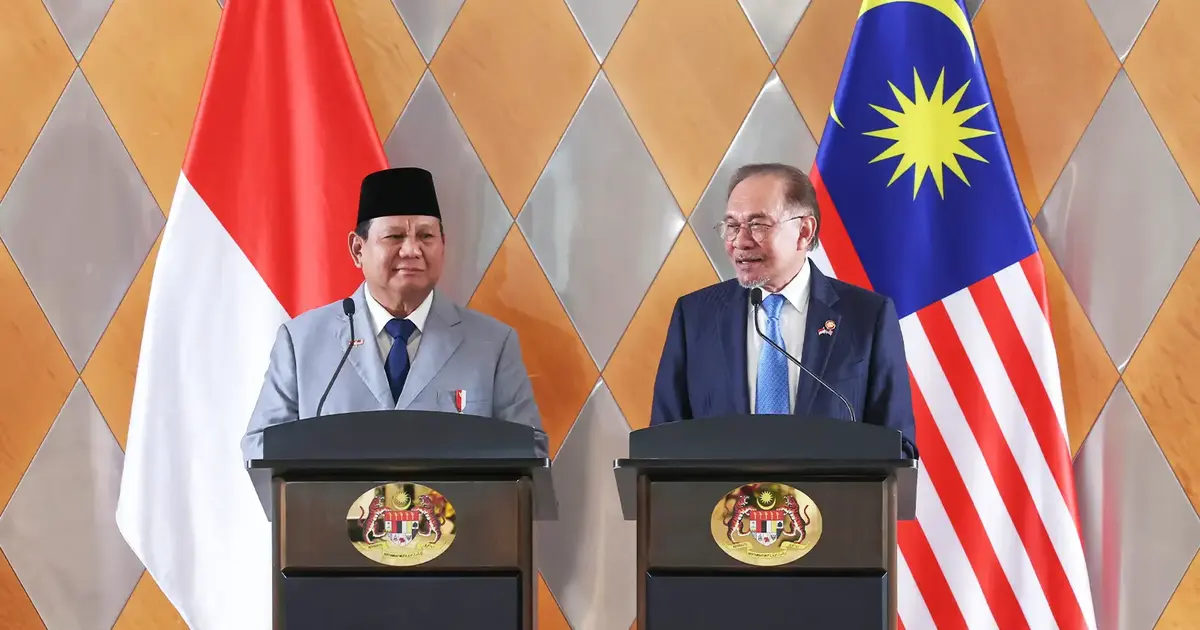
Prime Minister Anwar Ibrahim has taken direct diplomatic action over the troubled Eagle High venture, writing personally to Indonesian President Prabowo Subianto to address mounting concerns about Felda's substantial financial exposure. The communication underscores the severity of the situation facing Malaysia's federal land development agency, which stands to lose more than RM2 billion if the complex cross-border transaction is not resolved with care and strategic negotiation.
The Eagle High project represents one of the most significant financial challenges confronting Felda in recent years. The investment, which totals RM2 billion, has emerged as a critical issue requiring the highest levels of political attention. Anwar's decision to reach out directly to Prabowo signals that Malaysian leadership views this matter not merely as a corporate or administrative concern, but as an issue warranting intervention at the presidential level. The fact that the Prime Minister himself has chosen to pen correspondence to Indonesia's newly inaugurated leader demonstrates the urgency and gravity with which Kuala Lumpur regards the situation.
The scale of potential financial exposure is staggering. If mishandled, Felda faces the prospect of losing the entirety of its RM2 billion commitment, with realistic recovery scenarios suggesting the agency might recoup only RM200 million under favourable circumstances. This means a shortfall of RM1.8 billion in the worst-case scenario, representing a devastating blow to an organisation with historical significance in Malaysia's rural development agenda. For a country that has positioned Felda as a cornerstone of agricultural modernisation and smallholder prosperity, such losses would reverberate across multiple policy domains.
Felda's predicament reflects broader vulnerabilities within the Malaysian investment ecosystem. Large-scale capital deployment in cross-border ventures, particularly those involving complex corporate structures and foreign partnerships, requires robust due diligence frameworks and ongoing monitoring mechanisms. The Eagle High transaction appears to have encountered difficulties that earlier scrutiny or more stringent oversight protocols might have mitigated. The fact that the situation has deteriorated to the point where prime ministerial intervention is necessary suggests institutional gaps in risk management and governance at both Felda and potentially within relevant federal oversight bodies.
The choice to communicate through diplomatic channels rather than through formal commercial or legal avenues indicates that negotiations have likely reached an impasse. Indonesian President Prabowo, as the head of state and commander of Indonesia's military establishment before entering civilian politics, carries substantial influence within Jakarta's power structures. An appeal from Malaysia's Prime Minister to the Indonesian President suggests that resolving this matter may require political coordination at the highest echelons of both governments, potentially involving considerations beyond purely commercial interests.
The timing of Anwar's letter is noteworthy given Indonesia's recent political transitions. Prabowo's presidency began in October 2024, and his administration continues navigating domestic priorities and international relationships. The insertion of a significant bilateral economic issue into these early months of his tenure reflects Malaysia's assessment that immediate action is necessary. Bilateral economic cooperation between Malaysia and Indonesia carries substantial weight, encompassing trade, investment, and regional development initiatives. A RM2 billion dispute involving a Malaysian state enterprise could become an unnecessary friction point if not handled diplomatically.
For Malaysian investors contemplating ventures in Indonesia or other regional economies, the Eagle High situation carries cautionary implications. The case demonstrates that even government-linked entities with institutional backing face risks in complex international transactions. Transparency in deal structuring, clarity regarding exit strategies, and robust mechanisms for addressing performance issues require careful attention during the initial phases of investment. The seeming inability to resolve the matter through conventional corporate channels until reaching the prime ministerial level suggests that contractual frameworks may have contained ambiguities or that partner conduct fell short of agreed obligations.
Felda's role in Malaysia's agricultural and rural sectors means that this financial drain directly impacts the agency's capacity to pursue its core mandate. The federal land development fund serves smallholder farmers across peninsular Malaysia, and substantial capital losses could constrain expansion programmes, infrastructure improvements, or support services to constituent communities. Regional development patterns may suffer if Felda's investment capacity diminishes significantly. This ripple effect transforms what might appear as a discrete commercial problem into a matter affecting rural livelihoods and agricultural productivity.
The potential recovery of only RM200 million from a RM2 billion investment reflects a fundamental value destruction of 90 percent. Such dramatic impairment suggests either that the underlying asset has deteriorated substantially since acquisition, or that contractual terms disadvantage Felda in any liquidation or restructuring scenario. Understanding why recovery prospects are so limited requires scrutiny of the deal structure, the nature of the underlying business, and the legal standing Felda occupies relative to other creditors or stakeholders. These details will become crucial as negotiations advance.
Ahead lies the complex process of resolving the dispute through diplomatic engagement between Malaysian and Indonesian authorities. Anwar's letter represents the opening move in what may become protracted negotiations. The involvement of presidential-level leadership from both nations indicates that political considerations now interweave with commercial and legal arguments. For Malaysia's broader investment strategy and for Felda specifically, the resolution of Eagle High will carry lessons about international venture partnerships and the importance of robust institutional oversight in cross-border capital deployment.

