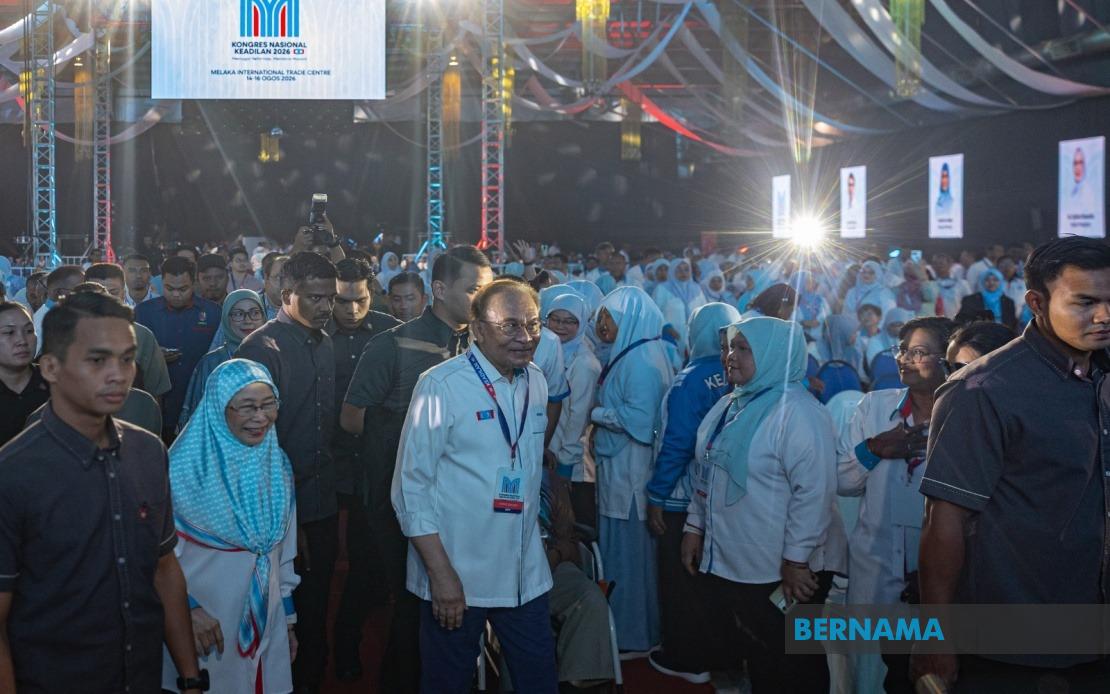
Prime Minister Datuk Seri Anwar Ibrahim has publicly reaffirmed his administration's intention to maintain its working relationship with UMNO-Barisan Nasional at the federal level, framing the choice as essential to Malaysia's political stability and economic wellbeing. Speaking during the PKR National Congress 2026 at the Melaka International Trade Centre, Anwar sought to address mounting speculation about tensions within the Unity Government coalition by emphasising that pragmatic governance must supersede individual ambitions or grievances.
Anwar's remarks come against a backdrop of recent political friction that has prompted observers to question the durability of the coalition that has anchored Malaysian politics since the 2022 general election. By explicitly stating that cooperation with UMNO-BN would continue, the Prime Minister signalled his determination to keep the broad alliance intact despite underlying strains. His comments also served as an implicit rebuke to those within his own party or allied factions who may harbour reservations about the partnership or who might use coalition tensions for personal advancement.
The PKR president articulated a principle-driven vision of decision-making that deliberately deprioritises the ego-driven factors often associated with Malaysian politics. He contended that political choices should be guided not by personal interest, pursuit of ministerial posts, or emotional reactions to setbacks, but rather by a sober assessment of what genuinely serves the population and strengthens the nation. This framing positions Anwar as a statesman willing to subordinate narrower considerations to broader national interest—a narrative that carries significant weight in Malaysian political discourse.
Anwar's invocation of economic growth as a cornerstone of the coalition's continued partnership underscores how the Unity Government's legitimacy increasingly rests on demonstrable delivery. With Malaysia's economy facing persistent headwinds from global uncertainty and domestic structural challenges, the coalition's ability to pursue coherent economic policy depends on maintaining functional unity. Fragmentation would inevitably complicate fiscal planning, investment attraction, and the implementation of long-term structural reforms that many analysts regard as essential to Malaysia's competitiveness.
The timing and venue of Anwar's statement carry symbolic weight. Delivering these remarks at a PKR congress allows the Prime Minister to address his own party base directly, reassuring members that their continued participation in the Unity Government serves the party's interests and the nation's broader goals. For PKR members who may harbour doubts about cooperating with UMNO—a party that PKR has historically opposed—Anwar's emphasis on pragmatism and measurable benefits provides a rationale for continued coalition participation.
The stability that Anwar champions has particular relevance for Malaysia's business community and foreign investors, who have expressed concern about political volatility in recent years. A fractured coalition or premature elections would introduce unpredictability at a time when the economy requires consistent policy direction. By publicly committing to continuity with UMNO-BN, Anwar signals to domestic and international stakeholders that Malaysia's political leadership remains committed to preventing the kind of instability that characterised earlier periods of coalition governments.
However, Anwar's reaffirmation also implicitly acknowledges that the coalition relationship requires active stewardship and periodic reinforcement. The fact that he felt compelled to address questions about the UMNO-BN partnership suggests that cracks have become visible enough to generate market speculation and party-level concern. In Malaysian politics, where rumour and factional manoeuvring often precede actual developments, Anwar's statement functions as both a reassurance and a clear assertion of his preferences to any within his own party contemplating alternative strategies.
The broader regional context adds weight to Anwar's emphasis on stability. Southeast Asia's economic integration and competitive dynamics mean that political uncertainty in Malaysia carries ripple effects across the region. A government perceived as fragile or distracted by internal conflict risks losing investor confidence to more stable neighbours and competing regional economies. Anwar's prioritisation of stability thus reflects not merely domestic political calculation but awareness of Malaysia's position within a competitive regional ecosystem.
Anwar's stress on decision-making guided by principle rather than emotion also points to deeper governance questions. Malaysian politics has long been susceptible to cycles in which personal rivalries, disputed patronage networks, and faction jockeying destabilise government coalitions. By publicly articulating a preference for rational, interest-based cooperation, Anwar attempts to shift the tone of political discourse toward outcomes-focused governance—though whether such frameworks can consistently override factional interests remains an open question in Malaysian politics.
The statement reflects Anwar's political maturation since becoming Prime Minister. Earlier in his career, Anwar was often portrayed as a figure whose personal ambitions drove his political calculations. His current emphasis on subordinating personal interest to national benefit represents a deliberate repositioning as a leader concerned primarily with governance outcomes. Whether this framing influences behaviour within the coalition's various factions will likely determine whether the Unity Government survives beyond the next general election cycle.
Looking forward, Anwar's commitment to continued UMNO-BN cooperation sets expectations that both PKR and UMNO must navigate carefully. Any significant breakdown in cooperation or defection of component parties would directly contradict the Prime Minister's public pronouncements, potentially damaging his credibility and triggering questions about his control over his own coalition. Conversely, maintaining visible unity while addressing the underlying tensions that periodically threaten the partnership will require continued leadership vigilance and genuine compromise from all coalition partners.

