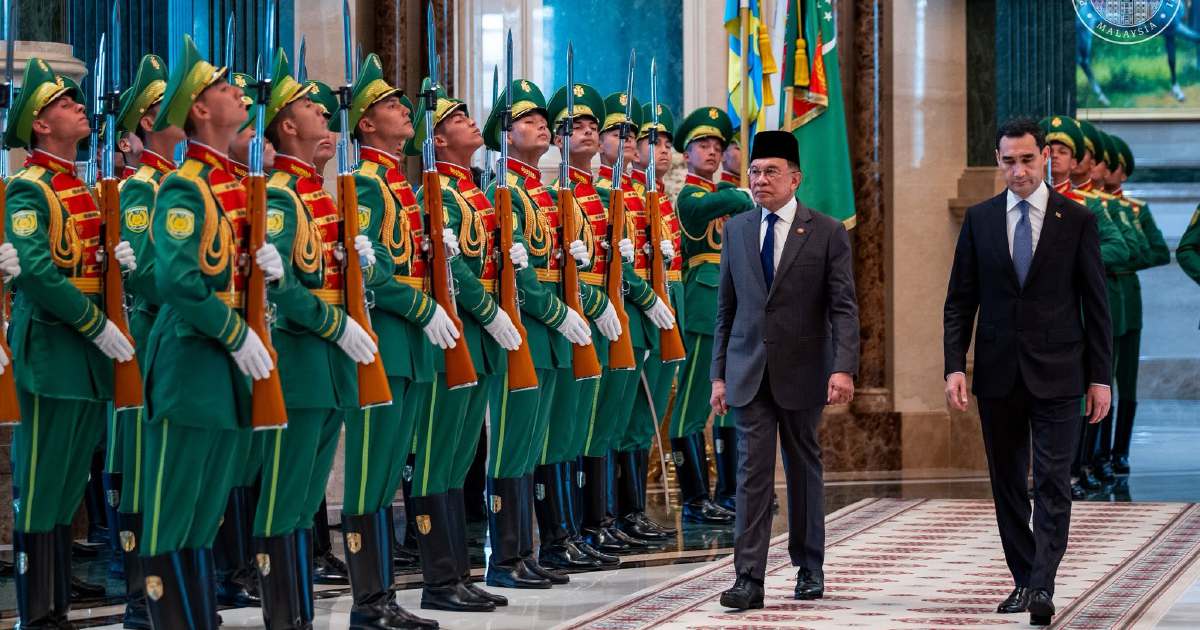
Prime Minister Datuk Seri Anwar Ibrahim arrived in Turkmenistan's capital Ashgabat today for his first official visit to the Central Asian nation since assuming office, a diplomatic milestone that underscores Malaysia's expanding engagement with the region beyond its traditional Southeast Asian sphere. The welcome ceremony held at the Presidential Palace represented the kind of high-level protocol extended to visiting heads of government, signalling Turkmenistan's commitment to deepening bilateral relations with Malaysia.
The visit carries particular significance for Malaysian foreign policy, as it reflects the Anwar administration's deliberate strategy to broaden Malaysia's international footprint and establish stronger ties across diverse geopolitical regions. Turkmenistan, positioned along the historic Silk Road and strategically situated between the Caspian Sea and Central Asian neighbours, offers Malaysia new avenues for trade, investment, and energy cooperation. The nation's substantial hydrocarbon reserves and position as a major natural gas producer have long attracted international attention, and Malaysia's approach signals recognition of these economic opportunities.
For regional observers, this visit demonstrates how Southeast Asian countries are increasingly engaging with Central Asian states as part of a broader geopolitical rebalancing. While Malaysia has traditionally focused on immediate neighbours and major global powers, the outreach to Turkmenistan suggests a more assertive approach to multilateral diplomacy and economic diversification. This trajectory aligns with broader patterns of Middle Eastern and Central Asian nations seeking deeper ties with Asia-Pacific economies, recognising the region's economic dynamism and technological capabilities.
The Presidential Palace reception itself carries ceremonial weight within diplomatic practice. Such formal welcomes typically precede substantive bilateral discussions, during which delegations address shared interests spanning trade, investment frameworks, cultural exchange, and potentially strategic cooperation. The prominence afforded to the Malaysian delegation through official reception protocols indicates that Turkmenistan places meaningful value on strengthening its relationship with Malaysia and the wider Southeast Asian region.
Turkmenistan has emerged as an increasingly important player in Central Asian affairs, particularly following geopolitical shifts that have reshaped the regional balance of power. The nation maintains a distinctive foreign policy posture of neutrality and non-alignment, which has been officially recognised by the United Nations. This stance creates unique opportunities for nations like Malaysia, which similarly values independent foreign policy and strategic flexibility. The convergence of these principles provides a foundation for substantive cooperation beyond merely symbolic diplomatic gestures.
From an economic standpoint, Malaysia stands to benefit from exploring partnerships with Turkmenistan across multiple sectors. The Central Asian nation's energy resources represent a long-term strategic interest for countries seeking to diversify supply chains and reduce dependence on traditional regional suppliers. Simultaneously, Malaysia's expertise in financial services, technology, palm oil production, and manufacturing could open doors for Malaysian companies seeking to expand into Central Asian markets, many of which remain underdeveloped relative to their economic potential.
The visit also reflects Malaysia's awareness of China's substantial Belt and Road Initiative investments throughout Central Asia. By engaging directly with Turkmenistan and neighbouring states, Malaysia positions itself as an alternative partner capable of offering value-added cooperation without necessarily displacing existing relationships. This pragmatic approach distinguishes Malaysia's diplomacy and appeals to Central Asian governments seeking partners who respect their sovereignty and offer genuine mutual benefit rather than extractive relationships.
Cultural and people-to-people dimensions merit consideration alongside commercial and strategic calculations. Turkmenistan's majority Muslim population shares common ground with Malaysia on religious and cultural matters, potentially facilitating broader cooperation within Islamic forums and development initiatives. Educational exchanges, tourism promotion, and business people networks can strengthen ties at grassroots levels, creating constituencies within both nations invested in sustained bilateral relations.
The timing of this inaugural official visit under Anwar's leadership carries additional weight, as it represents his personal commitment to expanding Malaysia's international engagement. Unlike ceremonial visits by junior diplomatic representatives, a prime ministerial journey signals top-tier priority and provides opportunity for direct leadership-to-leadership dialogue on matters of national significance. This personal engagement often accelerates diplomatic progress and establishes working relationships between key decision-makers.
Looking forward, observers will closely monitor whether this visit produces tangible outcomes such as memoranda of understanding, trade agreements, or institutional frameworks for ongoing cooperation. The ceremonial welcome represents merely the formal opening; substantive achievements would better demonstrate the visit's lasting significance for Malaysia-Turkmenistan relations. Such developments could position Malaysia as a gateway through which Central Asian resources and investment might reach Southeast Asian markets, while simultaneously creating opportunities for Malaysian enterprises across the Caspian region.
The visit exemplifies how contemporary international relations increasingly transcend traditional geographical boundaries and regional blocs. Malaysia's engagement with Turkmenistan fits within a broader pattern of Asian connectivity initiatives and reflects recognition that prosperity and security in the twenty-first century depend upon sustained engagement across diverse regions and cultures. Whether this visit catalyses deeper partnership or remains primarily symbolic will become apparent through subsequent governmental actions and bilateral initiatives.

