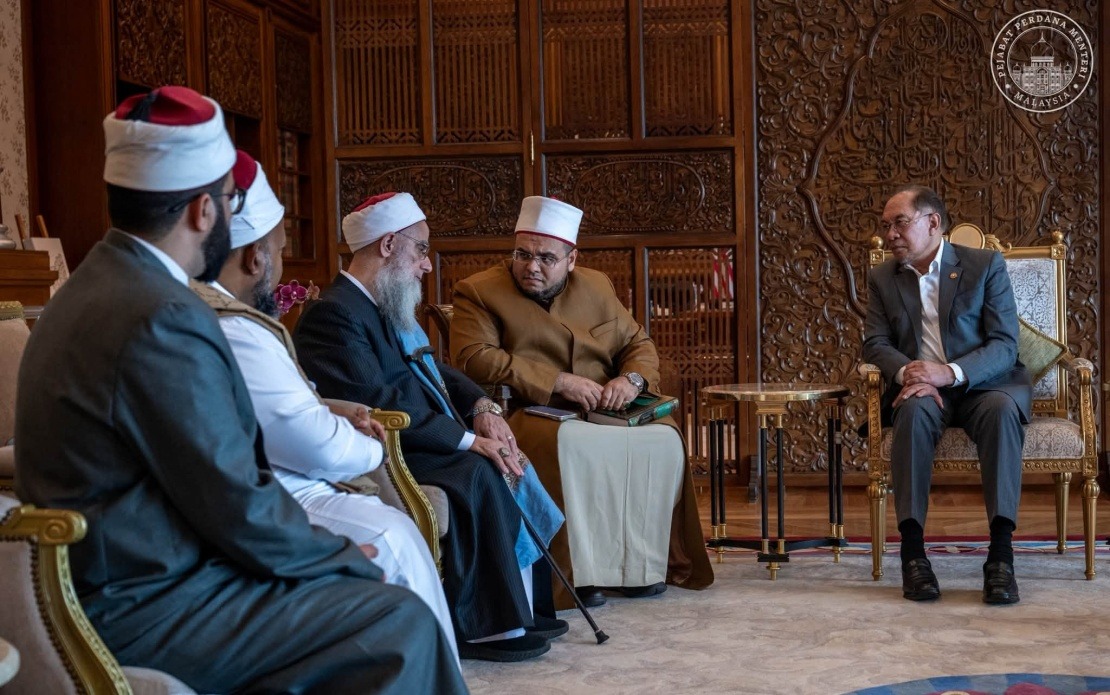
Prime Minister Datuk Seri Anwar Ibrahim received a visit from Sheikh Dr Mustafa An-Nadwi Al-Hasani Mansurah, a prominent Egyptian Islamic scholar, at his Putrajaya office on July 20. The meeting, announced via social media, highlighted Anwar's engagement with leading figures in Islamic intellectual circles and reflected the government's continued emphasis on fostering dialogue with respected religious scholars from across the Muslim world.
Anwar characterised Sheikh Dr Mustafa as a distinguished authority whose academic work centres on the preservation of moral integrity, intellectual rigour, and deep scholarship, particularly within the field of hadith studies. The Prime Minister's description underscored the significance of selecting visiting scholars whose contributions extend beyond mere religious instruction to encompass a broader philosophical approach to knowledge dissemination. By publicly acknowledging the Egyptian scholar's credentials, Anwar positioned the engagement as part of a broader intellectual exchange rather than a routine diplomatic courtesy.
The Prime Minister emphasised Sheikh Dr Mustafa's lineage within contemporary Islamic scholarship, noting his formative relationship with the late Sheikh Abul Hasan Ali al-Nadwi, a globally respected Islamic intellectual whose influence spans decades of Islamic thought and practice. This connection places Sheikh Dr Mustafa within a recognised tradition of scholarly excellence, suggesting that the visitor represents an established school of Islamic learning that has maintained relevance through rigorous academic standards and moderate approaches to contemporary challenges. The reference to al-Nadwi serves as a credential affirming the authenticity and standing of the visiting scholar within international Islamic academic circles.
Central to Anwar's remarks was a reflection on the contemporary intellectual landscape, where sensationalism frequently displaces substantive learning and thoughtful discourse. The Prime Minister articulated concern about the prevalence of superficial engagement with ideas, contrasting this with the quiet, persistent influence of genuine scholarship. This critique resonates with ongoing debates in Malaysia and Southeast Asia regarding the quality of public discourse, the role of social media in shaping public opinion, and the challenge of promoting evidence-based reasoning within societies increasingly influenced by viral narratives and emotional appeals rather than considered analysis.
Anwar employed a poetic formulation in describing how knowledge operates—comparing its spread to morning dew that falls silently yet nurtures life. This metaphorical language reflects a philosophical stance that values incremental intellectual influence over dramatic pronouncements, a perspective that contrasts sharply with contemporary communication strategies that prioritise immediacy and intensity. The comparison suggests that the Prime Minister views meaningful intellectual contribution as occurring through subtle, sustained effort rather than high-profile campaigns or sensational gestures.
The two figures discussed current affairs during the meeting, a deliberately broad characterisation that permits flexibility in determining which specific issues formed the subject of their conversation. Given Sheikh Dr Mustafa's background in Islamic scholarship and ethics, the discussions likely encompassed matters relating to religious guidance on contemporary governance, the ethical dimensions of policy-making, or the Islamic perspective on contemporary global challenges. The vague description may also reflect diplomatic convention, which sometimes leaves the specifics of substantive exchanges private while publicising the fact of the meeting itself.
Sheikh Dr Mustafa's visit to Malaysia extended beyond the meeting with the Prime Minister, encompassing a series of knowledge sessions designed to share his scholarly insights with local audiences. This broader engagement pattern indicates that the visitor's agenda involved substantive intellectual contribution to Malaysian Islamic discourse rather than limited protocol-based interaction. Educational programmes featuring visiting scholars have become an established mechanism through which Malaysia seeks to enhance local Islamic intellectual capacity and connect domestic scholars with international developments in Islamic thought.
Anwar expressed gratitude for the Egyptian scholar's supplications for Malaysia's continued national unity and prosperity, a gesture recognising the spiritual dimensions of interfaith and intercommunal relations. The emphasis on prayers for national cohesion reflects persistent attention to Malaysia's complex religious and ethnic composition, where symbolic gestures affirming solidarity and shared aspirations hold particular significance. By publicly acknowledging the scholar's prayers for the nation, Anwar highlighted the contribution that respected international religious figures can make to strengthening Malaysia's social fabric.
The Prime Minister reciprocated with blessings for Sheikh Dr Mustafa's continued health, scholarly endeavours, and capacity to guide communities with wisdom, moderation, and compassion. This reciprocal exchange of prayers and good wishes represents a conventional but meaningful diplomatic practice that extends beyond formal agreements to encompass mutual respect and shared values. The specific invocation of moderation and compassion aligns with Anwar's broader political messaging emphasising inclusive governance and measured approaches to diverse societal interests.
The reception of Sheikh Dr Mustafa reflects Malaysia's positioning as a hub for Islamic scholarship and intellectual exchange within Southeast Asia. By hosting prominent international scholars and facilitating public knowledge sessions, the government reinforces its claim to intellectual leadership within the Muslim world and demonstrates commitment to elevating public discourse beyond political messaging. Such engagements signal to domestic audiences that the administration values learning and wisdom while simultaneously projecting Malaysia as an attractive destination for intellectual exchange.
From a regional perspective, the visit illustrates the continued vitality of Islamic intellectual networks connecting Malaysia with the Arab world and broader Muslim-majority regions. These connections remain significant channels for knowledge transfer, the dissemination of moderate Islamic perspectives, and the cultivation of shared understandings regarding contemporary challenges facing Muslim societies. For Malaysian scholars and students, exposure to figures like Sheikh Dr Mustafa provides opportunities to engage with internationally recognised authorities and potentially to establish connections that facilitate future collaborative research and educational partnerships.
The timing and publicity given to this engagement suggest that Anwar's government views such intellectual exchanges as integral to its broader governance agenda. By emphasising the importance of wisdom, knowledge, and moral values, the Prime Minister reinforces his administration's intellectual credentials and appeals to constituencies valuing serious engagement with substantive issues. The meeting also demonstrates the government's recognition that addressing Malaysia's complex challenges requires drawing upon diverse sources of expertise and wisdom, including perspectives from established Islamic scholars with proven track records of thoughtful, moderate scholarship.
Looking forward, this engagement represents one example among many through which Malaysia continues to cultivate its role as a centre for Islamic learning and moderate Islamic thought. The presence of distinguished international scholars contributes to an intellectual environment where diverse perspectives can be explored and where Malaysian thinkers can access contemporary global conversations regarding Islam's relationship with modernity, governance, ethics, and social responsibility. Such initiatives, while often receiving limited media attention, cumulatively strengthen Malaysia's institutional capacity for informed policy-making and contribute to the development of intellectual resources upon which the nation's future progress increasingly depends.

