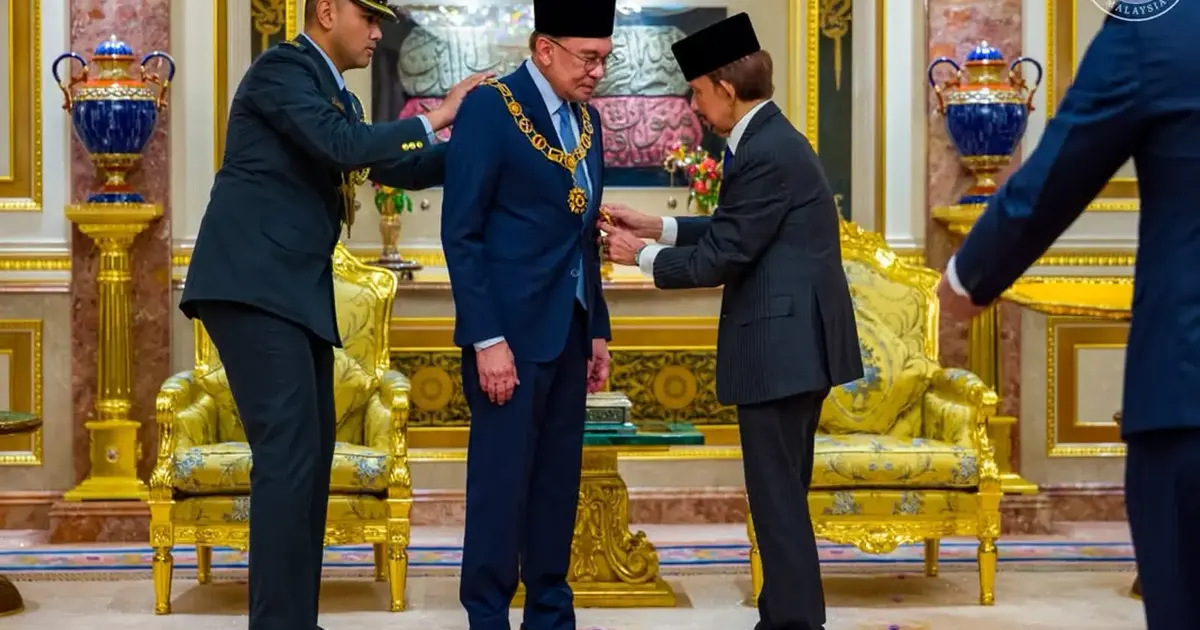
Prime Minister Anwar Ibrahim has been conferred the Darjah Kerabat Laila Utama Yang Amat Dihormati (D.K.), a distinguished honour bestowed by Sultan Hassanal Bolkiah of Brunei, in recognition of his leadership and contributions to regional diplomacy and bilateral relations between Malaysia and the Southeast Asian nation.
The award underscores the importance Sultan Hassanal Bolkiah places on Malaysia's political leadership and the strategic partnership between the two neighbouring countries. Such honours reflect not merely personal recognition but broader state-to-state esteem at the highest levels, signalling Brunei's confidence in Anwar's stewardship of Malaysia during a pivotal period of regional recalibration and economic challenges.
The Darjah Kerabat Laila Utama Yang Amat Dihormati represents one of Brunei's most significant honours in its decorative system, typically bestowed upon senior foreign dignitaries and figures of international standing. The distinction carries both ceremonial weight and diplomatic significance, marking recipients as individuals of consequence in the kingdom's external relations framework.
This honour arrives amid ongoing efforts to strengthen Malaysia-Brunei ties across multiple sectors. Both nations share maritime boundaries, economic interests, and membership in regional organisations including the Association of Southeast Asian Nations (ASEAN). Enhanced personal recognition at the leadership level frequently catalyses deeper cooperation in trade, security, and cultural initiatives between neighbouring countries.
Anwar's receipt of this distinction reflects his government's commitment to maintaining robust relations with all ASEAN partners, particularly smaller economies like Brunei that seek reassurance of engagement from larger regional actors. For Malaysia, sustaining strong bilateral ties with neighbours remains fundamental to its regional influence and stability in Southeast Asia.
The honour also carries symbolic weight within Malaysia's domestic political context. International recognition of the prime minister's standing bolsters his authority domestically and demonstrates that Malaysia's leadership continues to command respect on the global stage despite the nation's internal political complexities in recent years. Such external validation can positively influence domestic confidence in the administration's direction.
From Brunei's perspective, honouring the Malaysian prime minister reflects its diplomatic strategy of maintaining equilibrium among larger regional powers while building personal relationships that transcend official channels. Sultan Hassanal Bolkiah, one of the world's longest-reigning monarchs, has consistently pursued a measured foreign policy that emphasises stability, business relations, and non-interference in neighbours' internal affairs.
Bilateral ties between Malaysia and Brunei have historically been characterised by pragmatism and mutual respect despite occasional disagreements over maritime boundaries and resource-sharing arrangements. The two nations maintain cordial defence and security partnerships, conduct regular high-level visits, and cooperate through various ASEAN forums where consensus-building remains essential.
For Anwar specifically, such international honours serve multiple purposes: they validate his legitimacy as Malaysia's leader to both domestic constituencies and international audiences, they strengthen personal relationships with regional counterparts that often prove crucial for bilateral negotiations, and they demonstrate continuity in Malaysia's commitment to regional relationships despite domestic political transitions.
The timing of this honour may also reflect Brunei's interest in solidifying relations during a period when Malaysia itself is navigating significant domestic and regional adjustments. International relationships built on trust and mutual recognition often prove more resilient during periods of transition or uncertainty, providing stable anchors for broader strategic partnerships.
Looking forward, such exchanges of honour and recognition typically foreshadow expanded cooperation frameworks. Malaysia and Brunei may leverage this moment to deepen collaboration in emerging areas such as digital economy initiatives, renewable energy projects, and enhanced people-to-people exchanges that benefit both societies.
The broader implication for Southeast Asia is that bilateral relationships between regional nations remain vibrant and actively cultivated through both formal mechanisms and personal relationships at the highest levels. This continued investment in diplomatic ties, symbolised through honours and state recognition, suggests regional leaders are determined to maintain cooperative frameworks even as the international environment becomes more complex and competitive.

