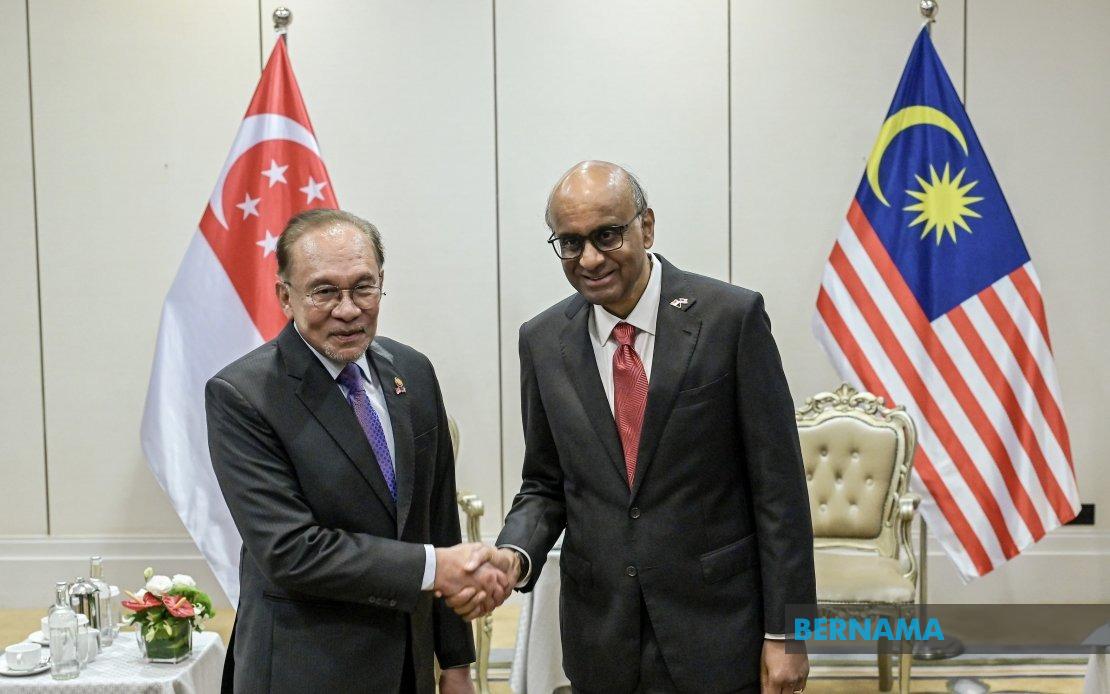
Prime Minister Datuk Seri Anwar Ibrahim welcomed Singapore President Tharman Shanmugaratnam during an official three-day state visit to Malaysia from July 13 to 15, underscoring the enduring strategic partnership between the two Southeast Asian neighbours. The high-level reception included a formal courtesy call at Anwar's office, demonstrating the ceremonial importance both governments accord to bilateral engagement at the presidential and prime ministerial level.
The 40-minute meeting brought together Malaysia's economic leadership alongside senior Singapore delegations, reflecting the multifaceted nature of contemporary Malaysia-Singapore relations. Foreign Minister Datuk Seri Mohamad Hasan, Investment, Trade and Industry Minister Datuk Seri Johari Abdul Ghani, and Entrepreneur and Cooperatives Development Minister Steven Sim Chee Keong attended the discussions, signalling government-wide commitment to deepening ties across trade, investment, and entrepreneurial development. This ministerial representation indicates the visit extended beyond ceremonial courtesy to encompass substantive policy dialogue on matters central to both economies.
Tharman's visit reciprocates the Yang di-Pertuan Agong Sultan Ibrahim's state visit to Singapore in May 2024, establishing a pattern of high-level exchange that reinforces institutional bonds between the two nations. The reciprocal nature of these visits reflects diplomatic protocol and mutual recognition of shared interests spanning trade, security, and regional stability. Such exchanges serve as critical platforms for addressing bilateral challenges and identifying new cooperation opportunities at the highest governmental level.
Singapore occupies a uniquely significant position within Malaysia's trade landscape, ranking as the country's second-largest trading partner globally whilst simultaneously serving as Malaysia's largest trading partner among ASEAN member states. This dual distinction underscores the disproportionate importance of the Singapore relationship within Malaysia's broader commercial strategy, particularly given ASEAN's collective economic weight and Malaysia's integration into the regional supply chain.
Bilateral trade figures demonstrate the robust health of economic relations between the two countries. Total bilateral trade reached RM402.35 billion in 2025, representing a modest 1.5 per cent increase from the previous year. Whilst this growth rate may appear modest in isolation, it reflects sustained commercial momentum in a complex global environment characterised by supply chain disruptions and economic uncertainties affecting multiple sectors.
More notably, the recent trajectory of Malaysia-Singapore trade suggests accelerating momentum. From January to May 2025, bilateral commerce expanded by 14.5 per cent to RM189.90 billion, substantially outpacing the full-year growth rate. This acceleration indicates strengthening commercial activity in the opening months of 2025 compared to the same period in 2024, when bilateral trade stood at RM165.93 billion. Such acceleration warrants careful monitoring, as it may reflect either structural improvements in bilateral trade competitiveness or temporary cyclical factors.
For Malaysian policymakers and business leaders, the trade relationship with Singapore carries profound implications. The island nation serves as both a major market for Malaysian exports and a crucial supplier of high-value products and services that feed into Malaysian manufacturing and service sectors. Singapore's strategic position as a financial and trading hub amplifies its influence over broader Southeast Asian commerce, making bilateral relations determinative for Malaysia's regional economic standing.
The state visit provides an opportune moment for both governments to address structural challenges within the bilateral relationship. Issues including water supply agreements, transborder security cooperation, and coordination on regional maritime matters require sustained high-level attention. Equally, opportunities exist to deepen integration across emerging sectors including digital economy, green technology, and fintech innovation, where both nations possess complementary strengths and growing expertise.
For Malaysian enterprises and investors, the strengthening political relationship signals continued openness to cross-border commerce and investment flows. Singapore's sophisticated financial infrastructure and access to global capital markets remain invaluable for Malaysian companies seeking international expansion, whilst Malaysian markets offer growth opportunities for Singaporean firms seeking to develop regional presence beyond the island nation's limited domestic base.
The visit also carries implications for ASEAN cohesion and regional diplomatic positioning. Malaysia and Singapore, as founding ASEAN members with the most developed bilateral relationship, frequently model the kind of pragmatic, substantive cooperation that underpins regional integration. Their engagement demonstrates that economic interdependence and institutional maturity can coexist with discrete national interests, offering a template for other member states navigating similar dynamics.

