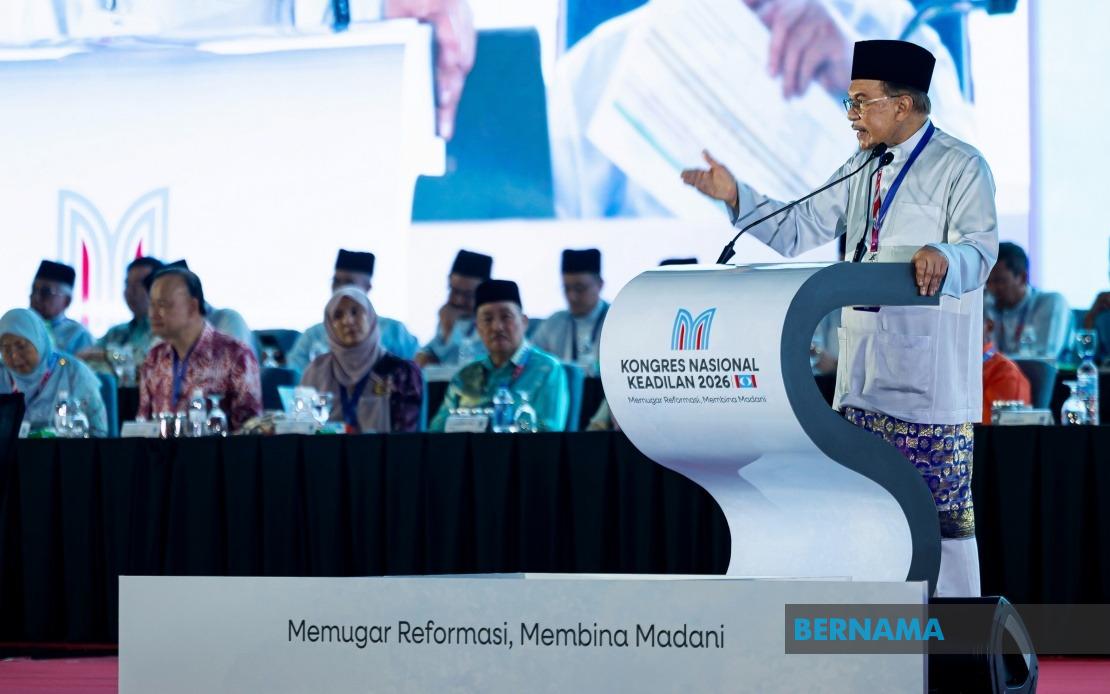
Prime Minister Datuk Seri Anwar Ibrahim moved swiftly to extinguish speculation about his working relationship with Deputy Prime Minister Datuk Seri Dr Ahmad Zahid Hamidi, insisting their partnership remains intact despite mounting tensions within Malaysia's Unity Government. Speaking at the 2026 PKR National Congress in Melaka on Thursday, Anwar dismissed recent claims by former UMNO Youth chief Khairy Jamaluddin that trust between the two senior leaders had eroded to its lowest point since the coalition took power following the 2022 general election.
The Prime Minister's comments represent a calculated attempt to stabilise perceptions of internal cohesion within the governing alliance at a moment when the partnership shows visible strain. Anwar characterised Khairy's assessment as reflecting a fundamentally different worldview rather than objective reality, suggesting that those who see conflict and confrontation where he sees cooperation are simply viewing the political landscape through a distorted lens. His invocation of a "peaceful path" versus a "confrontational path" underscores an effort to reframe the narrative around his leadership style and vision for coalition management.
The timing of Anwar's remarks carries particular significance given recent developments that have tested the Unity Government's coherence. Khairy's intervention came on the heels of the Barisan Nasional decision to cooperate with Perikatan Nasional in the Negeri Sembilan state election—a move that effectively sidelined Pakatan Harapan and signalled shifting political alignments within the coalition. This development highlighted the fragile nature of the arrangement that has governed Malaysia since November 2022, when Anwar's party joined forces with UMNO and other partners to prevent a government led by Perikatan Nasional.
Anwar sought to reinforce his message of goodwill by highlighting his explicit acknowledgment of Ahmad Zahid's contribution to coalition stability. During his presidential address at the Melaka International Trade Centre, the Prime Minister publicly thanked both Zahid and UMNO for their instrumental role in establishing the Unity Government in its formative stages. This public recognition served a dual purpose: acknowledging the Deputy Prime Minister's legitimacy as UMNO president and Barisan Nasional chairman while simultaneously demonstrating to party supporters that inter-coalition friction remains manageable through mutual respect and dialogue.
The dispute between Anwar and Khairy reflects deeper ideological and personality differences that have characterised their political relationship for years. Khairy, who lost his UMNO Youth position and parliamentary seat for Rembau, has positioned himself as a more vocal critic of the governing coalition's direction. His assertion that trust between Anwar and Zahid had deteriorated to unprecedented levels represents an attempt to illuminate what he perceives as fundamental fractures within the government's upper echelon. Whether his claims carry institutional weight or merely reflect a personal perspective from the political sidelines remains contested.
The broader context for this public disagreement involves the persistent challenge of maintaining coalition discipline across ideologically distinct parties. The Pakatan Harapan component—comprising Anwar's PKR, the DAP, and other smaller parties—operates under fundamentally different principles than the Barisan Nasional, which relies on traditional patronage networks and Malay-Muslim constituencies. Reconciling these differences has consistently proven difficult, and recent electoral setbacks for Pakatan Harapan in state-level contests have increased internal pressure for either coalition restructuring or alternative strategic partnerships.
Anwar's assertion that differences of opinion can be resolved through discussion and peaceful approaches echoes his long-standing commitment to democratic deliberation and consensus-building. Yet this philosophy has faced repeated stress tests as concrete political interests have collided. The Negeri Sembilan decision by Barisan Nasional to pivot toward Perikatan Nasional, for instance, demonstrated that tactical considerations sometimes override coalition loyalty. Such moments inevitably generate questions about the durability of relationships between Anwar and senior Barisan Nasional figures like Ahmad Zahid.
For Malaysian observers and regional analysts, the significance of Anwar's intervention lies in what it reveals about the coalition's current stability and future trajectory. The Prime Minister's felt need to publicly defend his relationship with his Deputy suggests that perceptions of disharmony have gained sufficient traction to warrant direct rebuttal. Whether his reassurances will prove sufficient to calm concerns among party grassroots and within the broader business and investor communities remains uncertain, particularly given the proliferation of similar claims from within government ranks over recent months.
The unity construct that has underpinned Malaysian governance for nearly two years continues to demonstrate resilience in formal institutional terms, yet growing cracks in personal relationships between key stakeholders suggest that the arrangement's foundations may be shifting beneath the surface. Anwar's emphasis on peaceful problem-solving reflects both his personal leadership philosophy and his pragmatic recognition that the alternative—open coalition rupture—would likely benefit Perikatan Nasional and complicate his political agenda heading toward the next general election. Whether this approach can sustain the government through mounting pressures and competing electoral calculations from its component parties will likely define Malaysian politics through the remainder of this parliamentary term.

