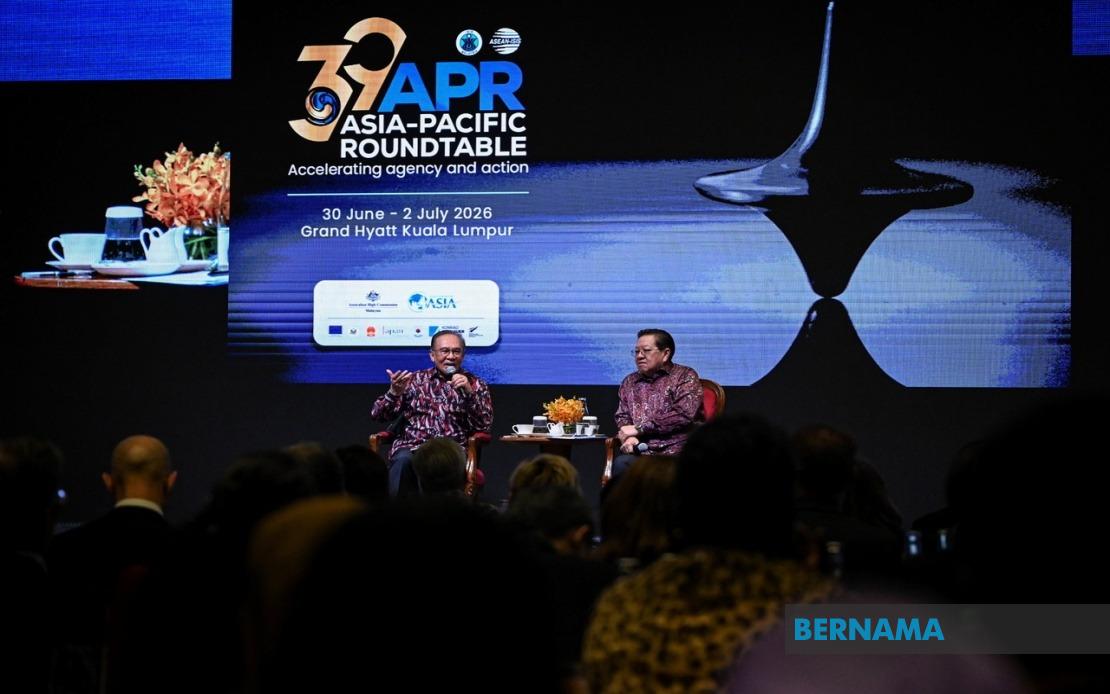
Prime Minister Datuk Seri Anwar Ibrahim has dismissed the prevailing anxiety surrounding conflict in the South China Sea, instead advocating a diplomatic approach grounded in mutual respect and legal frameworks to safeguard the region's future. Speaking at the 39th Asia-Pacific Roundtable in Kuala Lumpur on Thursday, Anwar directly challenged what he characterised as an alarmist perspective that treats confrontation as a foregone conclusion, arguing that such narratives undermine the genuine progress being made through engagement and cooperation.
Anwar's remarks carry particular significance given Malaysia's complex position as a claimant state with territorial interests in the disputed waters while simultaneously maintaining critical economic and strategic ties with China. The Prime Minister made clear that his government has experienced productive relations with Beijing despite the maritime disagreements, noting that his personal interactions with Chinese leaders including President Xi Jinping and Premier Li Qiang have been marked by positive exchanges rather than hostility. This characterisation of Malaysia-China relations stands in contrast to some regional observers who view the territorial disputes as inherently destabilising.
Central to Anwar's argument is Malaysia's commitment to the United Nations Convention on the Law of the Sea (UNCLOS), which he identified as a shared framework that should guide resolution efforts. He highlighted China's own stated support for UNCLOS and the ongoing ASEAN-China Code of Conduct negotiations as evidence that all parties remain committed to peaceful mechanisms for managing disagreements. The Code of Conduct represents a multi-year diplomatic initiative aimed at establishing binding rules for behaviour in contested waters, and Anwar stressed that these negotiations should continue as the primary vehicle for addressing maritime tensions.
The Prime Minister's dismissal of what he termed "phobia" about South China Sea threats reflects a calculated attempt to reshape regional discourse away from worst-case scenarios towards a focus on existing cooperative mechanisms. By describing Malaysia's experience as marked by "meaningful exchanges" rather than confrontation, Anwar positioned his government as a pragmatic player capable of balancing its own territorial claims with broader regional stability considerations. This approach suggests Malaysia will not align with those advocating for confrontational postures or military buildups in response to Chinese activities.
Anwar emphasised ASEAN's demonstrated capacity to maintain peace across decades through strong personal relationships among member state leaders, who he noted regularly engage in direct communication to prevent disputes from escalating. This institutional perspective underscores how the bloc's informal mechanisms—regular dialogue, consensus-building traditions, and personal connections among leaders—function as stabilising forces that transcend formal military or legal mechanisms. The implication is that ASEAN unity and consistent engagement matter more than external security arrangements or legal victories.
The Prime Minister also seized the opportunity to advocate for reform of global multilateral institutions, positioning Malaysia and ASEAN as voices calling for a more equitable international order through organisations like the United Nations and the World Trade Organisation. This broader framing connects South China Sea stability to wider questions about how developing nations exercise influence in international governance, suggesting that Malaysia sees addressing maritime disputes within a context of reforming global power structures to better represent Asian interests.
Beyond the South China Sea, Anwar expressed optimism regarding the Cambodia-Thailand border dispute, welcoming both nations' commitment to continued negotiations. He contextualised many regional border disagreements as historical artefacts of the colonial era, a perspective that deflects blame from any particular contemporary actor and emphasises that such issues require patient, sustained dialogue rather than zero-sum approaches. His confidence in eventual peaceful settlements reflects an institutional faith in ASEAN's conflict-resolution mechanisms and the willingness of member states to prioritise regional harmony.
The emphasis on dialogue and legal frameworks over military deterrence signals Malaysia's preference for maintaining strategic flexibility and economic connections with all major powers rather than adopting zero-sum geopolitical alignments. For Southeast Asian economies heavily dependent on trade and investment flows from multiple directions, Anwar's approach reflects practical necessities: confrontational postures risk disrupting the commercial relationships that underpin regional prosperity. Malaysia's position as a maritime state with its own South China Sea claims but equally significant economic interests in Chinese markets makes this balancing act essential.
Anwar's comments also implicitly challenge those within ASEAN who advocate for closer security partnerships with Western powers as a counterweight to Chinese assertiveness. By stressing dialogue and mutual trust as primary stabilising forces, he articulates an alternative vision of regional security centred on ASEAN cohesion and the maintenance of strategic autonomy rather than alignment with external powers. This approach appeals to members wary of being drawn into great power competition while simultaneously managing their own territorial concerns.
The timing of these remarks reflects ongoing international scrutiny of South China Sea tensions, including concerns from countries like the United States and allied nations about freedom of navigation and the rules-based international order. Anwar's reframing of the issue as one amenable to solution through existing legal frameworks and negotiation mechanisms may be partly intended to assuage international audiences that ASEAN is capable of managing regional disputes without external intervention.
Looking forward, Malaysia's approach as articulated by Anwar suggests the country will continue pursuing a middle path: maintaining its maritime claims and participation in Code of Conduct negotiations while refusing to join confrontational coalitions or military buildups. This strategy depends heavily on China's continued willingness to engage diplomatically and respect agreed frameworks, making the success of ongoing negotiations crucial to sustaining Malaysia's cooperative stance. For the broader region, Anwar's confidence in dialogue and institutional mechanisms will be tested by the pace and outcome of Code of Conduct finalisation and the management of future incidents in contested waters.

